
Risk-Reward Ratio: Build Better Algo Strategies
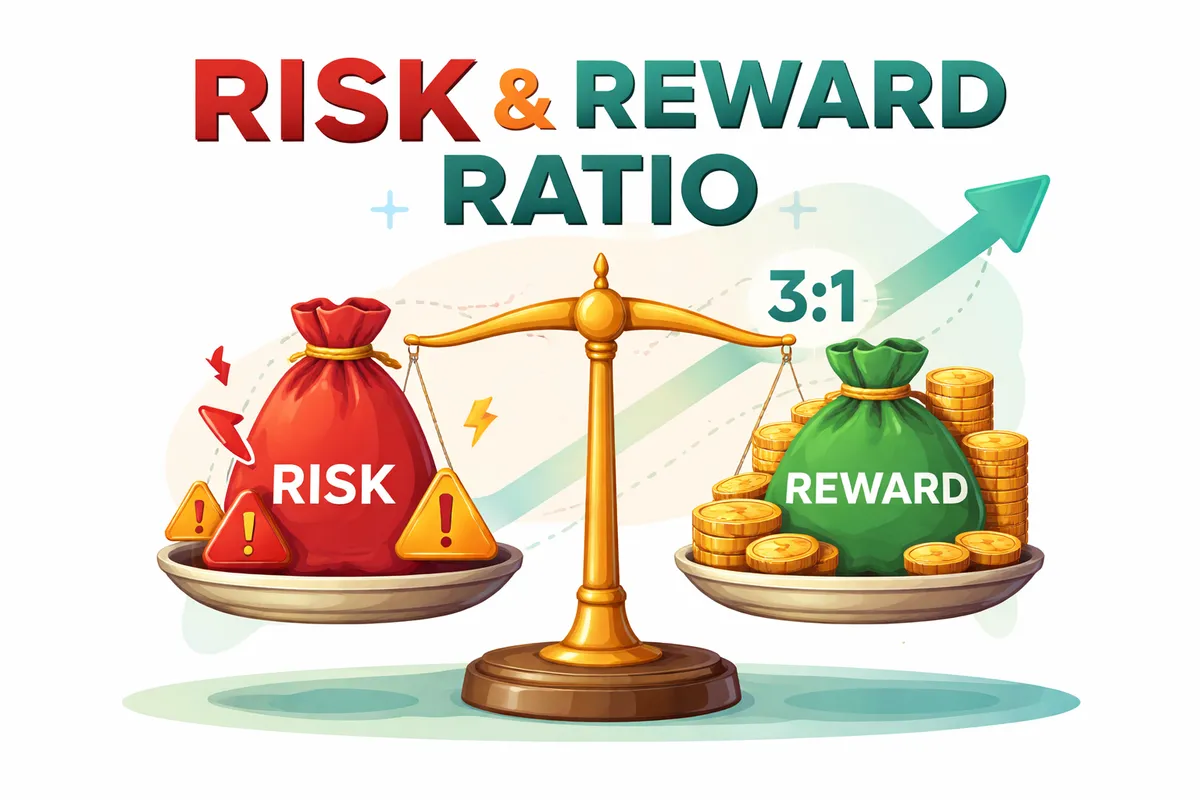
The risk-reward ratio is one of the most important concepts in algorithmic trading — and one of the most misunderstood. Every time a strategy opens a trade, it is implicitly making a claim about how much it expects to win versus how much it risks losing. Making that relationship explicit, measurable, and consistent is what separates strategies that survive long-term from those that do not.
What Is the Risk-Reward Ratio?
The risk-reward ratio is a measure that compares the potential profit of a trade to the potential loss. It is expressed as a ratio — for example, 1:2 means that for every one unit of capital risked on a trade, the strategy targets two units of profit. A 1:3 ratio means three units of profit targeted for every one unit at risk. The ratio is calculated before the trade is entered, based on where the stop-loss and take-profit levels are set relative to the entry price.
The risk-reward ratio does not tell you whether a trade will win or lose. What it tells you is whether the structure of the trade makes mathematical sense given your strategy’s historical win rate.
Why Does the Risk-Reward Ratio Matter in Algo Trading?
The risk-reward ratio matters because win rate alone does not determine profitability. A strategy that wins 70% of trades can still lose money if the average loss is three times the average win. Conversely, a strategy that wins only 40% of trades can be highly profitable if its average win is three or four times its average loss.
This is the mathematical foundation that many retail traders overlook. Systematic traders build the risk-reward ratio into their strategies at the design stage — not as an afterthought. Once defined, every trade the strategy takes carries a consistent structure: a known maximum loss, a known profit target, and a clear expectation of how those two figures relate to each other. This consistency is what allows a strategy to be properly backtested and evaluated. Without it, performance data is essentially meaningless because no two trades are comparable.
How Does the Risk-Reward Ratio Interact With Win Rate?
The relationship between risk-reward ratio and win rate determines a strategy’s mathematical edge — or lack of one. The break-even win rate for any risk-reward ratio can be calculated: with a 1:1 ratio, you need to win more than 50% of trades to be profitable. With a 1:2 ratio, the break-even win rate drops to around 33%. With a 1:3 ratio, it drops to 25%.
This is powerful information. A trend-following strategy that wins 35% of trades but consistently achieves 1:3 risk-reward ratios has a strong mathematical edge. The same strategy mismanaged — cutting profits early and letting losses run — could show a 60% win rate but still lose money overall. The risk-reward ratio is the mechanism that makes the edge real.
What Makes a Good Risk-Reward Ratio?
There is no universal answer — the right ratio depends on the strategy type and the market being traded. As a general guide:
- Mean-reversion strategies typically use 1:1 or 1:1.5 ratios. These strategies win more often but take smaller profits per trade, relying on a high win rate to generate returns.
- Trend-following strategies typically target 1:2, 1:3, or higher. They win less often but take large profits when they do — the classic asymmetric payoff structure.
- Breakout strategies commonly use 1:2 as a starting point, with the stop placed below the breakout level and the target set at the next major resistance.
What matters more than the specific ratio is consistency. A strategy that applies a different risk-reward calculation to every trade has no reliable edge — because there is no way to know in advance what the expected value of any given trade is. The ratio must be defined in the strategy rules, not decided trade by trade.
How to Apply the Risk-Reward Ratio in Arrow Algo?
Arrow Algo’s no-code visual block builder makes it straightforward to embed a consistent risk-reward ratio directly into any strategy. When building an entry condition, you pair it with a stop-loss block and a take-profit block. The stop-loss defines the risk side of the ratio — the maximum amount the strategy will lose on the trade if it goes wrong. The take-profit defines the reward side.
For example, if your entry condition fires when the Stochastic RSI crosses above 20 from oversold territory, you can set the stop-loss block to place the stop a defined number of pips or ATR multiples below the entry, and the take-profit block at twice that distance. Every trade the strategy takes will automatically carry a 1:2 structure — without you needing to calculate it manually each time.
Once the strategy is built, Arrow Algo’s backtesting engine shows you the average win, average loss, and overall risk-reward achieved historically. This tells you whether the theoretical ratio you designed is being realised in practice — and whether the win rate is sufficient to make the ratio profitable. Adjust the stop and target distances, retest, and refine until the numbers support the edge you are building for.
What Are the Key Takeaways?
- The risk-reward ratio compares a trade’s potential profit to its potential loss — defined before entry, not after
- Win rate alone does not determine profitability; the risk-reward ratio is equally important
- A 1:2 ratio requires only a 33% win rate to break even; a 1:3 ratio requires only 25%
- Different strategy types suit different ratios — mean-reversion tends toward 1:1, trend-following toward 1:2 or higher
- Consistency matters more than the specific number — the ratio must be fixed in the strategy rules, not decided trade by trade
- In Arrow Algo, stop-loss and take-profit blocks let you embed a precise risk-reward ratio into every strategy without any manual calculation
For further reading, see Investopedia’s guide to the risk-reward ratio and how it combines with position sizing for complete trade management.
Educational disclaimer: This content is for educational purposes only and does not constitute financial advice. Trading involves significant risk and you should only trade with capital you can afford to lose. Past performance is not indicative of future results.
Disclaimer: The information provided in this article is for educational purposes only and does not constitute financial advice. Trading involves significant risk and you should only trade with capital you can afford to lose. Past performance is not indicative of future results. Always conduct your own research before making any trading decisions.
Ready to build your own automated trading strategies without writing a single line of code? Start for free at Arrow Algo and join thousands of traders who’ve made the switch to systematic trading.