
Opening Range Breakout: Give Every Entry a Boundary
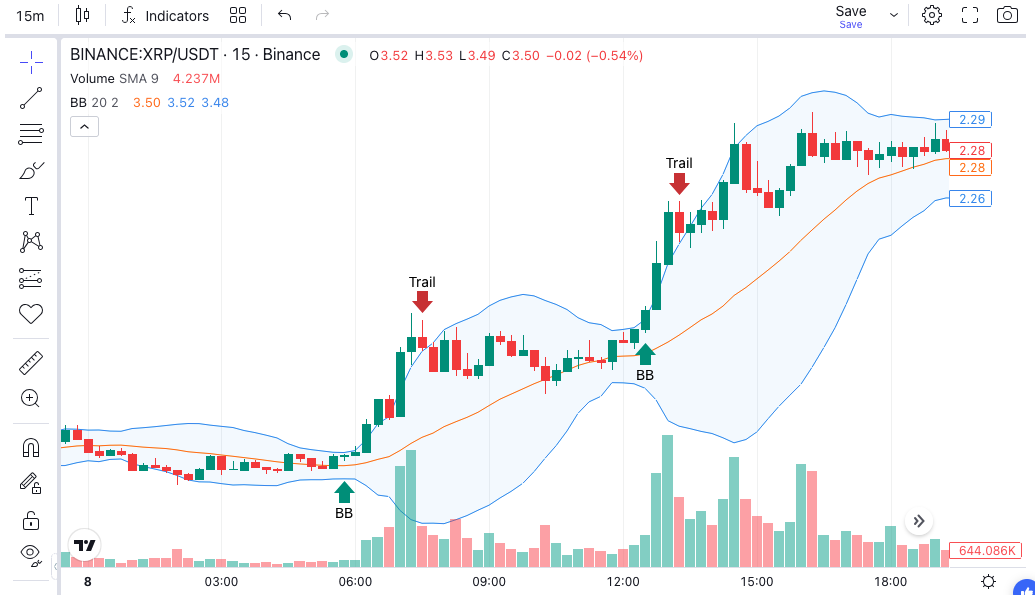
An opening range breakout gives a fast-moving market two fixed boundaries before you consider an entry. Record the initial high and low. Wait for the measurement window to finish. Then test whether price can move beyond that completed range.
The tricky part in crypto is deciding what counts as the opening. Trading continues around the clock. Your algorithm needs a session definition that stays consistent across every test.
What Is an Opening Range Breakout?
An opening range breakout is an intraday strategy that looks for movement beyond a session’s initial price boundaries. In this version, those boundaries are the highest high and lowest low within a fixed opening window.
For example, measure the first six five-minute candles after 00:00 UTC. Their combined high and low become the day’s reference range. Only consider entries after the sixth candle closes.
Related ORB methods use a distance from the opening price instead. Research from Umeå University examines that alternative formulation. Results from one definition do not automatically validate another.
Our example below is a research specification. It makes no claim of profitability.
Why Does a Fixed Opening Window Help?
A fixed window makes the idea auditable. Every session has a start, a measurement period and an entry period. You can identify exactly which candles created a signal.
That structure also limits hindsight. Without it, a trader can redraw the range until a past breakout looks obvious. An algorithm needs the boundary that existed before the entry.
A fixed range differs from a rolling channel. A rolling channel changes as new candles arrive. The opening range stays unchanged until the next session resets it.
Our Donchian breakout strategy covers the rolling approach. Keeping these definitions separate prevents an accidental change of strategy during implementation.
Which Opening Makes Sense in a 24-Hour Market?
Start with one clearly defined anchor. Midnight UTC is easy to reproduce and avoids daylight-saving changes. It is a research convention, not evidence of a special market edge.
Another candidate is the US cash-equity opening. The NYSE lists its core session as 09:30–16:00 Eastern Time. An associated crypto strategy should follow that local clock, including daylight-saving changes.
Do not hard-code one UTC hour and call it the New York opening throughout the year. Also decide how weekends and US holidays affect eligibility. Crypto continues trading when the cash market is closed.
Compare session choices on training data, then lock the choice before evaluating untouched dates. Trying every possible starting minute invites selection bias.
A Testable Opening Range Breakout Rule Set
Use the following long-only example to make every decision explicit:
| Decision | Research rule |
|---|---|
| Data | One exchange, one pair, five-minute candles |
| Session anchor | 00:00 UTC each day |
| Measurement window | 00:00 inclusive to 00:30 exclusive |
| Upper boundary | Highest high of the six completed opening candles |
| Lower boundary | Lowest low of those same candles |
| Entry window | After range completion, with signal timestamps before 04:00 UTC |
| Entry trigger | First completed close above the fixed upper boundary |
| Initial protective threshold | Fixed opening-range low |
| Trade limit | At most one entry per session |
| Scheduled exit | First evaluation at or after 04:00 UTC |
The earliest eligible signal comes from the candle spanning 00:30–00:35. Model entry at the next available price. Do not give the backtest an entry at an earlier breakout price it could not know to take.
Translate the Range Into Planned Risk
Suppose the opening high is $100 and the low is $98. A completed candle closes at $100.20. If the modelled entry is also $100.20, the stop distance is $2.20 per unit.
A hypothetical $22 loss budget therefore permits ten units before costs. Fees and slippage reduce that size. This arithmetic illustrates sizing, not a recommended allocation.
Very narrow ranges can imply excessive position size. Apply a separate maximum exposure limit. Wide ranges can leave little room for a useful move before the scheduled exit.
Which Errors Turn a Clean Rule Into a Misleading Result?
Including the breakout candle in the range. The entry candle belongs after the measurement window. Letting it alter the high changes the trigger you are testing.
Leaving the range rolling. A six-candle Donchian channel keeps moving. Capture its value when the opening window finishes, then preserve that value.
Forgetting the daily reset. Yesterday’s boundaries and trade counter must not qualify today’s signals. Treat an incomplete opening window as ineligible.
Check the Ambiguous Cases
Assuming favourable intrabar order. One candle can touch both an entry and a stop. Coarse candle data may not reveal which occurred first. Use finer data or a conservative assumption.
Ignoring failed breaks. A close outside the range can reverse immediately. Compare any retest or volume filter against the simple baseline. Extra conditions need evidence.
Blocking exits with the clock. Ending the entry window should not disable protective exits. Keep position management independent of permission to open new positions.
How to Apply Opening Range Breakout Rules in Arrow Algo
Use Arrow Algo’s no-code visual builder to separate measurement, storage and entry conditions.
Start with the candle feed and Time Filter blocks for the chosen windows. A six-period Donchian calculation can identify the opening extremes at 00:30 UTC. Alternatively, calculate the maximum high and minimum low across those six candles.
The essential next step is retaining those completed values. Use value-storage logic to capture the boundaries once, then prevent later candles from overwriting them. Arrow Algo’s maths-block documentation describes its variable block for storing values.
Add an explicit session reset and a range-ready condition. Validate the candle timestamps and evaluation order in the backtest. A Time Filter combined with a continuously updating Donchian channel is insufficient by itself.
Compare completed closing prices with the stored upper boundary. Combine that condition with the entry window, flat-position status and unused daily entry allowance. Connect the result to a buy action block.
Keep the protective threshold and scheduled exit on separate branches. Inspect days with no breakout, missing opening data and a failed first entry. Confirm that the one-entry limit prevents a second attempt.
If you choose to deploy a tested version, your rules send signals to your own exchange account. The exchange decides whether to accept and execute each order.
What Should an Opening-Range Test Establish?
- The range uses only completed opening candles and stays fixed afterwards.
- Session timing, resets and entry limits work on every eligible day.
- Fees, slippage and ambiguous candles do not disappear from the model.
- Results survive a separate test period, rather than one favourable month.
- Any added filter improves the chosen evaluation criteria beyond the simpler baseline.
Disclaimer: This content is for educational purposes only and does not constitute financial advice. Trading involves significant risk and you should only trade with capital you can afford to lose. Past performance is not indicative of future results. Always conduct your own research before making any trading decisions.
Ready to build your own automated trading strategies without writing a single line of code? Start for free at Arrow Algo and join thousands of traders who've made the switch to systematic trading.