
Profit Factor in Trading: What the Numbers Tell You
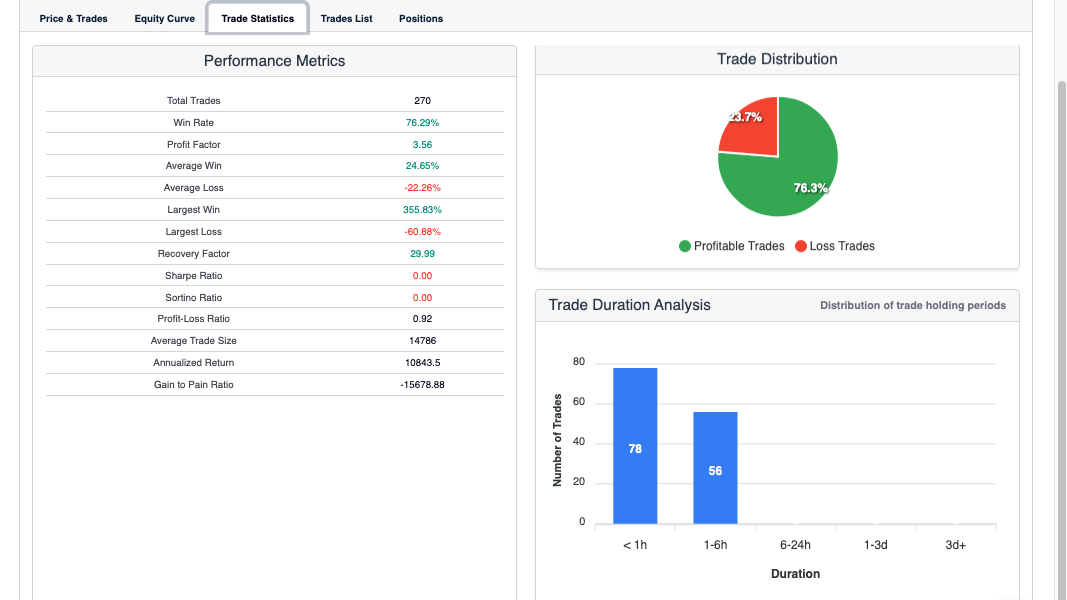
Profit factor is one of the first metrics systematic traders check when a backtest finishes — and for good reason. A single number that measures the ratio of total profits to total losses, it tells you whether a strategy’s edge is real, marginal, or non-existent. Understanding profit factor is essential for anyone evaluating algorithmic trading strategies seriously.
What Is Profit Factor?
Profit factor is the ratio of gross profit to gross loss across all trades in a backtest period.
Gross profit is the sum of all winning trade returns. Gross loss is the sum of all losing trade returns. Divide one by the other and you get profit factor.
If a strategy generated $10,000 in total profits and $5,000 in total losses, the profit factor is 2.0. For every dollar lost, the strategy returned two dollars in gains.
- Below 1.0: The strategy loses more than it makes — unprofitable overall
- Exactly 1.0: Break-even — every dollar lost is matched by a dollar gained
- 1.0–1.5: Marginally profitable — likely fragile once live trading costs are applied
- 1.5–2.5: A solid range for most systematic strategies
- Above 3.0: Strong — but worth checking carefully for overfitting
Why Profit Factor Matters More Than Win Rate
Win rate is the metric most traders look at first. It is also the most misleading on its own.
A strategy can win 80% of its trades and still have a profit factor below 1.0. This happens when the 20% of losing trades are significantly larger than the 80% of wins. The wins are frequent but small. The losses are rare but large. The net result is a losing strategy despite a high win rate.
Profit factor captures both sides simultaneously. It accounts for how often the strategy wins and how large those wins and losses are relative to each other. That makes it a more complete and reliable measure of strategy quality than win rate in isolation.
For algorithmic traders comparing multiple strategies, profit factor is also directly comparable across different assets, timeframes, and market conditions. A profit factor of 1.8 means the same thing whether the strategy trades BTC on a 15-minute chart or ETH on a daily chart.
How Profit Factor Relates to Other Backtest Metrics
Profit factor is most useful when read alongside other statistics rather than as a standalone number.
Expectancy measures the average expected outcome per trade in absolute terms. Profit factor is a ratio; expectancy gives you the dollar-level context. Both should point in the same direction.
Maximum drawdown is what profit factor does not tell you. A profit factor of 2.0 achieved through a 60% peak-to-trough drawdown is a fundamentally different strategy from one with the same ratio and a 10% drawdown. The first would be nearly impossible to trade in practice.
Sharpe ratio measures risk-adjusted returns using volatility as the denominator. Profit factor uses raw loss totals. Both are useful, but they highlight different dimensions of the same strategy’s behaviour.
Trade count matters for context. A profit factor of 2.0 from 12 trades carries less statistical weight than the same ratio from 300 trades. Small sample sizes make any metric unreliable.
What Is a Good Profit Factor?
There is no single threshold that applies to every strategy type. Context determines what constitutes a strong result.
High-frequency strategies with hundreds of trades can sustain profitability at lower profit factors — even 1.2–1.3 — because the large sample size creates statistical reliability and small edges compound quickly. Longer-term swing strategies with fewer trades need higher profit factors to generate confidence, since each individual trade carries more weight.
Transaction costs erode profit factor directly. A backtest showing 1.6 may drop to 1.2 once exchange fees, spread, and slippage are applied. Always test with realistic cost assumptions, especially for shorter timeframes where fees represent a larger percentage of each trade.
Be cautious with very high profit factors. A reading above 3.5 in a backtest often signals overfitting — the strategy has been tuned too specifically to past data and will not replicate that performance in live markets. Validate high profit factors with out-of-sample testing or walk-forward analysis before drawing conclusions.
How to Apply Profit Factor in Arrow Algo
Arrow Algo calculates profit factor automatically in every backtest report. Run a strategy on historical exchange data and the platform returns profit factor alongside win rate, expectancy, Sharpe ratio, and maximum drawdown — all in one place, without any manual calculation.
When comparing two strategy variants in the block builder, profit factor is one of the quickest filters to apply. Build both versions, run the backtests, and use profit factor to shortlist which deserves deeper analysis before examining individual trades.
Arrow Algo also surfaces profit factor across walk-forward test windows. Walk-forward testing evaluates a strategy across multiple sequential out-of-sample periods. Seeing a consistent profit factor above 1.5 across all windows is a much stronger signal than a single in-sample backtest result — it suggests the edge is robust rather than curve-fitted.
Build and backtest your own profit-factor-driven strategies at arrowalgo.com — no coding required.
Key Takeaways
- Profit factor = gross profit ÷ gross loss — a number above 1.0 means the strategy is net profitable
- It captures both win frequency and trade magnitude in a single ratio
- A solid range for most systematic strategies is 1.5–2.5
- Always read it alongside drawdown, expectancy, trade count, and realistic cost assumptions
- Profit factors above 3.5 in backtests can indicate overfitting — validate with out-of-sample testing
- Win rate alone is not enough; profit factor is the metric that proves whether the edge is real
- Arrow Algo reports profit factor automatically in every backtest — no manual calculation needed
Disclaimer: This content is for educational purposes only and does not constitute financial advice. Trading involves significant risk and you should only trade with capital you can afford to lose. Past performance is not indicative of future results. Always conduct your own research before making any trading decisions.
Ready to build your own automated trading strategies without writing a single line of code? Start for free at Arrow Algo and join thousands of traders who’ve made the switch to systematic trading.