
Risk-Adjusted Returns: What They Mean for Traders
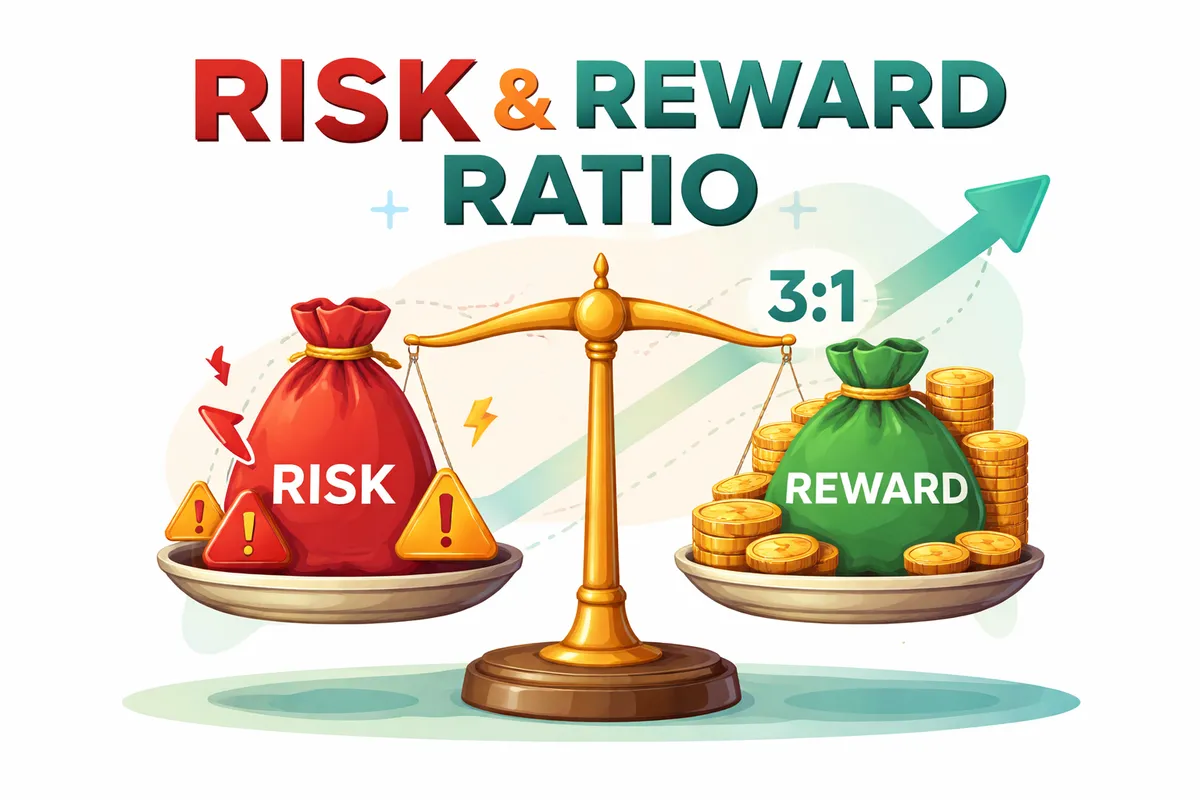
Risk-adjusted returns measure how much profit a trading strategy generates relative to the risk it takes to produce that profit. Two strategies can show identical gains over the same period. But if one achieves that with a 5% maximum drawdown and the other with a 40% drawdown, they are not equivalent. Ignoring risk when evaluating performance leads to selecting strategies that look impressive on paper but are unsustainable in practice. For algorithmic traders, understanding risk-adjusted returns is fundamental to building strategies worth running live.
What Are Risk-Adjusted Returns?
Risk-adjusted returns express performance as a ratio of profit to risk. The exact form of that ratio varies by metric, but the core principle is always the same: reward cannot be evaluated without context. Context is risk.
A strategy returning 50% per year sounds strong. But if it regularly draws down 45% to get there, most traders will abandon it before capturing those returns. The psychological and financial pressure of a 45% drawdown is real. A strategy returning 20% per year with a maximum drawdown of 8% is likely far more deployable — and will actually be run long enough to deliver its edge.
Risk-adjusted metrics exist to surface this distinction and make strategies comparable on equal footing, regardless of how aggressively they are sized or how volatile their underlying markets are.
Why Risk-Adjusted Returns Matter for Systematic Traders
Algorithmic traders backtest dozens of strategies. Raw returns create a misleading ranking. A high-leverage strategy in a volatile market can show spectacular backtested returns that are impossible to replicate without blowing up. A lower-returning strategy with smooth equity curve and small drawdowns may be far more valuable — it can be sized up confidently and survived through difficult periods.
Risk-adjusted metrics also expose optimisation traps. Overfitted strategies often show high raw returns because they have been tuned to capture every profitable move in a specific historical window. But they typically show poor risk-adjusted performance because the equity curve is jagged and the drawdowns are large. A genuinely robust strategy tends to produce good risk-adjusted numbers even in out-of-sample testing.
Beyond evaluation, risk-adjusted thinking shapes how you build strategies in the first place. Rather than maximising raw return, you target the best return per unit of risk. That framing changes which stop-loss levels, position sizes, and exit conditions you choose.
What Are the Key Risk-Adjusted Return Metrics?
Sharpe Ratio is the most widely used metric. It divides excess return (return above the risk-free rate) by the standard deviation of returns. A higher Sharpe Ratio means more return per unit of volatility. A reading above 1.0 is generally considered acceptable. Above 2.0 is strong for a live trading strategy. The Sharpe Ratio penalises both upside and downside volatility equally — which can disadvantage strategies with high but inconsistent positive returns.
Sortino Ratio addresses that limitation. It only penalises downside volatility — the kind that actually hurts. Upside volatility is not counted against the strategy. The Sortino Ratio is often more informative than the Sharpe Ratio for strategies with asymmetric return profiles, such as momentum strategies that produce occasional large wins alongside small frequent losses.
Calmar Ratio compares annualised return to maximum drawdown. A Calmar Ratio of 1.0 means the strategy returned 100% of its maximum drawdown in a year. A ratio above 1.0 is considered good. The Calmar Ratio is particularly useful for evaluating strategies intended to run for extended periods — it directly captures the capital recovery question: how long does it take to earn back the worst loss?
MAR Ratio is closely related to the Calmar Ratio and divides the compound annual growth rate by the maximum drawdown. It is used similarly to assess long-term risk efficiency.
How to Compare Strategies Using Risk-Adjusted Returns
When comparing two strategies, start with the Sharpe or Sortino Ratio to assess return quality relative to volatility. Then check the Calmar Ratio to understand the worst-case capital recovery scenario. A strategy with a higher Sharpe but a much larger maximum drawdown than an alternative may still be the worse choice for most traders — the drawdown question is what determines whether you actually stay in the strategy.
Also consider the consistency of returns across different market conditions. A strategy that produces a 2.0 Sharpe Ratio in trending markets but a negative Sharpe in ranging markets is fragile. A strategy maintaining a positive Sharpe across multiple market regimes is more likely to deliver those numbers going forward.
Look at these metrics across your backtest and your walk-forward out-of-sample period separately. If risk-adjusted performance degrades significantly out-of-sample, that signals overfitting. For guidance on setting up proper out-of-sample testing, see our guide on in-sample vs out-of-sample testing.
How to Apply Risk-Adjusted Returns in Arrow Algo
Arrow Algo’s backtest results report includes Sharpe Ratio, Sortino Ratio, maximum drawdown, and return figures alongside each other. After running a backtest, you can read these metrics directly without needing external spreadsheets or tools.
Use the metrics as a guide during strategy building. After making a change to your strategy — adjusting a stop-loss level, changing an indicator parameter, modifying position sizing — compare the updated backtest results against the previous version. Look at what happened to the Sharpe or Sortino Ratio and the maximum drawdown together. A change that improves raw return but increases maximum drawdown and drops the Sortino Ratio may not be a genuine improvement.
Arrow Algo’s walk-forward testing feature lets you assess risk-adjusted performance across rolling out-of-sample windows. This is the most reliable way to check whether your strategy’s risk profile holds up beyond the in-sample period. Build your strategy in the visual block builder, run the walk-forward test, and check whether the Sharpe and Calmar ratios remain consistent. Strategies that maintain their risk-adjusted performance across multiple out-of-sample windows have a much stronger claim to being genuinely robust. Learn more about performance measurement frameworks at Investopedia.
What Are the Key Takeaways?
- Risk-adjusted returns measure profit relative to the risk taken — two strategies with identical returns are not equal if their drawdowns and volatility differ.
- The Sharpe Ratio measures return per unit of total volatility. Above 1.0 is acceptable; above 2.0 is strong for live trading.
- The Sortino Ratio only penalises downside volatility, making it more useful for strategies with asymmetric return profiles.
- The Calmar Ratio compares annual return to maximum drawdown — it directly captures the capital recovery question.
- A strategy that maintains good risk-adjusted metrics out-of-sample is far more reliable than one that only performs in the backtest window.
- Arrow Algo reports Sharpe Ratio, Sortino Ratio, and maximum drawdown in every backtest — use them together, not in isolation.
Educational disclaimer: This content is for educational purposes only and does not constitute financial advice. Trading involves significant risk and you should only trade with capital you can afford to lose. Past performance is not indicative of future results.
Disclaimer: The information provided in this article is for educational purposes only and does not constitute financial advice. Trading involves significant risk and you should only trade with capital you can afford to lose. Past performance is not indicative of future results. Always conduct your own research before making any trading decisions.
Ready to build your own automated trading strategies without writing a single line of code? Start for free at Arrow Algo and join thousands of traders who’ve made the switch to systematic trading.