
SuperTrend Knockout (SuperTrend KO): Complete Guide for Algorithmic Trading
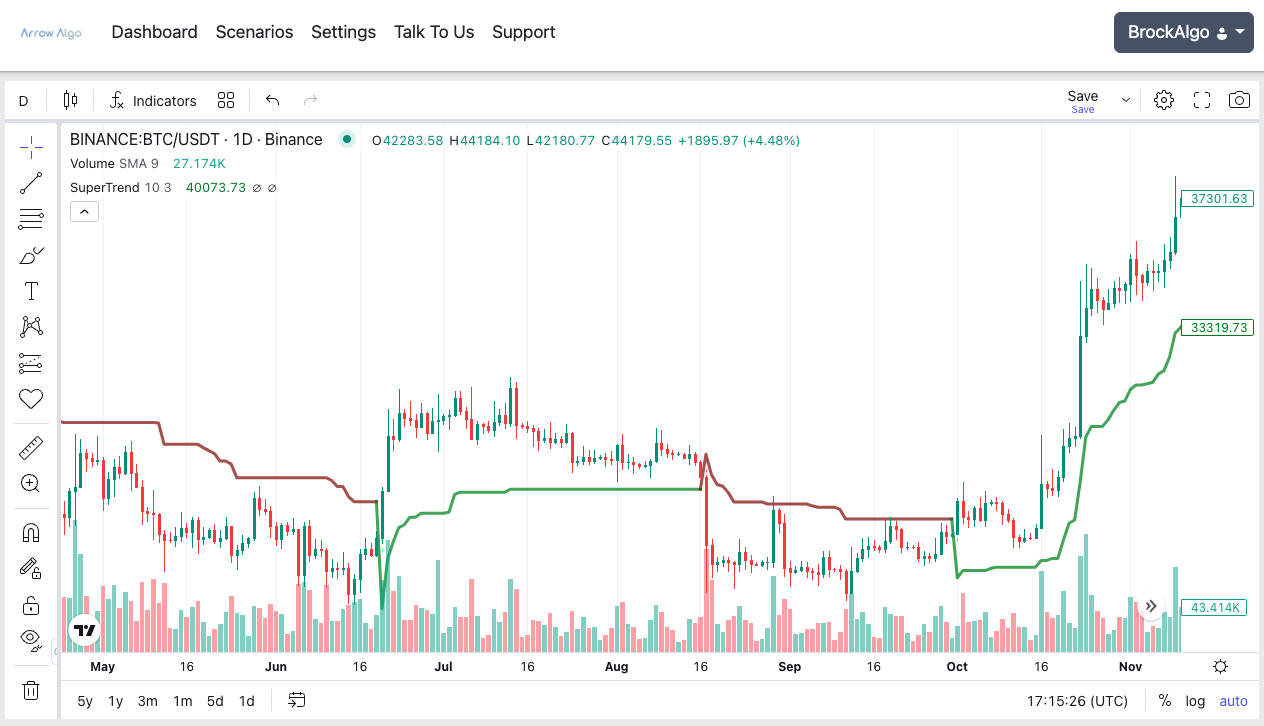
The SuperTrend Knockout (SuperTrend KO) is a trend-following indicator that builds on the classic SuperTrend by adding a confirmation filter to reduce false signals. Where the original SuperTrend generates a new directional signal every time price crosses its band, the Knockout version requires price to move through an additional threshold before confirming a trend change. The result is an indicator that trades less frequently but with higher conviction per signal — making it well-suited for systematic strategies that prioritise quality over quantity.
What Is the SuperTrend Knockout?
The SuperTrend Knockout is a modified trend indicator that uses two layers of ATR-based bands instead of one. The inner band functions like the classic SuperTrend — it tracks the trend and flips direction when price crosses it. The outer band is the knockout threshold. A trend change is only confirmed when price breaks through the outer band, not just the inner one.
This dual-layer structure acts as a filter. In trending markets, price moves strongly enough to break through both bands. In choppy or ranging markets, price often crosses the inner band but fails to reach the knockout level. Those crosses are ignored. Only genuine, committed trend moves generate signals.
The name “Knockout” refers to the idea that the previous trend must be knocked out convincingly before a new one is confirmed. The indicator will stay in the previous trend direction until price has the momentum to clear both thresholds. This patience is the core design principle behind the indicator.
How Is the SuperTrend Knockout Calculated?
The SuperTrend Knockout is built from ATR, the Average True Range, which measures recent price volatility. Two separate band calculations are performed using ATR.
The inner bands sit closer to price and are calculated using a smaller ATR multiplier. They form the initial trend boundary — similar to a standard SuperTrend setup. The outer bands sit further from price and use a larger ATR multiplier. They form the knockout threshold that price must clear to confirm a valid signal.
When price is in an uptrend, the lower outer band acts as the knockout support level. The trend remains bullish as long as price stays above it. A bearish signal only triggers when price falls below the inner band AND continues through the outer knockout level. When price is in a downtrend, the upper outer band is the knockout resistance. The trend remains bearish until price breaks above both the inner band and the outer knockout threshold.
In Arrow Algo, the SuperTrendKO block handles all of this automatically. You set the ATR period and the multipliers for the inner and outer bands. The block outputs the current trend direction and the band values, ready to connect to your entry and exit logic.
How to Read SuperTrend Knockout Signals?
The SuperTrend Knockout produces cleaner signals than the classic SuperTrend because of the knockout filter. When a signal fires, it carries more weight. Here is how to read them.
Bullish signal: A bullish SuperTrend KO signal fires when price was in a downtrend and has now broken above the upper outer knockout band. The previous bearish trend has been knocked out. The indicator flips to bullish. This signals a potential trend reversal or continuation long setup depending on context.
Bearish signal: A bearish signal fires when price was in an uptrend and breaks below the lower outer knockout band. The previous bullish trend has been knocked out. The indicator flips to bearish.
No signal — filter active: If price crosses the inner band but does not reach the outer knockout threshold, the indicator holds its previous direction. This is the filter doing its job. In a ranging market, you may see price oscillating across the inner band repeatedly without ever generating a signal. That is the correct behaviour — the market lacks the momentum to knock out the trend.
Band width as context: Wider bands indicate higher recent volatility. Narrower bands indicate a calmer, more compressed market. Signals generated in wider-band environments carry more weight — price had to move a greater distance to trigger the knockout confirmation.
What Are the Best SuperTrend Knockout Trading Strategies?
Trend-following with reduced whipsaw: The most direct application is as a replacement for the classic SuperTrend in trend-following strategies. Enter long on a bullish knockout signal, exit and reverse on a bearish knockout signal. The knockout filter removes many of the false flips that plague the standard SuperTrend in sideways conditions. The tradeoff is slightly later entries — but the reduction in losing trades on false signals typically more than compensates.
Signal confirmation layer: Rather than using SuperTrend KO as the primary entry trigger, it works well as a confirmation block in a multi-condition strategy. A momentum indicator fires the initial signal. SuperTrend KO must be in the matching direction before the entry is approved. This combination uses the knockout indicator’s trend context without depending on it alone. For a guide on combining signals effectively, see our post on confluence trading strategy.
Higher-timeframe trend filter: Applying SuperTrend KO on a higher timeframe — daily or weekly — and using it as a directional filter for lower-timeframe entries is a practical multi-timeframe application. Only take long entries on the one-hour chart when the daily SuperTrend KO is bullish. This aligns short-term trades with the dominant trend and avoids counter-trend entries.
What Are Common SuperTrend Knockout Mistakes to Avoid?
Setting the outer multiplier too close to the inner: If both bands are nearly the same width, the knockout filter adds almost no filtering value. The outer band needs to be meaningfully wider than the inner band for the two-layer structure to serve its purpose. Test different multiplier combinations during backtesting to find a separation that filters out noise without making signals too rare.
Expecting no false signals: The knockout filter reduces false signals — it does not eliminate them. In strongly trending markets that then transition into a range, the indicator will eventually generate a false reversal signal. Every trend indicator does. The goal is to reduce frequency, not achieve perfection.
Using it in isolation during ranging markets: Even with the knockout filter active, the SuperTrend KO will generate signals in extended ranging conditions if volatility compresses enough to keep the bands narrow. Adding a market regime filter — such as an ADX reading above a threshold — to only trade SuperTrend KO signals when there is a confirmed trend is a practical safeguard.
Ignoring the band width context: A knockout signal in a low-volatility, narrow-band environment is weaker than the same signal in a wide-band, high-volatility environment. The same signal type is not equally meaningful in all market conditions. Build in awareness of band width when evaluating signal quality. Learn more about volatility-based filtering at Investopedia’s trading education resources.
How to Build SuperTrend Knockout Strategies in Arrow Algo?
Arrow Algo includes the SuperTrendKO block as a native indicator. Drag it onto your strategy canvas and connect it to your price data source. The block outputs the trend direction (bullish or bearish) and the band values for the inner and outer levels.
To build a basic trend-following strategy, connect the SuperTrendKO direction output to an entry condition block. When the output changes from bearish to bullish, that is a long entry signal. When it changes from bullish to bearish, that is a close-long and short-entry signal. Add a stop-loss block below the outer knockout band to protect against sharp reversals.
To build the higher-timeframe filter version, use two SuperTrendKO blocks at different timeframes. Wire the higher-timeframe block’s direction output into a condition block — entries are only permitted when it matches the intended trade direction. Then use the lower-timeframe block to time the specific entry. Arrow Algo’s visual builder lets you connect these blocks without writing a single line of code. Backtest across multiple pairs and timeframes before going live to understand how the knockout multiplier settings affect performance across different market conditions.
What Are the Key Takeaways?
- SuperTrend Knockout adds an outer ATR-based band to the classic SuperTrend — trend signals only confirm when price breaks through both the inner and outer levels.
- The dual-band structure filters out false reversals in choppy markets while preserving signal quality in genuine trends.
- Bullish signal: price breaks above the upper outer band from a downtrend. Bearish signal: price breaks below the lower outer band from an uptrend.
- If price crosses the inner band but not the outer, no signal fires — the knockout filter is working as intended.
- Works best in trending markets; combine with a regime filter (such as ADX) to avoid choppy market conditions.
- In Arrow Algo, the SuperTrendKO block handles all calculations — connect it to your entry logic visually with no code required.
Educational disclaimer: This content is for educational purposes only and does not constitute financial advice. Trading involves significant risk and you should only trade with capital you can afford to lose. Past performance is not indicative of future results.
Disclaimer: The information provided in this article is for educational purposes only and does not constitute financial advice. Trading involves significant risk and you should only trade with capital you can afford to lose. Past performance is not indicative of future results. Always conduct your own research before making any trading decisions.
Ready to build your own automated trading strategies without writing a single line of code? Start for free at Arrow Algo and join thousands of traders who’ve made the switch to systematic trading.