
RSI + Moving Average Strategy: How to Build It in Arrow Algo
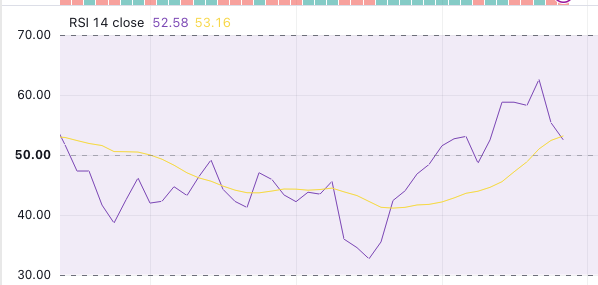
The RSI + moving average strategy combines two of the most widely used tools in systematic trading to create a more reliable entry approach. By using a moving average to identify the prevailing trend and RSI to time entries within that trend, the strategy eliminates the most common failure mode of RSI trading alone: entering counter-trend positions during strong directional moves.
What Is the RSI + Moving Average Strategy?
The strategy has two distinct components, each doing a different job:
- Moving average (trend filter): Determines the direction of the prevailing trend. When price is above the moving average, the trend is considered bullish. When price is below it, the trend is bearish.
- RSI (entry timing): Identifies when price has pulled back to an oversold level within that trend. An RSI reading below 30 in an uptrend signals a potential dip-buying opportunity.
The entry rule follows naturally: when price is above the moving average AND RSI drops below 30, enter long. When price is below the moving average AND RSI rises above 70, enter short. Both conditions must be true simultaneously — neither alone is sufficient.
Why RSI and Moving Averages Work Better Together
RSI alone generates signals in all market conditions — including against the prevailing trend. An RSI reading below 30 in a strong downtrend is not a buying opportunity. It is a confirmation that the trend is powerful. Without a directional filter, RSI traders consistently take counter-trend entries at the worst possible moment.
A moving average fixes this. It acts as a gate: the RSI signal only triggers when price is on the correct side of the average. The two indicators measure different things — the moving average tracks the broad price relationship over time, while RSI measures short-term momentum extremes. They are genuinely independent, which means when both agree, the confluence is meaningful.
Choosing the Right MA Period and RSI Settings
The moving average period determines how many trend-following signals you receive and how quickly the filter responds to trend changes:
- EMA 20: Fast-moving, many signals, more false positives in choppy markets
- EMA 50: A reliable balance for most crypto strategies — identifies meaningful trends without excessive noise
- EMA 200: Slow-moving, very few signals, enters trends late but with high conviction
For RSI, the standard 14-period setting works well in most cases. A shorter period (e.g. 9) makes RSI more sensitive and fires more frequently. A longer period (e.g. 21) produces smoother signals with fewer but stronger readings.
One practical adjustment: when combined with a moving average filter, you can often relax the RSI thresholds from 30/70 to 35/65. The MA filter already handles the trend direction — so you do not need to wait for extreme RSI readings before entering. RSI thresholds should reflect what actually works on your specific asset and timeframe, not the textbook default.
How to Structure Entries and Exits
Long entry: Price is above the EMA AND RSI crosses below 30 (or 35 with the relaxed threshold). Both conditions must be active at the same time.
Short entry: Price is below the EMA AND RSI crosses above 70 (or 65). Again, both required.
Long exit — choose the first trigger:
- RSI rises above 70 — the trade has reached the reversion target
- Price crosses below the EMA — the trend filter has been violated; the rationale for the trade no longer holds
Short exit: RSI drops below 30 OR price crosses above the EMA.
Add a stop loss below the recent swing low or at 1.5–2x ATR from entry. The MA provides a natural directional stop, but a hard price-based stop prevents extreme adverse moves from doing serious damage.
For a related approach that uses RSI level extremes without a trend filter, see the RSI overbought oversold strategy guide.
What Are the Most Common Mistakes?
- Using a very short moving average: An EMA 5 or EMA 10 weaves above and below price constantly — it is not a reliable trend indicator. Use EMA 50 or longer as the minimum filter period.
- Not exiting when price crosses through the MA: If you entered long because price was above the EMA, and price then drops below it, the original rationale is gone. Exit or tighten the stop immediately rather than holding and hoping.
- Taking RSI signals when price is far extended from the MA: An RSI signal when price is 8% above the EMA is lower quality than one when price has pulled back near the EMA. The closer the price is to the MA at the point of the RSI signal, the tighter the potential risk and the cleaner the setup.
- Over-optimising both indicators together: Running hundreds of MA and RSI period combinations on historical data will always find a perfect-looking backtest. Test a manageable range and validate on out-of-sample data before trusting the result.
How to Build the RSI + Moving Average Strategy in Arrow Algo
Arrow Algo’s no-code visual block builder lets you assemble this strategy entirely through drag-and-drop — no programming required.
Add your indicators:
- EMA block — set the period (start with 50)
- RSI block — set the period (default 14)
Build the entry logic:
- Condition block: current price is greater than EMA output (trend filter)
- Condition block: RSI output is below 30 or 35 (entry timing)
- Connect both conditions to an AND block — the entry fires only when both are true simultaneously
Build the exit logic:
- Condition block: RSI output rises above 70 (reversion target)
- Condition block: current price drops below EMA output (trend break)
- Connect both to an OR block — exit fires on the first condition that triggers
Set a stop loss on the entry block, run a backtest, and compare results across different EMA periods. Arrow Algo shows you the performance impact of each change in real time.
Key Takeaways
- The RSI + moving average strategy uses MA for trend direction and RSI for entry timing within that trend
- The combination eliminates counter-trend RSI signals — the most common cause of losses with RSI alone
- EMA 50 is a reliable starting period; RSI 14 with 30/70 thresholds, or relaxed to 35/65 with the MA filter active
- Exit when RSI reaches the opposite extreme OR when price crosses back through the MA — first trigger wins
- Avoid very short MAs; the trend filter must be meaningful to add value
- Build and backtest the full strategy in Arrow Algo’s no-code visual block builder
Disclaimer: This content is for educational purposes only and does not constitute financial advice. Trading involves significant risk and you should only trade with capital you can afford to lose. Past performance is not indicative of future results. Always conduct your own research before making any trading decisions.
Ready to build your own automated trading strategies without writing a single line of code? Start for free at Arrow Algo and join thousands of traders who’ve made the switch to systematic trading.