
Sharpe Ratio and Performance Metrics in Algorithmic Trading
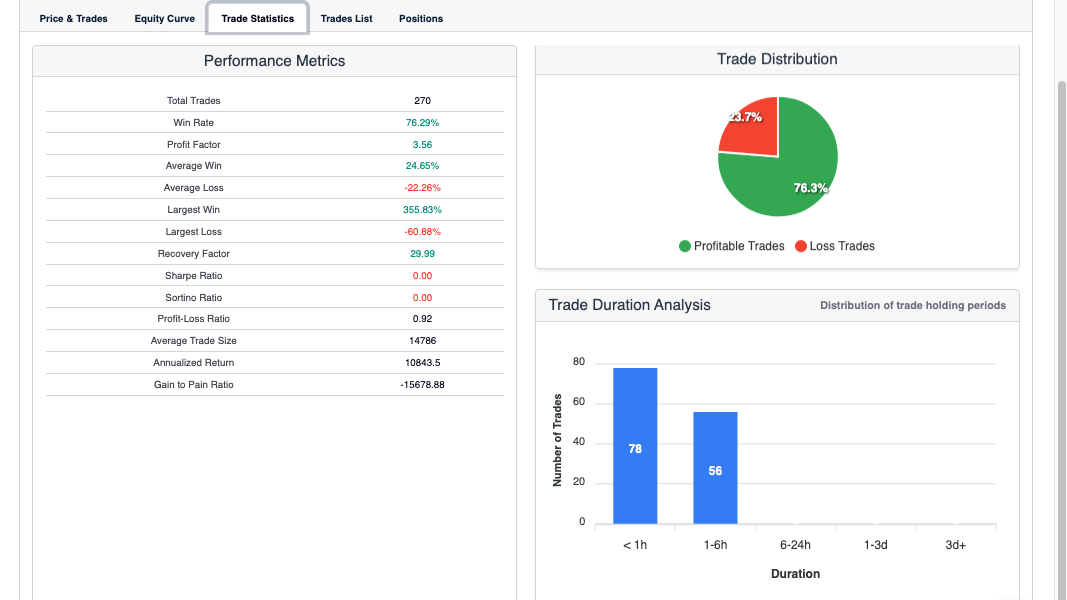
Most traders focus almost entirely on how often their strategy wins. But the Sharpe ratio and other performance metrics reveal something more important. They show not just whether a strategy makes money, but whether the returns justify the risk taken. A strategy that returns 30% per year with violent drawdowns may be worse than one returning 15% smoothly. Without performance metrics, it is impossible to tell the difference. Evaluating strategies properly separates serious systematic traders from those who abandon good strategies too early. It also stops traders from holding bad ones too long.
What Is the Sharpe Ratio?
The Sharpe ratio is a risk-adjusted performance metric that measures how much return a strategy generates for each unit of risk it takes on. William F. Sharpe developed it — his Nobel Prize work transformed portfolio theory. You calculate it by taking the strategy’s average return above the risk-free rate and dividing it by the standard deviation of those returns. In plain terms: for each unit of volatility, how much reward does the strategy deliver?
A Sharpe ratio above 1.0 is generally considered acceptable. Above 2.0 is very good. Above 3.0 is exceptional. A ratio below 1.0 means returns do not compensate for the risk. A negative Sharpe ratio means the strategy performs worse than holding cash.
Why the Sharpe Ratio Alone Is Not Enough
The Sharpe ratio is useful but incomplete. It uses standard deviation as its risk measure. This treats upside volatility (large winning days) the same as downside volatility (large losing days). A strategy with enormous winning streaks and steady losses can have a mediocre Sharpe ratio — even if it is genuinely profitable. This is why serious strategy evaluators use a suite of metrics together rather than relying on any single number.
What Are the Essential Performance Metrics for Algorithmic Trading?
Sortino Ratio
The Sortino ratio is a refined version of the Sharpe ratio that only penalises downside volatility — the bad kind. The calculation excludes upside volatility entirely. This makes the Sortino ratio more appropriate for trading strategies. Large wins are welcome — only losses need minimising. A Sortino ratio above 2.0 signals strong performance. Trend-following strategies tend to score better on Sortino than Sharpe. Their occasional large wins inflate the standard deviation that Sharpe penalises.
Maximum Drawdown
Maximum drawdown measures the largest peak-to-trough decline in a strategy’s equity curve. It represents the worst-case loss a trader would have experienced across the full backtest period. It is arguably the most psychologically important metric. It tells you how much pain you would have had to endure to capture the strategy’s long-run returns.
A strategy with 40% returns but a 60% maximum drawdown may be mathematically profitable but practically unusable. Most traders abandon it during the drawdown, locking in the loss and missing the recovery. A more modest strategy with 20% annual returns and a 15% maximum drawdown gives traders a much better chance of staying the course through difficult periods.
Calmar Ratio
The Calmar ratio divides the annualised return by the maximum drawdown, producing a single number that captures the relationship between reward and worst-case risk. A Calmar ratio above 1.0 means the strategy’s annual return exceeds its maximum historical drawdown. Above 3.0 is excellent. This metric is particularly useful when comparing strategies with similar returns but very different drawdown profiles.
Win Rate and Average Win/Loss Ratio
Always evaluate win rate (the percentage of profitable trades) alongside the average win/loss ratio (the average size of winning trades divided by the average size of losing trades). A strategy with a 40% win rate is not necessarily poor — if the average win is 3× the average loss, the strategy has a strong positive expected value. Conversely, a strategy with a 70% win rate may be losing money if the average loss is 5× the average win.
The combination of win rate and win/loss ratio produces the mathematical expectancy — the average amount the strategy expects to make per trade over a large sample. This is the most fundamental measure of whether a strategy has an edge at all.
Recovery Factor
The recovery factor divides the total net profit by the maximum drawdown. It answers the question: for every unit of worst-case loss experienced, how much total profit did the strategy generate? A recovery factor above 3.0 suggests the strategy’s profitability meaningfully outweighs its risk of loss.
How to Use Performance Metrics When Backtesting in Arrow Algo
Arrow Algo’s backtesting engine calculates these metrics automatically after running a strategy against historical data. When evaluating your backtest results, use this framework:
- First check the equity curve shape — a smooth, consistent upward slope with shallow drawdowns is more valuable than a volatile curve even if the final return is higher
- Check the Sharpe ratio — above 1.0 as a minimum, above 1.5 as a good target for live trading
- Check maximum drawdown — ask yourself honestly whether you could have continued trading through that drawdown without abandoning the strategy
- Check the number of trades — a strategy with a great Sharpe ratio over 20 trades has no statistical validity; aim for at least 100 trades in the backtest period
- Compare in-sample vs out-of-sample performance using the walk-forward analysis feature — a strategy that performs similarly across both is genuinely robust; one that degrades significantly out-of-sample is likely overfit to historical data
The visual block builder in Arrow Algo allows you to adjust strategy parameters, rerun the backtest, and observe how performance metrics change in real time — making the process of optimising for genuine risk-adjusted performance far more accessible than traditional coding-based approaches.
What Are the Key Takeaways?
- The Sharpe ratio measures risk-adjusted return — above 1.0 is acceptable, above 2.0 is strong
- The Sortino ratio is often more useful than Sharpe for trading strategies because it only penalises downside volatility
- Maximum drawdown is the most psychologically important metric — evaluate whether you could genuinely survive it
- Win rate and average win/loss ratio must be evaluated together, not separately
- A strategy’s performance metrics should be consistent across in-sample and out-of-sample periods to be trustworthy
- Arrow Algo’s backtesting engine calculates all key metrics automatically, letting you compare strategies and optimise for genuine risk-adjusted performance
Educational disclaimer: This content is for educational purposes only and does not constitute financial advice. Trading involves significant risk and you should only trade with capital you can afford to lose. Past performance is not indicative of future results.
Disclaimer: The information provided in this article is for educational purposes only and does not constitute financial advice. Trading involves significant risk and you should only trade with capital you can afford to lose. Past performance is not indicative of future results. Always conduct your own research before making any trading decisions.
Ready to backtest your own strategies and evaluate their performance metrics without writing any code? Start for free at Arrow Algo — build, test, and refine your approach before risking real capital.