
Standard Deviation (StdDev): Complete Guide for Algorithmic Trading
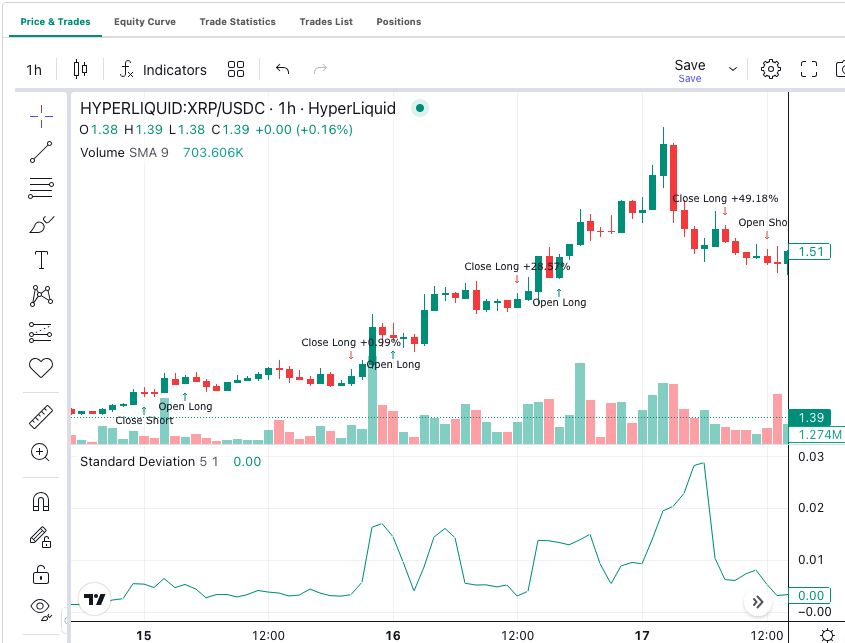
Standard Deviation is a statistical measure of price volatility that quantifies how far prices typically move from their average over a given period. In algorithmic trading, this indicator is one of the most fundamental building blocks for volatility analysis and risk management. It forms the mathematical foundation behind Bollinger Bands and helps systematic traders gauge whether a market is calm or volatile.
What Is Standard Deviation in Trading?
Standard Deviation measures how spread out price values are relative to their mean over a specified lookback period. A low reading means prices are clustered tightly around the average. This indicates a quiet, range-bound market. A high reading means prices are swinging widely, signalling elevated volatility.
In practical terms, if Bitcoin has a 20-period reading of $500, price has been fluctuating roughly $500 above and below its average. If that jumps to $2,000, volatility has quadrupled. This information is critical for traders who need to adjust stop-loss distances and position sizes based on current conditions.
How Is Standard Deviation Calculated?
The calculation follows a straightforward statistical process. First, calculate the simple moving average of closing prices over your chosen period — typically 20 candles. Second, for each candle, find the difference between the close and the average. Square that difference. Third, take the average of all squared differences. Finally, take the square root.
The result is expressed in the same units as price. A value of $1,500 on Bitcoin means the typical fluctuation from the mean is $1,500. Most platforms, including Arrow Algo, calculate this automatically. You simply set the period and connect your price source.
How to Read Standard Deviation Signals?
This indicator does not generate buy or sell signals on its own. Instead, it measures the intensity of price movement. You use it to filter or modify other signals. The key patterns to watch are expansions, contractions, and relative levels.
An expansion — where the value rises sharply from a low level — indicates a breakout or trend move is underway. Markets alternate between consolidation and trending phases. A rapid expansion often marks the transition.
A contraction — where the value falls to unusually low levels — signals that a big move may be coming. This is the “calm before the storm” pattern. Compressed volatility frequently precedes explosive breakouts. However, the indicator alone does not tell you which direction the breakout will go.
Comparing the current reading to its own moving average gives you a relative measure. When the value sits above its 20-period average, volatility is elevated. When below, the market is quieter than usual. This relative approach works better than fixed thresholds because different assets have different baseline volatility.
What Are the Best Standard Deviation Trading Strategies?
Volatility breakout filter: Only take breakout entries when the reading is rising and above its 20-period average. This filters out false breakouts during low-volatility chop. When the value is flat or falling, the market lacks energy to sustain a move.
Dynamic stop-loss sizing: Set your stop distance as a multiple of the current value — typically 1.5 to 2.5 times the 20-period reading. In volatile markets, stops are wider to avoid noise. In quiet markets, stops are tighter. This adapts automatically, unlike fixed-percentage stops. Combine with proper position sizing for complete risk management.
Volatility squeeze entry: Monitor for unusually low readings — below the 20th percentile of recent history. When the value compresses and then begins expanding, enter in the direction of the initial move. Pair with RSI or MACD for directional confirmation.
What Are Common Mistakes to Avoid?
The most common mistake is treating this as a directional indicator. A high reading means the market is volatile. It does not tell you whether price will rise or fall. Always pair it with a trend or momentum tool for direction.
Another frequent error is using a fixed threshold across different assets. A value of $500 is enormous for a $10 altcoin but trivial for Bitcoin at $67,000. Use percentage-based values or compare the reading to its own average for cross-asset analysis.
Traders also sometimes overlook the lookback period. A 20-period value on a 1-hour chart captures roughly one day of volatility. The same 20-period on a daily chart captures a full month. Match your period to your strategy’s holding time.
How to Build Standard Deviation Strategies in Arrow Algo?
Arrow Algo includes this block in its visual builder. It calculates volatility automatically from any price input. Connect a data source block to provide close prices, add the block with your preferred period, and use condition blocks to create your filter.
For a volatility breakout strategy, add an SMA block on the output to create a relative comparison. When the current value crosses above its own SMA, volatility is expanding. Combine this with a price breakout condition and a directional indicator. Arrow Algo backtests instantly so you can test different period combinations.
What Are the Key Takeaways?
- Standard Deviation measures how far price moves from its average — higher readings mean more volatility
- It is a volatility tool, not a directional signal — combine with trend or momentum indicators
- Low readings often precede large breakout moves in either direction
- Use multiples of the value for dynamic stop-loss sizing that adapts to conditions
- Compare the reading to its own moving average rather than using fixed thresholds
- Adjust the lookback period to match your strategy’s timeframe and holding period
Educational disclaimer: This content is for educational purposes only and does not constitute financial advice. Trading involves significant risk and you should only trade with capital you can afford to lose. Past performance is not indicative of future results.
Disclaimer: The information provided in this article is for educational purposes only and does not constitute financial advice. Trading involves significant risk and you should only trade with capital you can afford to lose. Past performance is not indicative of future results. Always conduct your own research before making any trading decisions.
Ready to build your own automated trading strategies without writing a single line of code? Start for free at Arrow Algo and join thousands of traders who’ve made the switch to systematic trading.