
Standard Error (StdErr): Complete Guide for Algorithmic Trading
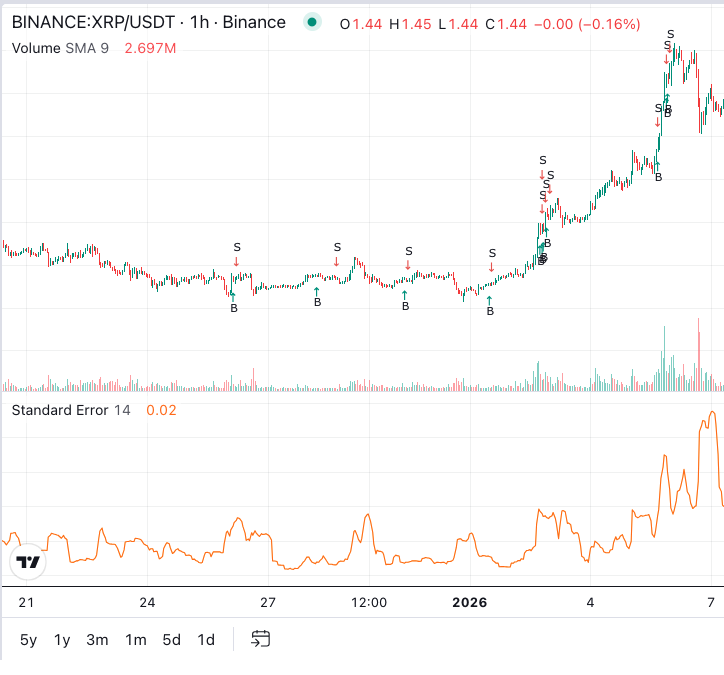
The Standard Error (StdErr) is a statistical indicator that measures how closely price tracks a linear regression line. It tells systematic traders how much noise or deviation exists around the expected trend. A small Standard Error means price is following its trend cleanly. A large one means price is choppy and unpredictable.
What Is the Standard Error Indicator?
Standard Error is a technical indicator built on linear regression analysis. It measures the average distance between actual closing prices and the regression line fitted over a look-back period.
In practical terms: when price trends cleanly, the Standard Error stays low. When price moves erratically, the Standard Error rises. This makes it a useful tool for identifying whether market conditions suit trend-following or mean-reversion approaches.
Standard Error is closely related to the Linear Regression indicator, which plots the trend line itself. Standard Error tells you how reliable that trend line actually is.
How Is the Standard Error Calculated?
The calculation follows these steps — all handled automatically by the indicator block:
- A linear regression line is fitted to closing prices over a set period (e.g. 14 bars).
- The difference between each actual price and the corresponding point on the regression line is measured.
- These differences are squared and averaged.
- The square root of that average gives the Standard Error value.
The result is expressed in price units. A Standard Error of $200 on Bitcoin means prices deviate an average of $200 from the trend line. A value of $50 means price is hugging the regression line very closely.
You can explore the statistical foundation in Investopedia’s guide to Standard Error.
How to Read Standard Error Signals?
Standard Error is a context indicator. It does not generate buy or sell signals on its own. It tells you what kind of market you are in.
Low Standard Error:
- Price is tracking the regression line closely.
- Market conditions are orderly and trend-like.
- Trend-following strategies may perform well.
High Standard Error:
- Price is deviating significantly from the regression line.
- Market is noisy or in transition.
- Mean-reversion approaches may be more appropriate.
Rising Standard Error: Conditions are becoming less predictable. Consider reducing position sizes or pausing new entries.
Falling Standard Error: Conditions are becoming more orderly. A trend may be establishing itself.
What Are the Best Standard Error Trading Strategies?
1. Trend-Filter Strategy
Use Standard Error as a filter before entering trend-following trades. Only take entries when the Standard Error is low and falling. This ensures you enter during orderly market conditions — not during choppy periods that erode trend-following returns.
2. Volatility-Based Position Sizing
Scale position size based on the Standard Error value. When Standard Error is low, markets are more predictable and you may increase exposure slightly. When Standard Error is high, reduce position size to account for the additional noise.
3. Regime Detection
Combine Standard Error with the slope of the Linear Regression line. A low Standard Error with a positive slope signals an uptrend regime. A high Standard Error — regardless of slope — suggests a directionless market. Adjust your strategy selection based on the detected regime.
What Are Common Standard Error Mistakes to Avoid?
Using it in isolation. Standard Error measures dispersion around a trend line. It does not confirm trend direction. Always pair it with a directional indicator such as a moving average or Linear Regression slope.
Choosing too short a look-back period. A 5-bar Standard Error reacts quickly but produces noisy readings. A 14–20 bar period gives more stable, actionable context for most markets.
Ignoring absolute price levels. A Standard Error of $500 means something different on a $2,000 asset than on an $80,000 one. Normalise the value against current price when comparing across different markets.
Treating it as a momentum indicator. Standard Error measures dispersion, not speed or direction. Expecting it to time entries like RSI or MACD will produce poor results.
How to Build Standard Error Strategies in Arrow Algo?
Arrow Algo includes Standard Error as a native indicator block. You can add it to any strategy using the drag-and-drop visual builder — no coding required.
Here is how to build a trend-filter strategy in the visual builder:
- Add a Linear Regression block to generate trend direction.
- Add a Standard Error block and set your look-back period (14 bars is a solid starting point).
- Create a condition block: Standard Error must be below a threshold before any trade entry activates.
- Connect your main entry signal — for example, a moving average crossover — to fire only when the Standard Error condition is met.
- Backtest against live exchange data from Binance or Coinbase to validate the filter across different market conditions.
This setup ensures your strategy sits out noisy, uncertain periods automatically — and only trades when market conditions are clean.
What Are the Key Takeaways?
- Standard Error (StdErr) measures how closely price tracks a linear regression line.
- Low values indicate orderly, trend-like conditions. High values indicate noise.
- It is a context indicator — use it to filter other signals, not as a standalone trigger.
- Pair it with directional tools like Linear Regression slope or MACD for best results.
- In Arrow Algo, add the Standard Error block to any strategy using the no-code visual builder.
Disclaimer: This content is for educational purposes only and does not constitute financial advice. Trading involves significant risk and you should only trade with capital you can afford to lose. Past performance is not indicative of future results. Always conduct your own research before making any trading decisions.
Ready to build your own automated trading strategies without writing a single line of code? Start for free at Arrow Algo and join thousands of traders who’ve made the switch to systematic trading.