
Stochastic RSI (StochRSI): Complete Guide for Algorithmic Trading
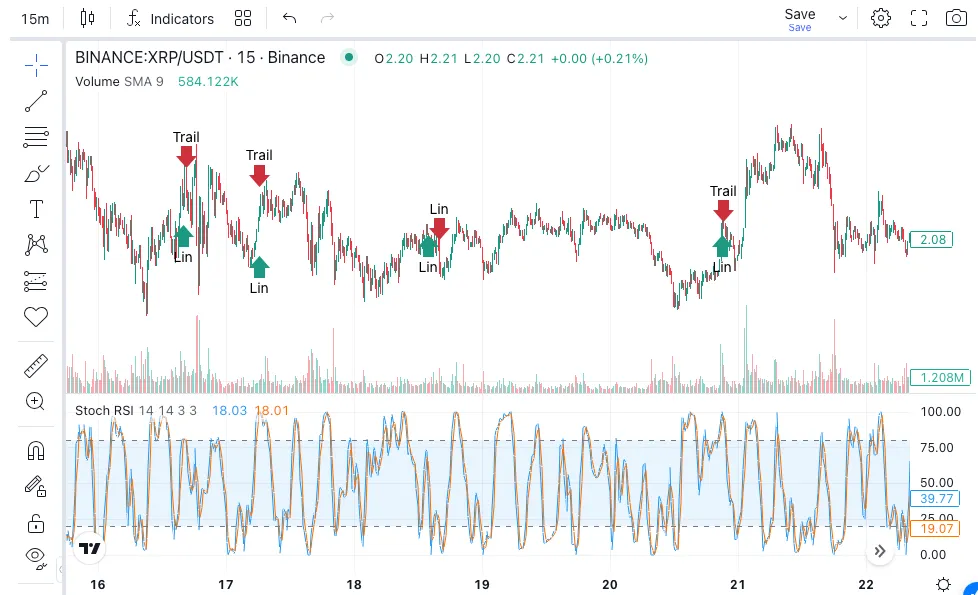
The Stochastic RSI is one of the most widely used momentum indicators in algorithmic trading, combining the strengths of two classic tools — the Relative Strength Index and the Stochastic Oscillator — into a single, more responsive signal. For traders building systematic strategies, it delivers faster, more sensitive readings than RSI alone, helping to identify overbought and oversold conditions with greater precision.
What Is the Stochastic RSI?
Stochastic RSI is a technical indicator that applies the Stochastic Oscillator formula to RSI values instead of price data. Developed by Tushar Chande and Stanley Kroll in their 1994 book The New Technical Trader, it produces a normalised value between 0 and 1 (or 0 and 100) that moves faster than either the RSI or the traditional Stochastic Oscillator on their own. This speed makes it particularly useful in fast-moving markets where classic RSI signals may lag.
Rather than comparing price changes, it compares RSI readings to their own historical range over a look-back period. The result is an indicator that is hyper-sensitive to momentum shifts — a popular choice among systematic traders who need precise entry and exit timing without relying on lagging signals.
How Is the Stochastic RSI Calculated?
The Stochastic RSI calculation happens in two stages. First, a standard RSI is calculated over a defined period — typically 14 candles. The RSI value reflects recent price momentum on a scale of 0 to 100.
Second, the Stochastic formula is applied to those RSI values: the current RSI is compared against its highest and lowest readings over the same look-back window. The formula subtracts the lowest RSI from the current RSI, then divides by the difference between the highest and lowest RSI — producing a value between 0 and 1.
Most charting platforms smooth the result by plotting two lines: the %K line (the raw Stochastic RSI value) and the %D line (a three-period moving average of %K). Crossovers between these two lines generate the actual trading signals. Common default settings use 14 periods for the RSI, 14 periods for the Stochastic look-back, and 3 periods of smoothing for both %K and %D.
No programming is needed to work with this formula. In Arrow Algo’s visual block builder, the StochRSI block handles every calculation automatically. You simply drag it onto your strategy canvas and configure the period settings from the block’s settings panel.
How to Read Stochastic RSI Signals?
Stochastic RSI oscillates between 0 and 1 (or 0 and 100, depending on display settings). Readings fall into three zones:
- Overbought zone (above 0.80 or 80): The current RSI is near the top of its recent range, suggesting the asset may be overextended. A reversal or consolidation could follow.
- Oversold zone (below 0.20 or 20): The RSI is near the bottom of its range, indicating potential selling exhaustion. A bounce or reversal may be imminent.
- Midrange (0.20–0.80): Momentum is neutral. Many traders avoid new positions based on Stochastic RSI alone when it sits in this zone, waiting for a clear extreme reading instead.
The most actionable signals from this indicator come from two patterns. First, crossovers: when the %K line crosses above the %D line inside the oversold zone, that is a potential buy signal. When %K crosses below %D from the overbought zone, that suggests a potential sell. Second, divergences: if price makes a new low while Stochastic RSI makes a higher low, that bullish divergence signals fading downside momentum before price confirms it.
What Are the Best Stochastic RSI Trading Strategies?
Stochastic RSI is versatile enough to support multiple strategy types. Here are three well-tested approaches used by systematic traders.
Reversal Strategy
This is the most straightforward approach. When the indicator drops below 20 (oversold) and %K then crosses above %D from below, traders enter a long position. A stop-loss sits below the recent swing low, and a target of 1:2 risk-to-reward is common. The inverse applies for short entries when Stochastic RSI is overbought and %K crosses below %D from above. This strategy performs best in ranging or mildly trending markets.
Trend-Filtered Strategy
To reduce false signals, many algorithmic traders pair Stochastic RSI with a trend indicator such as the Exponential Moving Average or the Average Directional Index (ADX). In an uptrend — confirmed by price trading above the 50 EMA, for example — only long entries are taken when Stochastic RSI pulls back to the oversold zone. This filters out counter-trend signals and typically improves win rate significantly.
Divergence Strategy
Divergences between price and Stochastic RSI can anticipate trend reversals before they are confirmed by price. A bullish divergence occurs when price makes a lower low but Stochastic RSI makes a higher low — suggesting selling pressure is weakening. This signal is particularly powerful at key support levels. In Arrow Algo, you can build divergence-based rules into a strategy visually without writing any code by combining the StochRSI block with price structure condition blocks.
What Are Common Stochastic RSI Mistakes to Avoid?
Stochastic RSI’s speed is also its biggest drawback. Because it reacts quickly to price changes, it generates many signals — and a significant portion are false. Here are the most common mistakes systematic traders make with this indicator.
- Trading every signal without a trend filter: In a strong uptrend, the indicator will repeatedly reach overbought levels. Shorting every such reading results in a string of losses. Always confirm the broader trend direction first.
- Ignoring the timeframe: Stochastic RSI behaves very differently on a 5-minute chart versus a daily chart. Default settings that produce solid results on one timeframe may generate noise on another. Always backtest your specific settings before going live.
- Using it in isolation: No single indicator should be the sole basis for a trade. It works best when combined with price action analysis, volume indicators, or trend-confirmation tools.
- Over-optimising parameters: Fitting every input (RSI period, Stochastic period, smoothing) to maximise historical performance almost always results in overfitting — a strategy that looks excellent in backtests but fails in live conditions. Keep your settings simple and test for robustness.
How to Build Stochastic RSI Strategies in Arrow Algo?
Arrow Algo’s no-code visual block builder makes it straightforward to build Stochastic RSI strategies without any programming knowledge. Drag the StochRSI block onto your strategy canvas and configure the RSI period, the Stochastic look-back period, and the smoothing parameters directly from the block’s settings panel.
To build a trend-filtered reversal strategy, combine the StochRSI block with an EMA block set to 50 periods. Add a condition that only triggers long entries when price is above the EMA and Stochastic RSI has crossed above 20 from below. Layer in a stop-loss block and a take-profit block to manage risk automatically.
Once your strategy is built, run it through Arrow Algo’s backtesting engine using live historical data pulled directly from the exchange. This lets you evaluate how your strategy rules would have performed across trending, ranging, and volatile market conditions — before committing any capital. Adjust your parameters based on real data rather than intuition, and then activate your strategy with full confidence.
What Are the Key Takeaways?
- Stochastic RSI applies the Stochastic Oscillator formula to RSI values, producing a faster and more sensitive momentum indicator
- It oscillates between 0 and 1 — readings above 0.80 are considered overbought, readings below 0.20 are considered oversold
- The strongest signals come from %K/%D crossovers in extreme zones and bullish or bearish divergences from price
- It generates frequent signals — adding a trend filter dramatically improves accuracy and reduces false entries
- It works best as part of a complete strategy, not as a standalone buy/sell trigger
- In Arrow Algo, you can build and backtest Stochastic RSI strategies visually without writing a single line of code
For further reading, see the Investopedia guide to the Stochastic RSI and the original research by Chande and Kroll in The New Technical Trader.
Educational disclaimer: This content is for educational purposes only and does not constitute financial advice. Trading involves significant risk and you should only trade with capital you can afford to lose. Past performance is not indicative of future results.
Disclaimer: The information provided in this article is for educational purposes only and does not constitute financial advice. Trading involves significant risk and you should only trade with capital you can afford to lose. Past performance is not indicative of future results. Always conduct your own research before making any trading decisions.
Ready to build your own automated trading strategies without writing a single line of code? Start for free at Arrow Algo and join thousands of traders who’ve made the switch to systematic trading.