
Strategy Review Process: When to Tweak and When to Retire
Every live trading strategy eventually underperforms. The question is not whether it will happen — it will — but how to tell the difference between a normal drawdown within expected parameters and a genuine breakdown that requires intervention. The strategy review process is the systematic framework that answers that question before emotion does.
What Is a Strategy Review Process?
A strategy review process is a defined, repeatable procedure for evaluating a live trading strategy that is underperforming — assessing whether the underperformance is within the bounds of normal statistical variation, whether market conditions have shifted in a way the strategy was not designed for, or whether the strategy’s core logic has stopped working and requires retirement. It converts an emotionally loaded decision — do I stop this strategy? — into a structured, data-driven one.
Why Systematic Traders Need a Review Process
The two most common and opposite mistakes in managing a live strategy are stopping it too early and stopping it too late. Stop too early and you abandon a valid edge at the bottom of a normal drawdown, then watch the strategy recover without you. Stop too late and you hold a broken strategy through an extended loss period that could have been avoided.
Both mistakes share the same root cause: the decision is driven by how the performance feels rather than what the data shows. A strategy review process removes that subjectivity. The criteria for intervention are defined before the strategy goes live — not after it starts losing.
Step One — Define Your Review Triggers in Advance
The review process starts before the strategy launches, not after it underperforms. Define the specific conditions that will trigger a formal review:
Drawdown threshold: Set a maximum live drawdown level based on your backtest data — typically 1.5× to 2× the backtest’s maximum drawdown. If the live strategy hits this level, a review is mandatory. Not discretionary — mandatory. This is your circuit breaker.
Win rate deviation: Calculate the minimum acceptable win rate from your backtest. If live win rate falls more than 10–15 percentage points below the backtested rate over a meaningful sample of trades, trigger a review. A single bad week is noise. Sustained deviation from the expected win rate is a signal.
Consecutive losses: Define a maximum consecutive loss count before review. If the backtest’s worst streak was 8 losses in a row and live performance hits 12, review the strategy regardless of whether the drawdown threshold has been reached.
Step Two — Diagnose Before Deciding
When a review trigger fires, the first action is diagnosis — not stopping the strategy. Work through the following questions systematically.
Is the drawdown within backtest parameters? Compare current live drawdown to the worst drawdown in your backtest. If live performance is worse than anything in the backtest, investigate why. If it falls within backtest range, this may be a normal drawdown.
Has the market regime changed? A trend-following strategy underperforming in a ranging market is not broken — it is in the wrong conditions. Check whether the current market regime (trending vs ranging, high vs low volatility) matches the conditions the strategy was designed for. See our post on regime switching strategy for how to detect and adapt to regime changes systematically.
Has something in the execution changed? Check whether fees, slippage, or order fill quality have changed since the backtest. Higher taker fees, wider spreads, or consistently worse fills than assumed can erode a strategy’s edge without any change in the underlying logic.
Is the sample size meaningful? A strategy averaging two trades per week needs at least 25–30 trades to produce statistically meaningful performance data. Reviewing after five trades is reviewing noise, not signal. Always check whether enough trades have occurred before drawing conclusions about live performance.
Step Three — The Decision Framework
After diagnosis, the decision falls into one of three categories:
Hold and monitor: Drawdown is within backtest range, regime matches strategy design, execution is normal, sample size is small. Continue running. Set a calendar date for the next formal review.
Pause and investigate: Performance is outside backtest parameters but the cause is unclear. Pause the strategy — do not retire it — while you investigate execution quality, data quality, and market conditions. Resume only when the cause is identified and addressed.
Retire: The strategy’s core logic has stopped working across sufficient sample size, or market structure has permanently changed in a way the strategy cannot adapt to, or the edge has decayed to the point where expected return no longer justifies the risk. Retire the scenario and return to backtesting and development.
How to Run a Strategy Review in Arrow Algo
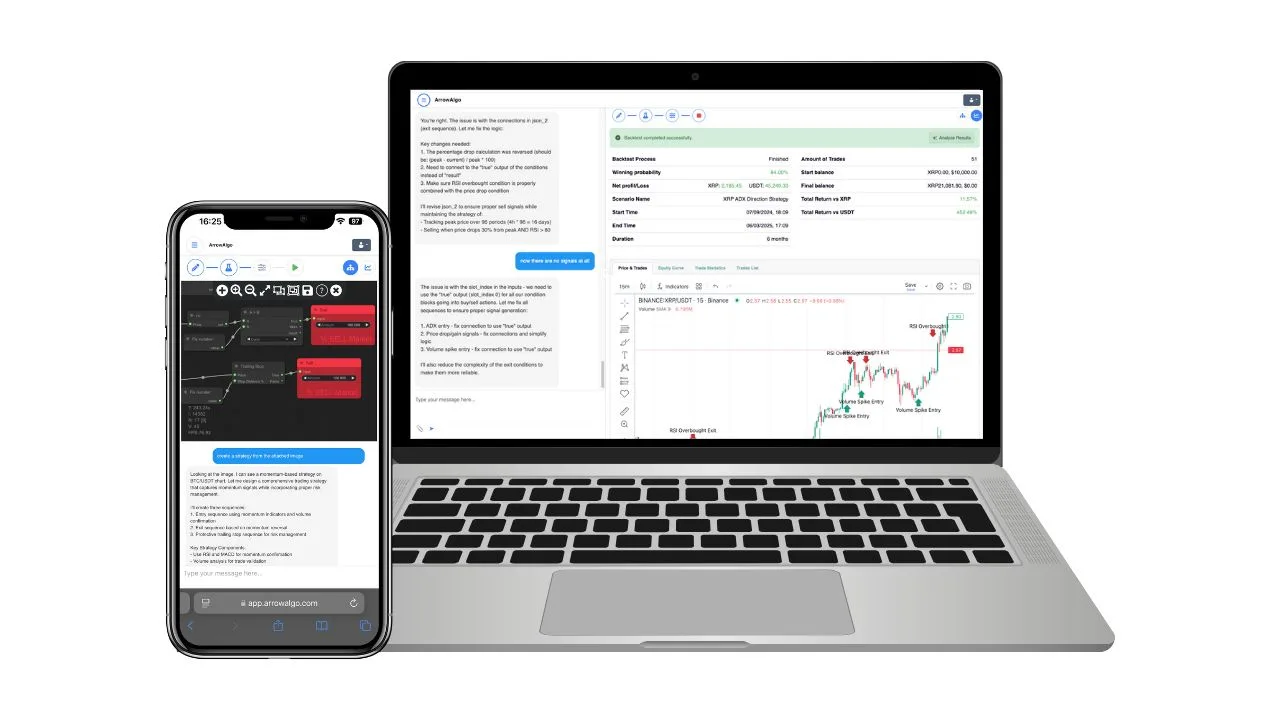
Arrow Algo’s live scenario dashboard gives you the data needed to run each step of the review process without manual calculation.
Check the current drawdown against your pre-defined threshold in the scenario’s performance metrics. Review the win rate and average win/loss figures against your backtest expectations. Examine the trade log to identify whether losing trades are failing on the entry signal, the exit, or through stops triggered by normal volatility.
If a regime question arises, add an ADX or ATR block to a test version of the scenario and run a short backtest on recent data to check whether conditions have shifted. Arrow Algo’s backtester lets you isolate a specific recent window — for example, the past 30 days — to compare live-period conditions against the full backtest history.
Document the review outcome and the reasoning. If you hold and monitor, note why. If you retire, note what failed and what you would change in the next iteration. The review process compounds in value over time — each documented decision teaches you something the next strategy benefits from.
What Are the Key Takeaways?
- A strategy review process is a defined framework for deciding whether a live strategy should be held, paused, or retired — based on data, not emotion
- Define review triggers before launch: drawdown threshold, win rate deviation, consecutive loss limit
- Diagnose before deciding: check whether performance is within backtest range, whether regime has changed, and whether the sample size is meaningful
- Three outcomes: hold and monitor, pause and investigate, or retire — each with specific criteria
- Arrow Algo’s live dashboard provides the drawdown, win rate, and trade log data needed to run each step of the review
- Document every review decision — the reasoning compounds in value across future strategy iterations
Disclaimer: This content is for educational purposes only and does not constitute financial advice. Trading involves significant risk and you should only trade with capital you can afford to lose. Past performance is not indicative of future results. Always conduct your own research before making any trading decisions.
Ready to build your own automated trading strategies without writing a single line of code? Start for free at Arrow Algo and join thousands of traders who’ve made the switch to systematic trading.