
Trend Following Strategies: A Guide for Algorithmic Traders
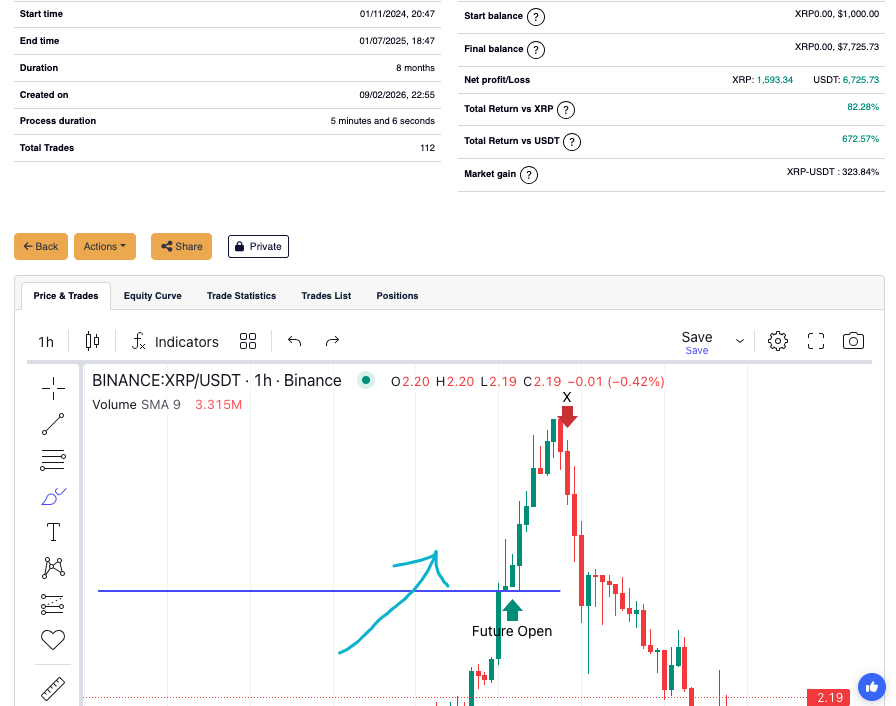
Trend following strategies are the bedrock of systematic trading. More hedge fund capital has been made following trends than through any other single approach in the history of financial markets — yet most retail traders either misunderstand what trend following actually means, or dismiss it as too simple to work. This post explains what trend following strategies are, why they work, and how to build and automate them without writing a single line of code.
What Are Trend Following Strategies?
Trend following strategies are systematic approaches that identify the direction of an asset’s price movement and enter positions aligned with that direction — buying in uptrends, selling or shorting in downtrends. The core premise is straightforward: markets trend more often than they do not, and a strategy designed to ride those trends while cutting losses quickly can generate consistent returns over time. The approach is explicitly reactive, not predictive. A trend follower does not try to forecast where the market will go. They observe where it is going and join the move in progress. The question is never “where will price be in three months?” — it is “what is price doing right now, and how do I participate in that movement systematically?”
Why Trend Following Strategies Work?
Markets trend for structural reasons that are unlikely to disappear:
- Institutional order flow — large funds cannot enter or exit positions in a single trade. A pension fund allocating to Bitcoin must buy over days or weeks, creating sustained directional pressure
- Information diffusion — news and fundamental developments are priced in gradually as more participants become aware of them. This creates trending moves rather than instant price adjustments
- Anchoring bias — traders anchor to recent price levels and resist selling at a loss, causing downtrends to persist longer than rational models would predict
- Momentum — academic research consistently documents that assets showing strong recent performance tend to continue outperforming in the near term. This is the behavioural foundation that trend following exploits
The result is a strategy that does not need to predict anything — it simply needs to identify when a trend is underway and stay with it until evidence suggests otherwise.
The Three Core Trend Following Strategy Approaches
1. Moving Average Crossover
The most widely used trend following signal. A fast moving average (e.g. 50-day) crossing above a slow moving average (e.g. 200-day) signals an uptrend beginning — the “Golden Cross.” The opposite — the fast MA crossing below the slow MA — signals a downtrend. The system enters in the direction of the cross and holds until the next crossover occurs. The main advantage is simplicity and clarity — there is never ambiguity about whether a signal has occurred. The main drawback is lag: moving averages are calculated from past prices, so the signal always arrives after the trend has already started.
2. Channel Breakout
Enter long when price breaks above its highest level over a defined lookback period (e.g. 20 days). Hold until price breaks below a shorter-term channel. This was the basis of the famous Turtle Trading system. It captures trend momentum from the moment a new directional move begins, rather than waiting for averages to confirm.
3. Price Action Trend Following
Define a trend as a series of higher highs and higher lows (uptrend) or lower highs and lower lows (downtrend). Enter on the first pullback after a new swing high, targeting a continuation of the trend. This approach requires more nuanced signal definition but can provide earlier entries with tighter initial stops.
Risk Management: The Part Most Traders Get Wrong
Trend following strategies have a counterintuitive risk profile. They typically have win rates below 50% — sometimes as low as 35–40%. What makes them profitable is not winning most trades, but winning large on the trades that work and losing small on the trades that don’t. This requires three non-negotiable risk management rules:
- Small, predefined stops on every trade — accept the loss quickly when a signal fails. A trend following strategy with large stops or no stops will eventually suffer a catastrophic loss
- Let winners run — do not take profits early because a position “has moved enough.” The large wins that make the strategy profitable come from holding through full trend moves
- Consistent position sizing — risk the same percentage of capital on each trade regardless of conviction. The strategy’s edge comes from systematic execution across many trades, not from individual position sizing decisions
The psychological difficulty of trend following strategies is that they feel wrong during the inevitable losing streaks. A 40% win rate means six consecutive losing trades can be statistically expected during any 200-trade run. Human discretion will tend to abandon the strategy exactly at this point — which is why automating it is such a significant advantage.
Trend Following Strategies vs Mean Reversion
Trend following and mean reversion are the two fundamental strategy types, and they tend to perform in different market regimes:
- Trend following excels in strong directional markets — sustained bull or bear moves driven by macro themes, institutional flows, or fundamental shifts
- Mean reversion performs better in ranging, low-volatility markets where price oscillates around a stable level
Many experienced systematic traders run both simultaneously, so that one strategy is always in an environment suited to it. Understanding when to apply each approach is one of the key skills in systematic trading.
Automating Trend Following Strategies in Arrow Algo
Arrow Algo’s visual block builder is purpose-built for exactly this type of rules-based system. Using the drag-and-drop interface you can:
- Add Moving Average blocks for your fast and slow periods and connect them to a Crossover Condition block that fires when the fast crosses above the slow
- Configure a Channel Breakout block (using Donchian Channels) to enter on new N-period highs and connect to automated position management
- Set a Stop Loss block at a fixed distance from entry — ensuring every trade has a predefined maximum loss regardless of what happens next
- Add a Trailing Stop block to let winning positions run while protecting accumulated gains as the trend matures
- Configure position sizing logic to risk a fixed percentage of account equity on each signal — automating the discipline that separates successful systematic traders from those who override their own rules
- Run the full system through backtesting to evaluate how the strategy would have performed across trending and ranging periods before going live
The biggest advantage of automating trend following strategies is behavioural: the system executes every signal, holds every winner to its stop, and takes every loss without hesitation. The discipline that is nearly impossible to maintain manually becomes a mechanical process.
What Are the Key Takeaways?
- Trend following strategies enter in the direction of prevailing price movement and exit when that movement reverses
- They work because markets trend for structural reasons — institutional flows, information diffusion, and momentum
- The three main approaches are moving average crossovers, channel breakouts, and price action signals
- Win rates are often below 50% — profitability comes from large wins and small losses, not from being right most of the time
- Automating trend following strategies removes the psychological barriers that cause most discretionary traders to abandon them during losing streaks
- Arrow Algo’s visual builder lets you design, test, and run trend following strategies without writing any code
Educational disclaimer: This content is for educational purposes only and does not constitute financial advice. Trading involves significant risk and you should only trade with capital you can afford to lose. Past performance is not indicative of future results.
Disclaimer: The information provided in this article is for educational purposes only and does not constitute financial advice. Trading involves significant risk and you should only trade with capital you can afford to lose. Past performance is not indicative of future results. Always conduct your own research before making any trading decisions. Ready to automate your first trend following strategy without writing a single line of code? Start for free at Arrow Algo and build a strategy that follows your rules while you sleep.