
Triple Exponential Moving Average (TEMA): Complete Guide for Algorithmic Trading
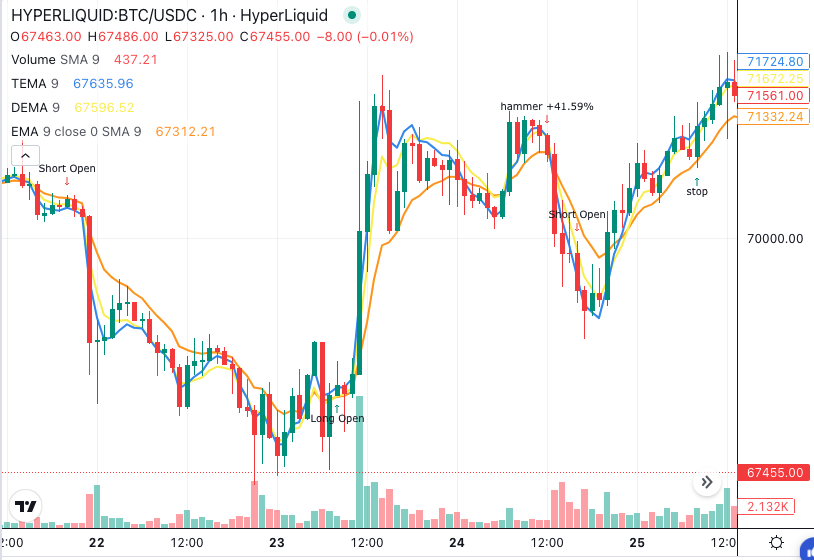
Triple Exponential Moving Average is a trend-following indicator that reduces the lag found in traditional moving averages by applying a unique triple-smoothing calculation. Developed by Patrick Mulloy in 1994, TEMA responds faster to price changes than a standard EMA or even a Double Exponential Moving Average (DEMA), making it a favourite among short-term and medium-term algorithmic traders.
What Is the Triple Exponential Moving Average?
Triple Exponential Moving Average is a smoothed trend indicator that combines three layers of exponential moving averages to dramatically reduce the delay between price action and the indicator’s response. Unlike a simple or exponential moving average, TEMA does not just average prices — it actively compensates for lag by subtracting out the slower-reacting components.
The result is a line that hugs price more closely during trending markets, giving traders earlier entry and exit signals. TEMA works on any timeframe and any asset, though its speed advantage is most valuable in fast-moving markets like crypto, where a few candles of lag can mean the difference between catching a move and chasing it.
Patrick Mulloy first introduced the Triple Exponential Moving Average in Technical Analysis of Stocks and Commodities magazine as a way to solve the persistent problem of moving average lag without sacrificing smoothness.
How Is the Triple Exponential Moving Average Calculated?
The Triple Exponential Moving Average calculation involves three steps, each building on the previous one. No programming is needed — Arrow Algo handles this automatically — but understanding the logic helps you use it effectively.
First, calculate a standard EMA of the closing price over your chosen period. Call this EMA1. Second, calculate an EMA of EMA1 using the same period. Call this EMA2. Third, calculate an EMA of EMA2. Call this EMA3.
The final TEMA value combines all three: TEMA = (3 × EMA1) − (3 × EMA2) + EMA3.
This formula works because subtracting the double-smoothed and adding the triple-smoothed values cancels out much of the inherent lag. The result tracks price turns more quickly than any single EMA while still filtering out minor noise. Common period settings range from 10 to 30, with shorter periods suited to scalping and longer periods better for swing strategies.
How to Read Triple Exponential Moving Average Signals?
Reading TEMA signals follows the same core principles as other moving averages, but the reduced lag means signals arrive earlier — and require slightly different interpretation.
Trend direction: When price sits above the TEMA line, the short-term trend is bullish. When price drops below TEMA, momentum has shifted bearish. Because TEMA reacts faster, these crossovers happen sooner than they would with an EMA or SMA of the same period.
Slope as momentum gauge: A steeply rising TEMA signals strong buying pressure. A flattening TEMA warns that momentum is fading even if price has not yet reversed. This slope change often precedes a reversal by several candles.
Dual TEMA crossovers: Using a fast TEMA (e.g. 10-period) and a slow TEMA (e.g. 30-period) creates a crossover system. When the fast TEMA crosses above the slow TEMA, it generates a bullish signal. A cross below generates a bearish signal. These crossovers are more responsive than traditional EMA crosses.
Dynamic support and resistance: In trending markets, price often bounces off the TEMA line as if it were a moving support or resistance level. Algorithmic traders use these touches as re-entry points within an established trend.
What Are the Best Triple Exponential Moving Average Trading Strategies?
TEMA trend-following strategy: Enter long when price closes above a 20-period TEMA and the TEMA slope is positive. Exit when price closes below TEMA or the slope turns negative. This approach captures the meat of trends while exiting before deep pullbacks. Pair it with ATR-based stops for consistent risk management.
TEMA crossover system: Use a 10-period and 30-period TEMA. Go long when the fast TEMA crosses above the slow TEMA and the price is above both lines. Go short when the fast TEMA crosses below. Adding a volume filter — only taking signals when volume exceeds its 20-period average — helps avoid false crosses during choppy markets.
TEMA pullback re-entry: During a confirmed uptrend (price above 50-period TEMA), wait for price to pull back and touch the 20-period TEMA, then enter long on the next bullish candle. This strategy captures swing entries within the larger trend and works especially well on 4-hour and daily timeframes.
What Are Common Triple Exponential Moving Average Mistakes to Avoid?
Using TEMA alone in ranging markets: TEMA excels in trends but generates frequent false signals during sideways consolidation. Always pair it with a range filter like ADX or Bollinger Band width to avoid whipsaws.
Setting the period too short: While TEMA already reduces lag, using very short periods (below 8) makes it overly sensitive and indistinguishable from raw price. A period of 10 to 30 typically balances speed and reliability.
Ignoring the broader trend: A TEMA buy signal on a 15-minute chart means little if the daily trend is firmly bearish. Always check the higher timeframe direction before acting on TEMA signals from shorter intervals.
Confusing TEMA with TRIX: Despite similar names, TEMA and TRIX measure different things. TEMA is a smoothed price line. TRIX measures the rate of change of a triple-smoothed EMA and oscillates around zero. Make sure you are using the correct block in your strategy builder.
How to Build Triple Exponential Moving Average Strategies in Arrow Algo?
Arrow Algo’s visual block builder includes a dedicated TEMA indicator block that handles all the triple-smoothing calculations automatically. Simply drag the TEMA block onto your canvas, connect it to your preferred data watcher, and set your desired period.
For a crossover system, add two TEMA blocks with different periods and connect their outputs to a condition block that compares them. The condition block fires a signal whenever the fast TEMA crosses above or below the slow TEMA, which you can route directly to a buy or sell action.
You can backtest your TEMA strategy against live historical exchange data to see exactly how it would have performed — no guesswork, no spreadsheets. Adjust the period, add filters, and iterate until you find settings that match your risk tolerance and trading style.
What Are the Key Takeaways?
- Triple Exponential Moving Average reduces lag by combining three layers of exponential smoothing into one responsive line
- TEMA works best in trending markets — pair it with a range filter like ADX to avoid false signals during consolidation
- Common strategies include trend direction, dual TEMA crossovers, and pullback re-entries within established trends
- Periods between 10 and 30 suit most trading styles, with shorter periods for scalping and longer ones for swing trading
- Always confirm TEMA signals with higher timeframe analysis and volume to improve reliability
- Arrow Algo’s no-code builder lets you add TEMA to any strategy with a simple drag-and-drop block
Educational disclaimer: This content is for educational purposes only and does not constitute financial advice. Trading involves significant risk and you should only trade with capital you can afford to lose. Past performance is not indicative of future results.
Disclaimer: The information provided in this article is for educational purposes only and does not constitute financial advice. Trading involves significant risk and you should only trade with capital you can afford to lose. Past performance is not indicative of future results. Always conduct your own research before making any trading decisions.
Ready to build your own automated trading strategies without writing a single line of code? Start for free at Arrow Algo and join thousands of traders who’ve made the switch to systematic trading.