
Zero-Lag Exponential Moving Average (ZLEMA): Complete Guide for Algorithmic Trading
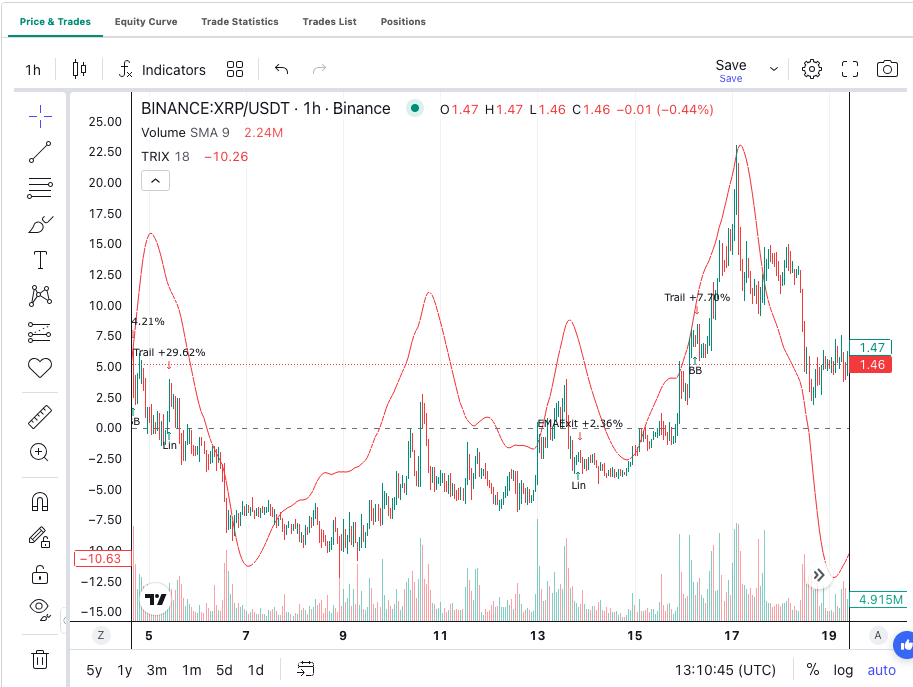
The Zero-Lag Exponential Moving Average (ZLEMA) solves one of the most persistent problems in technical analysis: the lag that makes standard moving averages slow to react to price changes. Developed by John Ehlers and Rick Way, the Zero-Lag Exponential Moving Average corrects the built-in delay of conventional EMAs, producing a smoother, faster-reacting trend line that stays closer to live price action.
What Is the Zero-Lag Exponential Moving Average?
The Zero-Lag Exponential Moving Average is a trend-following indicator that removes the time delay inherent in standard exponential moving averages. A standard EMA always trails price. The longer the period, the greater the lag. That lag causes late signals — you see the trend after it has already moved.
ZLEMA corrects this by projecting the price forward using recent momentum data before applying the smoothing formula. The result is a moving average that responds to price changes earlier than a conventional EMA of the same period. Because the Zero-Lag Exponential Moving Average stays closer to current price, it generates earlier entry and exit signals — a significant advantage in fast-moving markets.
How Is the ZLEMA Calculated?
The ZLEMA calculation uses three steps. No formulas to memorise — understanding the logic is enough to apply it effectively.
Step 1: Calculate the lag. Take the chosen period, subtract one, and divide by two. For a 14-period ZLEMA, the lag equals (14 − 1) ÷ 2 = 6.5, which rounds to 6 periods.
Step 2: Build an adjusted price. Take the current closing price and add the difference between today’s close and the close from 6 periods ago. This adjusted price compensates for the delay that a standard EMA would otherwise introduce. It effectively shifts the data forward in time.
Step 3: Apply an EMA to the adjusted price. Run a standard exponential moving average on the adjusted price input. The EMA smooths the data, but the lag correction from step 2 ensures the output stays close to current price action.
This process explains why ZLEMA behaves differently from a standard EMA. It does not simply speed up the calculation — it corrects for the structural lag before any smoothing begins.
How to Read ZLEMA Signals?
ZLEMA signals follow the same logic as standard EMA signals, but react much faster.
When price trades above the Zero-Lag Exponential Moving Average, the market shows an uptrend bias. When price trades below it, the bias shifts to the downside. A crossover — when price moves from below to above the ZLEMA — signals a potential long entry. A cross from above to below signals a potential exit or short entry.
The slope of the ZLEMA carries additional information. A steeply rising ZLEMA confirms strong upward trend momentum. A flattening ZLEMA warns that the trend is losing energy. A declining ZLEMA confirms downward pressure.
Two key thresholds apply in practice. When the Zero-Lag Exponential Moving Average sits well above recent price, the asset may be overextended to the downside and due for a bounce. When ZLEMA sits well below recent price, the asset may be overextended to the upside. These extremes help systematic traders avoid chasing moves late.
What Are the Best ZLEMA Trading Strategies?
Three ZLEMA strategies work well for systematic traders.
ZLEMA trend crossover. Use the Zero-Lag Exponential Moving Average as a dynamic support and resistance line. Enter long when price crosses above the ZLEMA with confirming volume. Exit when price crosses back below. This works best on higher timeframes — four-hour or daily charts — where noise is lower and trend signals are more reliable.
Dual ZLEMA crossover. Use two ZLEMAs with different periods, such as 10 and 30. When the shorter-period ZLEMA crosses above the longer-period ZLEMA, enter long. When the shorter crosses below the longer, exit or reverse. This approach filters out noise by requiring two moving averages to confirm a trend shift before signalling entry.
ZLEMA with RSI confirmation. Combine ZLEMA crossovers with the RSI — the Relative Strength Index, a momentum indicator that measures how fast price moves relative to recent history. Only take long ZLEMA signals when RSI sits above 50. Only take short ZLEMA signals when RSI sits below 50. This filter removes many low-quality signals in choppy, trendless markets.
What Are Common ZLEMA Mistakes to Avoid?
Four mistakes recur when algorithmic traders first use the Zero-Lag Exponential Moving Average.
Using ZLEMA in sideways markets. Because the Zero-Lag Exponential Moving Average reacts fast, choppy horizontal price action generates rapid back-and-forth crossovers. Those false signals stack up losses quickly. Always confirm a defined trend direction before applying ZLEMA entry rules.
Choosing too short a period. A 5-period ZLEMA is extremely sensitive to short-term noise. Frequent whipsaws make holding positions nearly impossible. Most systematic traders find settings between 14 and 21 periods more reliable for swing and position trading.
Ignoring volume. A ZLEMA crossover without supporting volume often fails to follow through. Volume confirms that real buying or selling pressure sits behind the move. Always cross-reference volume before committing to a signal.
Running ZLEMA in isolation. No single indicator tells the full picture. Pair the Zero-Lag Exponential Moving Average with at least one momentum or volume indicator for stronger confirmation before entering a position.
How to Build ZLEMA Strategies in Arrow Algo?
Arrow Algo’s visual block builder makes it straightforward to build and test Zero-Lag Exponential Moving Average strategies without writing a single line of code.
Drag the ZLEMA block from the indicators library onto your strategy canvas. Set the period using the visual input — adjust it and watch the line update on your chart in real time. Add the crossover logic block to define your entry condition. Connect a position block to set entry size and direction.
For a dual ZLEMA strategy, add a second ZLEMA block with a longer period. Connect both outputs to a crossover condition block. The canvas shows exactly how the two lines interact before you run a single backtest.
Arrow Algo pulls live historical data directly from exchanges like Binance, Coinbase, and HyperLiquid. Your backtest runs on the exchange’s own data — not a third-party dataset. Define your logic visually, backtest on real historical data, and deploy when your strategy is ready.
Explore how ZLEMA pairs with other trend-following tools in the Linear Regression guide, or start building at Arrow Algo today.
What Are the Key Takeaways?
- The Zero-Lag Exponential Moving Average corrects the built-in lag found in standard EMAs
- ZLEMA reacts faster to price changes — an advantage in trending markets, a risk in sideways conditions
- Use the Zero-Lag Exponential Moving Average on higher timeframes to reduce noise-driven false signals
- Combine ZLEMA with RSI or a second longer-period ZLEMA for stronger entry confirmation
- Always confirm volume before acting on a ZLEMA crossover signal
- Build, configure, and backtest Zero-Lag Exponential Moving Average strategies visually in Arrow Algo — no coding required
Educational disclaimer: This content is for educational purposes only and does not constitute financial advice. Trading involves significant risk and you should only trade with capital you can afford to lose. Past performance is not indicative of future results.
Disclaimer: The information provided in this article is for educational purposes only and does not constitute financial advice. Trading involves significant risk and you should only trade with capital you can afford to lose. Past performance is not indicative of future results. Always conduct your own research before making any trading decisions.
Ready to build your own automated trading strategies without writing a single line of code? Start for free at Arrow Algo and join thousands of traders who’ve made the switch to systematic trading.