
Aroon Crossover Strategy: How to Build It in Arrow Algo
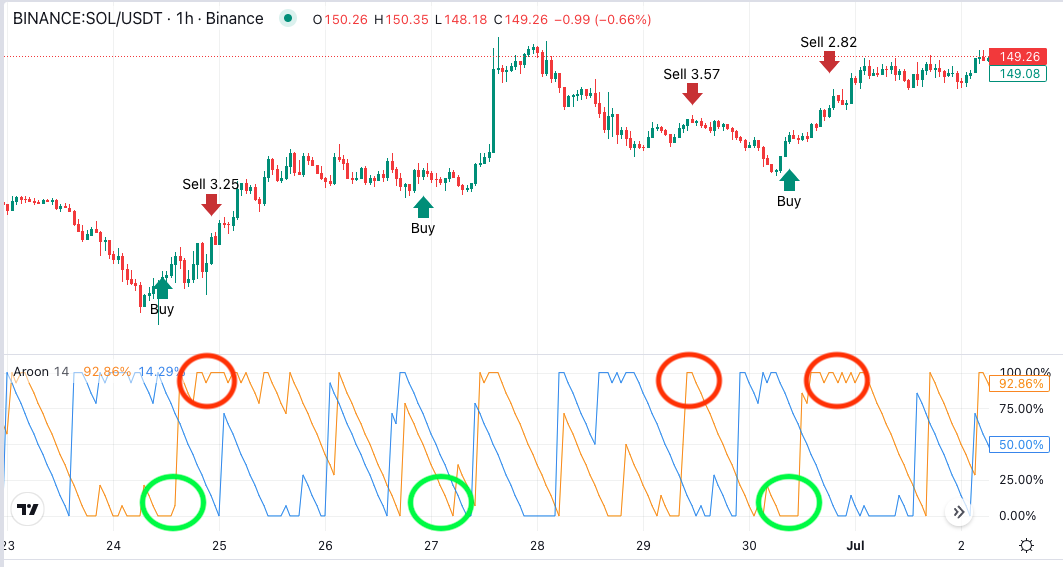
An Aroon crossover strategy answers a question most indicators never ask directly: how long ago did the market last make a new high? Tushar Chande built the Aroon indicator in 1995 around exactly that measurement — not how far price moved, but how recently it achieved an extreme. When the up-line crosses above the down-line, fresh highs have become more recent than fresh lows, and a trend may be starting. It is one of the simplest trend-detection mechanisms in the toolkit, and one of the most literal.
What Is an Aroon Crossover Strategy?
The Aroon indicator plots two lines, each scaled 0-100. Aroon Up measures how recently the highest high of the lookback window occurred; Aroon Down does the same for the lowest low. A reading of 100 means the extreme happened this bar; near 0, it happened at the far edge of the window. An Aroon crossover strategy trades the moment Aroon Up crosses above Aroon Down — new highs are now fresher than new lows — and exits or reverses on the opposite cross.
How Do the Two Lines Work?
With the standard 25-period setting, per Investopedia, Aroon Up asks: how many bars since the highest high of the last 25? Zero bars ago scores 100; twenty-five bars ago scores 0. In plain English, the lines are freshness meters. An uptrend keeps making new highs, so Aroon Up stays pinned near 100 while Aroon Down decays toward zero. A range lets both lines sag into the middle. That sagging is itself a signal: both lines below 50 means neither highs nor lows are fresh — the market is going nowhere.
Reading the Signals
- Up crosses above Down: the bullish crossover — recent price action has shifted toward new highs.
- Up above 70, Down below 30: an established, healthy uptrend.
- Both lines mid-range: consolidation — trend systems should stand down.
- Down crosses above Up: the trend has flipped; lows are now fresher than highs.
Two Aroon Strategies to Build
The Filtered Crossover
- Entry: Aroon Up crosses above Aroon Down while price is above its 200-period EMA.
- Exit: the opposite crossover, or a trailing stop.
- Character: classic trend following — comparable to a MACD crossover system, but built on recency of extremes rather than average momentum.
The Strength-Confirmed Entry
- Entry: crossover plus Aroon Up above 70 — the market isn’t just crossing, it is actively printing fresh highs.
- Exit: Aroon Up falling below 50 (highs going stale), or the opposite cross.
- Character: fewer, stronger signals. The 70 threshold filters the weak crossovers that happen when both lines drift through mid-range chop.
Building It in Arrow Algo
- Add an Aroon block and connect your candle feed — the period is an editable property, and the block outputs both lines.
- Use a crossover block on the Up and Down outputs for the entry signal.
- Add condition blocks for the 200 EMA price filter, and the Aroon Up > 70 strength check for the confirmed variant.
- Route the opposite crossover — or Aroon Up dropping below 50 — to your exit.
- Backtest on Binance, Coinbase, or HyperLiquid data. Compare both variants’ trade counts: the strength filter should cut the whipsaw trades without giving up much trend capture.
What Are the Common Mistakes?
- Trading mid-range crossovers. When both lines are sagging around 30-50, crossovers are noise. The strength threshold — or a regime filter — exists precisely for this.
- Confusing Aroon with momentum. Aroon measures recency, not magnitude. A one-tick new high scores 100 exactly like a massive breakout. Pair it with a volume or volatility check when magnitude matters.
- Short lookbacks in crypto chop. Aroon(10) on noisy pairs flips constantly. The standard 25 is the sensible floor for most timeframes.
- Ignoring the oscillator variant. Aroon Up minus Aroon Down compresses both lines into one signal around zero — sometimes cleaner to build with. Our Aroon Oscillator guide covers it.
The Essentials
- An Aroon crossover strategy trades the freshness of extremes: new highs recent, new lows stale — go long.
- Both lines mid-range is a built-in chop detector — stand down when nothing is fresh.
- Filter crossovers with the 200 EMA and the Aroon Up > 70 strength check.
- Aroon measures when extremes happened, never how big they were.
- Arrow Algo’s Aroon block outputs both lines for drag-and-drop rules — see the full Aroon guide for the indicator’s background.
Disclaimer: This content is for educational purposes only and does not constitute financial advice. Trading involves significant risk and you should only trade with capital you can afford to lose. Past performance is not indicative of future results. Always conduct your own research before making any trading decisions.
Ready to build your own automated trading strategies without writing a single line of code? Start for free at Arrow Algo and join thousands of traders who’ve made the switch to systematic trading.