
Awesome Oscillator Strategy: How to Build It in Arrow Algo
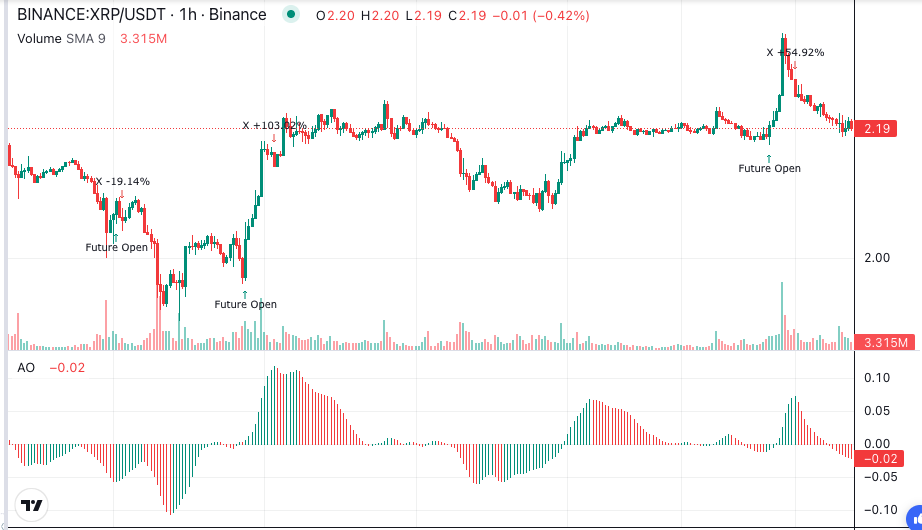
An Awesome Oscillator strategy measures the tug-of-war between recent momentum and the longer trend using nothing but two moving averages of the candle midpoint. Bill Williams named it immodestly, but the design is genuinely elegant: a histogram that swings around zero, showing whether short-term drive is gaining on or falling behind the market’s broader push. Three classic setups — the zero cross, the saucer, and twin peaks — turn that histogram into tradeable rules.
What Is an Awesome Oscillator Strategy?
The Awesome Oscillator (AO) subtracts a 34-period simple moving average from a 5-period one — both calculated on candle midpoints, the average of each bar’s high and low. The result plots as a histogram around a zero line. Above zero, recent momentum leads the longer trend; below zero, it lags. An Awesome Oscillator strategy trades the transitions: crossings of the zero line, and specific bar patterns that signal momentum turning before the line is crossed.
Using midpoints instead of closes is the quiet differentiator. It smooths out close-only noise and makes the AO read the whole bar’s positioning, which is why its signals differ from the MACD’s despite the similar construction.
What Do the Three Classic Signals Mean?
- Zero-line cross: the 5-period average overtakes the 34-period — momentum has flipped sides. The simplest and slowest signal.
- The saucer: with AO above zero, two falling histogram bars followed by a rising one — a momentum dip inside an uptrend ending. An early continuation entry.
- Twin peaks: below zero, two troughs where the second is shallower than the first, followed by a rising bar — selling pressure weakening before any zero cross, per Investopedia.
Two Awesome Oscillator Strategies to Build
The Filtered Zero Cross
- Entry: AO crosses above zero while price trades above its 200-period EMA.
- Exit: AO crossing back below zero, or a trailing stop.
- Character: slow and robust. It misses the first leg of moves but avoids most chop — momentum confirmation, not prediction.
The Saucer Continuation
- Setup: AO above zero (uptrend momentum established).
- Entry: two consecutive falling AO bars followed by one rising bar — the dip has resolved upward.
- Stop: below the recent swing low. Exit: AO crossing below zero or a fixed target.
- Character: earlier and more frequent than zero crosses — buying momentum pauses inside established trends.
Building It in Arrow Algo
- Add an Awesome Oscillator block and connect your candle feed.
- Use a crossover block on the AO output and a zero constant for the flip signal.
- Add an EMA block (200) with a condition block as the trend filter.
- For the saucer, use Lag blocks to compare the AO’s last three values — two decreasing then one increasing, all above zero — combined through condition blocks.
- Backtest both on Binance, Coinbase, or HyperLiquid data. Count the trades: the saucer fires far more often, so fees matter more to it.
What Are the Common Mistakes?
- Trading naked zero crosses. In ranging markets the AO oscillates across zero constantly. Without a trend filter, the flip signal is a chop detector that pays to be wrong.
- Confusing AO with MACD. No signal line, midpoints instead of closes, fixed 5/34 periods — the rules don’t transfer one-to-one.
- Taking every saucer. Saucers barely above zero are weak; the pattern works best when AO is clearly positive.
- Low-timeframe noise. Midpoint smoothing helps, but 1-minute crypto bars still overwhelm it. The AO earns its keep on 1-hour and above.
What Matters Most?
- An Awesome Oscillator strategy trades momentum transitions: zero crosses for trend flips, saucers and twin peaks for earlier turns.
- Midpoint-based smoothing makes AO steadier than close-based oscillators.
- Filter zero crosses with the larger trend; trade saucers only when AO is firmly positive.
- The AO is a momentum confirmer — pair it with structure, don’t trade it alone.
- Arrow Algo’s AO block plus Lag blocks make even the three-bar saucer pattern fully mechanical — see the complete Awesome Oscillator guide for the full background.
Disclaimer: This content is for educational purposes only and does not constitute financial advice. Trading involves significant risk and you should only trade with capital you can afford to lose. Past performance is not indicative of future results. Always conduct your own research before making any trading decisions.
Ready to build your own automated trading strategies without writing a single line of code? Start for free at Arrow Algo and join thousands of traders who’ve made the switch to systematic trading.