
Candle Close Confirmation: Why Your Algo Should Wait
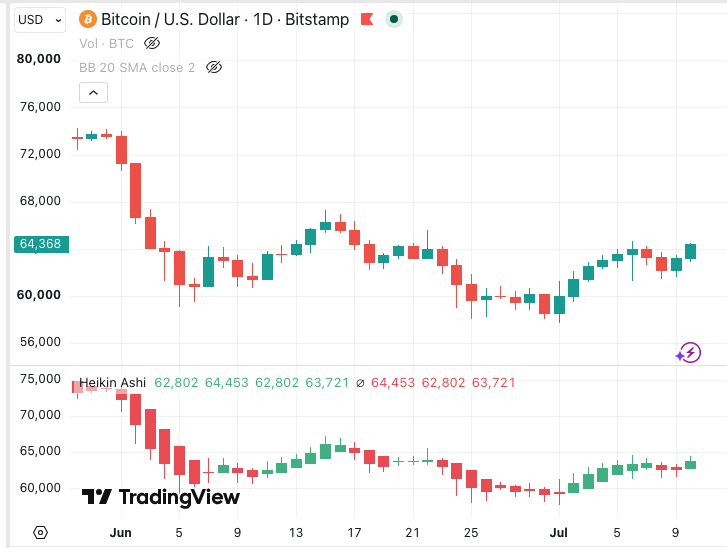
Candle close confirmation is the rule that a signal only counts once the candle that produced it has finished. It sounds like a detail. It is one of the biggest differences between a strategy that behaves live the way it did in the backtest and one that does not. This morning’s Bitcoin move is a good example. Price dropped to $81,034 overnight and recovered the whole fall within hours. An intrabar rule saw a breakdown. A close-based rule saw a wick. This post explains the difference, when each approach is right, and how to build the choice into a strategy without code.
What Is Candle Close Confirmation?
Candle close confirmation means a strategy evaluates its rules only on completed candles. On a 1-hour chart, the rules run once an hour, at the close. Between closes, nothing happens. Whatever price does inside the hour is invisible to the strategy until the candle finishes.
The alternative is an intrabar signal. The strategy watches live ticks and acts the moment a condition is true. If the rule is “buy when price crosses above the 20-period moving average”, an intrabar version buys at the first tick above the line. A close-based version waits to see whether price is still above it when the candle ends.
Every candlestick has four values: open, high, low and close. Only the close is final. The other three are still moving until the candle shuts. That is the whole issue.
Why Candle Close Confirmation Matters
Indicators are calculated from candle values. While a candle is open, its close is provisional. It is whatever the last traded price happens to be. That means every indicator reading on the current candle is provisional too. The RSI at 10:37 on a 1-hour chart is not the RSI. It is a guess at what the RSI will be at 11:00.
A rule evaluated on that provisional reading can fire and then un-fire. Price pokes above the moving average, the rule triggers, price falls back, and by the close the condition was never true. The chart shows no signal. The account shows a trade.
This is the intrabar version of repainting. The signal painted itself on the chart and then removed itself. The trade stayed. Our post on look-ahead bias covered the backtest side of this problem. The live side is the same mechanism in reverse.
What Goes Wrong With Intrabar Signals?
The backtest tested a different strategy
Backtests run on historical candles, and historical candles are all closed. The backtester saw a signal only where the close confirmed it. A live strategy acting intrabar fires on every provisional signal, including the ones that would have vanished. Those extra trades were never tested. The live results will not match, and the reason will be hard to see, because the rules look identical.
Whipsaws multiply
Price crosses a level several times inside a volatile candle more often than it closes across it. An intrabar rule trades every cross. On a breakout strategy that can mean three entries and three stops inside one hour. The whipsaw cost of intrabar rules is the most common reason a strategy that backtested well bleeds live.
Stop hunts work on you
A wick through a level is the signature of a stop hunt. Price spikes through, triggers resting orders, and reverses. Intrabar entries place you on the wrong side of exactly that move. Close-based entries ignore the wick unless the candle finishes beyond the level, which a stop hunt rarely does.
When Is an Intrabar Entry Worth the Risk?
Close confirmation costs time. On a daily chart, waiting for the close can mean entering a breakout 3% above the level. Sometimes that is too much. Three cases justify acting inside the candle.
Protective stops. A stop-loss should fire the moment price hits it. Waiting for the close to confirm a stop turns a 2% loss into whatever the candle decides. Entries wait. Stops do not. This is the one rule most systematic traders agree on.
Large timeframes with a smaller confirmation. If the strategy runs on the daily chart, the compromise is to confirm on a 4-hour or 1-hour close. Price has to close above the daily level on the lower timeframe. That is still a close, so it is still final. It just arrives sooner.
Volume-confirmed breakouts. If a breakout comes with volume far above average, the chance of a reversal inside the candle is lower. Some traders act intrabar only when volume is already above its full-candle average with most of the candle left. Even then, the false breakout rate is higher than for close-based entries.
How Does Timeframe Change the Trade-off?
On a 1-minute chart the close is seconds away. Waiting for it costs almost nothing in price. Close confirmation is nearly free, and the noise reduction is large. There is no good argument for intrabar rules on fast charts.
On a 1-hour chart, the wait can cost a fraction of a percent on a fast move. That is still usually less than the cost of the whipsaws it avoids.
On the daily chart the maths changes. A full day’s move can be 5% in crypto. Waiting for it to finish before entering is expensive. This is where the lower-timeframe confirmation earns its place. The signal is defined on the daily candle. The trigger is a 4-hour close. The strategy gets most of the noise filtering and a quarter of the delay.
The rule of thumb: the larger the candle, the more a lower-timeframe close confirmation is worth considering. The smaller the candle, the less reason there is to ever act inside it.
How to Apply Candle Close Confirmation in Arrow Algo
Arrow Algo strategies are built from blocks that read candle values, and backtests run on completed candles. Keeping the live strategy consistent with that is a design choice you make on the canvas.
Build every entry condition on the close output, not on the high or low. A condition that the close is above the upper band only becomes true when a candle finishes above it. A condition on the high becomes true on a wick.
For a confirmation delay, add a Lag block. Require the condition to be true on the current candle and the lagged one. Two consecutive closes is a stronger filter than one, and it costs one extra candle.
For a daily signal with a faster trigger, run the strategy on the 4-hour chart and use a higher-timeframe block to pull in the daily level. The entry condition is then a 4-hour close above a daily value. That is the compromise described above, built without code.
Keep stops on the order block, not in the signal logic. The stop-loss setting on the order fires at the price, not at the close. That is the behaviour you want from a protective exit.
Then backtest the close-based version against the intrabar-style version, built with conditions on the high and low. The difference in trade count tells you how many provisional signals the close rule is filtering out.
What Are the Key Takeaways?
- Only the close of a candle is final. Every indicator reading on an open candle is provisional.
- Intrabar signals can fire and un-fire. The trade stays. The backtest never saw it.
- Close confirmation cuts whipsaws and sidesteps stop hunts at the cost of one candle of delay.
- Stops are the exception. Protective exits should fire at the price, not the close.
- On large timeframes, confirm on a lower-timeframe close rather than acting intrabar.
- In Arrow Algo, build conditions on the close output, add a Lag block for a two-candle confirmation, and keep stops on the order block.
Disclaimer: This content is for educational purposes only and does not constitute financial advice. Trading involves significant risk and you should only trade with capital you can afford to lose. Past performance is not indicative of future results. Always conduct your own research before making any trading decisions.
Ready to build your own automated trading strategies without writing a single line of code? Start for free at Arrow Algo and join thousands of traders who've made the switch to systematic trading.