
Claude Code vs Codex vs Grok Build for Algo Traders
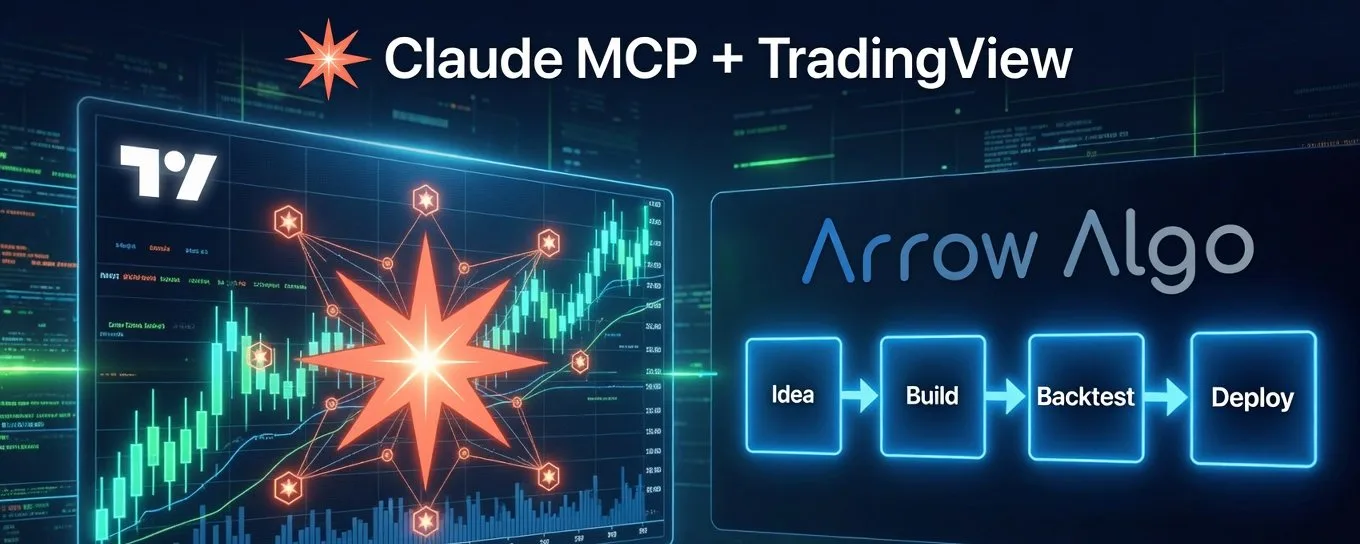
Claude Code vs Codex vs Grok Build is a different question from Claude vs ChatGPT vs Grok. The chat assistants answer when you ask. These three are terminal agents. Give one a goal, and it plans, acts, checks the result and acts again until it decides the job is done. Connected to Arrow Algo, that loop becomes build, backtest, read the report, change one rule, backtest again.
That autonomy is the appeal and the risk. This guide compares the three agents on the parts of the loop that matter for strategy research. It reports documented features as of 28 October 2026. It does not report a controlled benchmark or name a winner on returns.
For the chat-assistant comparison, see our Claude vs ChatGPT vs Grok guide. That post’s shared strategy brief works here too.
What Is a Terminal Coding Agent?
A terminal coding agent is a program that runs in a command line, takes a goal in plain English and works toward it using tools. The tools include reading and editing files, running commands and, through the Model Context Protocol, calling external services.
Arrow Algo exposes its visual builder through an MCP endpoint at app.arrowalgo.com/mcp/. Once connected, an agent can read the block definitions, create a strategy as visual blocks, run a backtest on exchange data and fetch the results. Our MCP for traders guide explains the connection in full.
None of the three agents needs to write code to do this. The strategy they produce is the same drag-and-drop graph you would build by hand. You can open it, inspect every block and change any setting.
Why the Loop Matters More Than the Chat
A chat assistant builds a strategy and stops. You read the backtest, decide what to change and ask again. Each round is a decision you made.
An agent closes that loop itself. It reads the backtest and decides the next change without you. Ten iterations can happen in the time one chat round takes.
That speed is useful when the agent is fixing a misconfigured block or running a planned set of parameter tests. It is dangerous when the agent is free to chase a better number. Ten unsupervised tweaks against one backtest window is overfitting with a tireless assistant. Our backtest statistical significance guide covers why the tenth improvement is usually luck.
The comparison below is about which agent gives you the most control over that loop, not which is cleverest.
Claude Code vs Codex vs Grok Build: Connection and Controls
All three connect to remote MCP servers. All three have a plan-first mode. The differences are in how they handle approval, parallel work and access.
| Claude Code | Codex | Grok Build | |
|---|---|---|---|
| Maker | Anthropic | OpenAI | xAI |
| Remote MCP | Yes, with browser sign-in | Yes, with browser sign-in | Yes, advertised as working from an existing Claude Code setup |
| Plan before acting | Plan mode | Plan mode | Plan mode, with per-step comments |
| Parallel sub-agents | Yes | Limited | Up to eight, each in its own working copy |
| Default caution | Asks before actions outside its permissions | Sandboxed by default, asks to leave the sandbox | Plan approval, then runs |
| Access | Claude subscription or API | ChatGPT subscription or API | SuperGrok or X Premium+ |
Sources: Anthropic’s Claude Code MCP documentation, OpenAI’s Codex documentation and xAI’s Grok Build announcement. Grok Build launched on 14 May 2026 and states that MCP servers configured for Claude Code work without changes. Verify that claim with the Arrow Algo endpoint in your own account before relying on it.
Arrow Algo’s recorded setup walkthroughs are under Bring your own AI on the home page. The MCP endpoint is the same for all three agents.
What a Build-Test-Iterate Loop Looks Like
Give the agent a brief, a budget of iterations and a stopping rule. A workable sequence:
- Read the blocks. The agent fetches Arrow Algo’s block definitions so it uses real block names and inputs.
- Build. It creates the strategy as visual blocks from your brief and saves it without starting it.
- Backtest. It runs the test on the period you named with the fee and slippage settings you named.
- Read. It reports trade count, net return, maximum drawdown and the three largest losses.
- Propose. It names one change and the reason, then waits or proceeds depending on your settings.
- Repeat up to the iteration budget, then stop and summarise every version tested.
Step five is where the agents differ in practice. Claude Code and Codex will pause for approval if you ask them to. Grok Build’s plan mode lets you edit the plan before it starts, which suits a fixed set of tests you have already decided on.
Where Parallel Agents Help and Hurt
Grok Build’s eight parallel sub-agents can run eight parameter variants at once. Claude Code can do the same with its own sub-agents. That is useful for a planned grid, such as testing five lookback periods you chose in advance.
It is harmful when the parallel runs are a search for the best result. Eight variants tested is eight chances to find a lucky combination. The more tests an agent runs, the higher the bar a good result has to clear. Decide the variants before the run and keep a period the agent never sees.
Where Autonomous Loops Go Wrong
The agent changes rules you did not ask about. Asked to move the profit target from 4% to 3%, an agent may also tidy the stop or swap an indicator period. Compare the graph before and after every iteration.
The agent optimises the wrong thing. Told to improve the result, it will improve net return. That usually means a tighter fit to the test window. Give it a different target, such as fewer trades with the same return or a shorter longest drawdown.
The loop never ends. Without an iteration budget, an agent can run until it finds a number it likes. Set the budget before starting. Five iterations is plenty for a first pass.
The summary hides the path. An agent that reports the final result and not the twenty versions it discarded has shown you a survivor. Ask for every version and its result.
Which One Runs the Loop Best?
The honest answer is that the differences are in control, not capability. All three can build a correct strategy from a clear brief. All three can wander if the brief is loose.
Claude Code and Codex make it easiest to insert an approval step between iterations. That suits traders who want to see each change before it runs. Grok Build’s plan-and-run model suits a test set you have fully specified in advance, and its parallelism gets through that set fastest.
Run the same brief through whichever agents you have access to. Use the brief from our chat-assistant comparison with an added line: “Stop after five backtests and list every version.” Then judge the saved graphs, the change log and the explanation of one losing trade.
How to Apply This in Arrow Algo
Connect your chosen agent to the Arrow Algo MCP endpoint. Ask it to read the block definitions before building anything.
Write the brief as rules, not goals. “Buy after a completed candle crosses above RSI 30 with close above the 200 EMA” is a rule. “Make a profitable RSI strategy” is an invitation to overfit.
Every strategy the agent saves appears in your workspace as a visual block graph. Open it. Check the crossover direction, the sizing and the exits against the brief. Nothing goes live until you start it yourself. If you do, your rules send signals to your own exchange account. The exchange decides whether to accept and execute them.
What Are the Key Takeaways?
- Terminal agents close the build-test-iterate loop themselves. That is faster than chat and easier to overfit with.
- Claude Code, Codex and Grok Build all connect to Arrow Algo through the same MCP endpoint.
- The real difference is control. Approval between iterations, an iteration budget and a holdout period matter more than the model.
- Decide parameter variants before a parallel run. More tests raise the bar a result must clear.
- Review the saved visual blocks after every change, and ask for every version tested, not just the last.
Disclaimer: This content is for educational purposes only and does not constitute financial advice. Trading involves significant risk and you should only trade with capital you can afford to lose. Past performance is not indicative of future results. Always conduct your own research before making any trading decisions.
Ready to build your own automated trading strategies without writing a single line of code? Start for free at Arrow Algo and join thousands of traders who've made the switch to systematic trading.