
Commodity Channel Index (CCI): Complete Guide for Algorithmic Trading
Commodity Channel Index (CCI): A Comprehensive Guide for Algorithmic Traders
The Commodity Channel Index (CCI) is a versatile momentum oscillator that has become a staple in many traders’ toolkits since its introduction in 1980 by Donald Lambert. Originally developed for commodity markets, the CCI has proven its worth across various financial instruments, including stocks, forex, and cryptocurrencies. At its core, the CCI measures the current price level relative to an average price over a specified period. This allows traders to identify cyclical trends, overbought and oversold conditions, and potential trend reversals. The indicator’s ability to provide insights into both trend direction and strength makes it particularly valuable for algorithmic trading strategies. Algo traders appreciate the CCI for its quantifiable nature and its ability to generate clear, actionable signals. Whether you’re developing trend-following systems, mean-reversion strategies, or looking for breakout opportunities, the CCI offers a robust framework for decision-making in automated trading environments.
How It Works
Mathematical Formula
The CCI is calculated using the following formula: CCI = (Typical Price - Simple Moving Average) / (0.015 * Mean Deviation) Where: - Typical Price = (High + Low + Close) / 3 - Simple Moving Average (SMA) = Average of Typical Price over N periods - Mean Deviation = Average of absolute deviations from SMA
Calculation Process
- Calculate the Typical Price for each period
- Compute the N-period Simple Moving Average of the Typical Price
- For each period, calculate the absolute deviation from the SMA
- Calculate the Mean Deviation by averaging the absolute deviations
- Apply the formula to get the CCI value
Visual Appearance
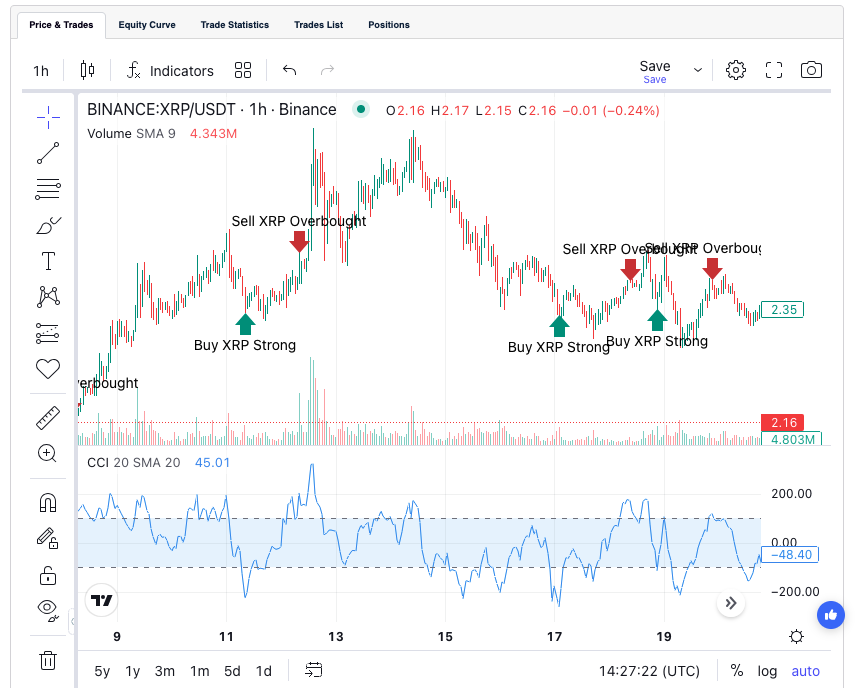
On charts, the CCI appears as a single line oscillating above and below a zero line. The indicator typically has overbought and oversold levels marked at +100 and -100, respectively. However, these levels can be adjusted based on the specific instrument or strategy requirements.
Key Parameters
The primary parameter for the CCI is the number of periods (N) used in the calculation. The default setting is often 20 periods, but this can be adjusted to make the indicator more or less sensitive to price movements.
What CCI Measures
The CCI essentially measures how far a security’s price has deviated from its statistical average. High positive values indicate that prices are well above their average (potentially overbought), while low negative values suggest prices are well below their average (potentially oversold).
Interpretation & Signals
Reading the Indicator
- CCI values above +100 indicate strong upward momentum
- CCI values below -100 suggest strong downward momentum
- CCI oscillating between -100 and +100 often indicates a ranging market
Common Trading Signals
Overbought/Oversold Reversals
- Buy when CCI moves from below -100 to above -100
- Sell when CCI moves from above +100 to below +100
Zero Line Crossovers
- Buy when CCI crosses above the zero line
- Sell when CCI crosses below the zero line
Trend Confirmation
- Uptrend confirmed when CCI remains predominantly above zero
- Downtrend confirmed when CCI stays mostly below zero
Divergences
Divergences occur when the price makes a new high or low, but the CCI fails to confirm: - Bullish Divergence: Price makes a lower low, but CCI makes a higher low - Bearish Divergence: Price makes a higher high, but CCI makes a lower high These divergences can signal potential trend reversals.
Signal Strength
The magnitude of CCI values can indicate signal strength: - Extreme readings (beyond ±200) suggest very strong momentum but increased reversal risk - Moderate readings (±100 to ±200) often indicate sustainable trends - Readings close to zero suggest weak or unclear momentum
Trading Strategies
1. CCI Trend-Following Strategy
This strategy aims to capture extended trends by entering on pullbacks. Entry Rules: - For long positions: CCI crosses above -100 during an established uptrend - For short positions: CCI crosses below +100 during an established downtrend Exit Rules: - For long positions: CCI crosses below +100 - For short positions: CCI crosses above -100 Timeframe: Daily charts for position trading, 4-hour charts for swing trading Market Conditions: Works best in trending markets with clear directional bias
2. CCI Mean Reversion Strategy
This strategy seeks to profit from price movements returning to an average. Entry Rules: - Buy when CCI drops below -200 and then crosses back above -200 - Sell when CCI rises above +200 and then crosses back below +200 Exit Rules: - Take profit when CCI crosses the zero line - Stop loss if CCI reaches ±300 Timeframe: 1-hour or 4-hour charts for intraday and swing trading Market Conditions: Most effective in ranging markets or during periods of consolidation
3. CCI Breakout Strategy
This strategy aims to capture strong momentum moves. Entry Rules: - Buy when CCI breaks above +100 with increasing volume - Sell when CCI breaks below -100 with increasing volume Exit Rules: - For long positions: CCI crosses below +100 - For short positions: CCI crosses above -100 - Use a trailing stop based on ATR (Average True Range) Timeframe: 15-minute or 1-hour charts for day trading, 4-hour for swing trading Market Conditions: Excels during periods of high volatility or at key support/resistance levels When Not to Use CCI: - During periods of extremely low volatility - In markets with no clear trend or range - When major news events are expected to cause erratic price movements
Implementation in Algo Trading
Integrating the CCI into algorithmic trading strategies requires careful consideration of several factors:
- Signal Generation: Define clear rules for interpreting CCI values and generating buy/sell signals. This might involve checking for specific crossovers, divergences, or extreme values.
- Confirmation: Consider using the CCI in conjunction with other indicators or price action patterns to confirm signals. For example, you might require a moving average crossover to confirm a CCI signal.
- Timeframe Alignment: Ensure that the CCI timeframe aligns with your overall strategy. Using multiple timeframes (e.g., a longer-term CCI for trend identification and a shorter-term CCI for entry timing) can provide a more robust approach.
- Dynamic Thresholds: Instead of fixed overbought/oversold levels, consider using dynamic thresholds based on recent CCI behavior or volatility measures.
- Backtesting Considerations: When backtesting CCI-based strategies, pay attention to:
- The impact of different period settings on performance: How the strategy performs in different market regimes
- The effect of transaction costs on high-frequency strategies
- Risk Management: Implement proper risk management rules, such as position sizing based on CCI signal strength or using adaptive stop-loss levels.
Common pitfalls to avoid: - Over-optimization: Avoid curve-fitting by testing your strategy on out-of-sample data - Ignoring context: The CCI should not be used in isolation; consider overall market conditions - Overtrading: Be cautious of generating too many signals in choppy markets Optimization tips: - Experiment with non-standard period settings (e.g., 14, 30, or 50) - Combine the CCI with volatility filters to adapt to changing market conditions - Use the CCI to adjust position sizes or risk parameters dynamically
Building with Arrow Algo’s Block Builder
Implementing CCI-based strategies using Arrow Algo’s NO-CODE block builder is straightforward and intuitive:
- Adding the Indicator: Simply drag and drop the CCI indicator block from the indicator library onto your strategy canvas.
- Configuring Parameters: Double-click the CCI block to open its settings. Here, you can visually adjust the number of periods and other parameters without writing any code.
- Creating Trading Logic: Use condition blocks to check CCI values or crossovers. For example, drag a “Condition” block and set it to “CCI crosses above -100” for a potential buy signal.
- Combining Indicators: Easily add other indicator blocks (e.g., Moving Averages) and connect them to your CCI conditions for more robust strategies.
- Setting Entry and Exit Rules: Use “Trade” blocks to define your entry and exit logic based on the conditions you’ve set up.
- Risk Management: Incorporate “Stop Loss” and “Take Profit” blocks, linking them to your CCI signals or other market conditions.
- Backtesting: Utilize Arrow Algo’s built-in backtesting tool to evaluate your strategy’s performance across different timeframes and market conditions.
The visual nature of the block builder allows you to quickly iterate on your ideas, testing various CCI configurations and combinations with other indicators – all without writing a single line of code.
Conclusion
The Commodity Channel Index (CCI) is a powerful tool for algorithmic traders, offering insights into trend strength, potential reversals, and overbought/oversold conditions. Its versatility allows for application across various markets and timeframes, making it a valuable component in many trading systems. Key takeaways for effective CCI implementation: - Use in conjunction with other indicators or price action for confirmation - Adapt CCI settings and thresholds to specific instruments and market conditions - Be aware of potential false signals, especially in choppy or low-volatility environments - Implement robust risk management alongside CCI signals As you incorporate the CCI into your algorithmic trading strategies, focus on developing a deep understanding of how it behaves across different market regimes. Continuously refine your approach based on backtesting results and live trading performance. Ready to build your own strategies using Commodity Channel Index (CCI)? Visit https://www.arrowalgo.com to start creating custom indicator-based strategies with Arrow Algo’s NO-CODE block builder platform.
Disclaimer: Algorithmic trading involves substantial risk. Past performance is not indicative of future results. This content is for educational purposes only and should not be considered financial advice. Always do your own research and consider consulting with a financial advisor before making trading decisions.
Educational disclaimer: This content is for educational purposes only and does not constitute financial advice. Trading involves significant risk and you should only trade with capital you can afford to lose. Past performance is not indicative of future results.