
Fair Value Gap Trading Strategy: How to Build It in Arrow Algo
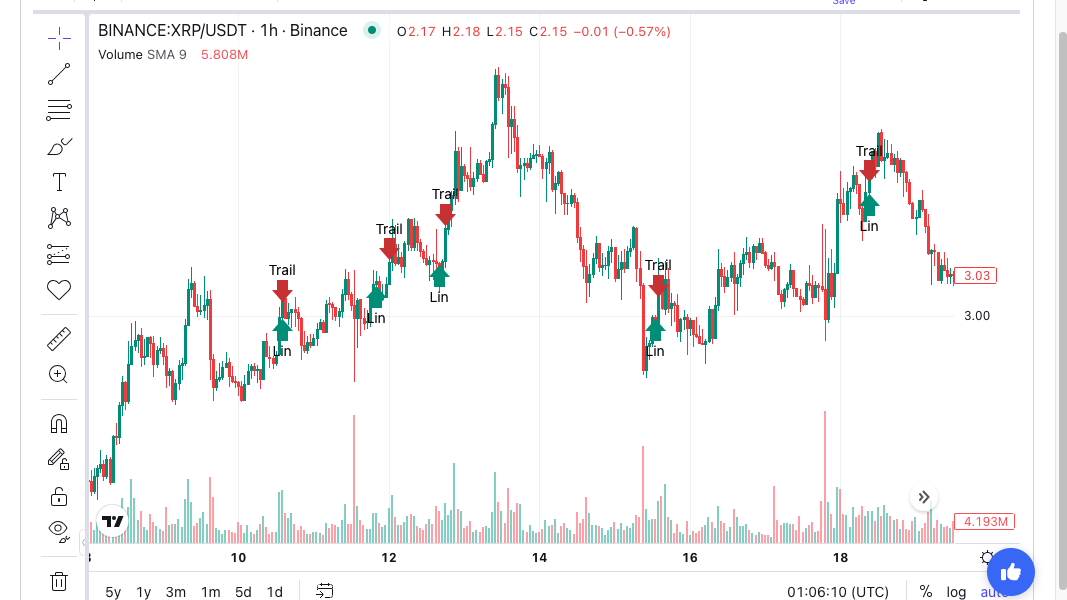
A fair value gap trading strategy trades the market’s tendency to revisit its own inefficiencies. When price moves so fast that one side of the book gets skipped entirely, it leaves a gap — a slice of the chart where almost no business was done. Markets have a habit of returning to these zones before continuing. The strategy waits for that return and trades the reaction.
How Does a Fair Value Gap Form?
The pattern needs three candles. In a bullish fair value gap, the middle candle is a large, aggressive move up. The gap is the space between the first candle’s high and the third candle’s low. If those two levels do not overlap, price effectively teleported through that zone. Buyers were so dominant that sellers never got a fair auction — hence the name.
A bearish fair value gap is the mirror image: a violent down candle leaves a void between the first candle’s low and the third candle’s high.
The mechanics matter because the gap represents an order imbalance. Resting orders in that zone never filled. When price rotates back into the gap, those unfilled interests — plus traders anticipating the fill — often produce a reaction. We covered the raw pattern in depth in our fair value gap complete guide. This post is about turning it into a strategy you can test.
Which Fair Value Gaps Deserve a Trade?
Most gaps are noise. Three qualifiers separate the tradeable ones.
Size first. A gap smaller than the market’s normal candle-to-candle wobble means nothing. Compare gap height to the Average True Range: a gap worth at least half an ATR reflects genuine displacement. Below that, skip it.
Trend alignment second. The highest-quality setups are continuation trades. In an uptrend, wait for price to retrace into a bullish gap and trade the bounce with the trend. Fading a strong trend because a bearish gap exists above is how fill-seekers get run over.
Freshness third. A gap works best on its first revisit. Once price has traded through a zone twice, the imbalance is spent. Old gaps from last month are chart decoration, not signals.
The Rule Set: Entry, Stop, and Target
The core sequence is mechanical. Detect a qualifying gap. Wait for price to trade back into it. Enter in the direction of the original impulse.
Where inside the gap do you enter?
Two common answers. The touch entry triggers the moment price enters the gap’s near edge — best price, most false starts. The midpoint entry waits for price to reach the 50% level of the gap, sometimes called consequent encroachment. Deeper fills tend to be more decisive: if the zone is going to hold, the midpoint is usually where it does. Backtest both against each other — the answer differs by pair and timeframe.
Managing the trade
The stop goes just beyond the far edge of the gap, with a small volatility buffer. A gap that fills completely and keeps going has invalidated the setup — there is nothing left to defend. Targets follow structure: the high or low the original impulse created is the natural first objective. Because the stop is the gap’s width plus a buffer, risk is tight and defined, and the reward-to-risk profile is naturally asymmetric.
What Trips Up Most Fair Value Gap Traders?
The classic error is treating every gap as a magnet that must be filled. Plenty of gaps never fill, and strong trends routinely leave a trail of unfilled gaps behind them. The fill is a tendency, not a law.
Counter-trend gap trading is the second trap. Shorting into a rally because a bearish gap sits overhead loses money in exactly the conditions where gaps form most often. Third, ranging markets stack small gaps in both directions, and a fair value gap trading strategy without a size filter will chop itself to pieces there. Finally, beware timeframe soup. A gap on the 1-minute chart is noise inside a 4-hour candle. Pick one timeframe for detection and stick to it.
How to Build a Fair Value Gap Strategy in Arrow Algo?
Arrow Algo has a dedicated Fair Value Gap block, so detection is automatic — no manual candle-counting, no subjective zones. Drop it onto the canvas and it flags active gaps from live exchange data.
The rest is standard drag-and-drop logic. A condition gate fires when price re-enters a detected gap. An ATR block enforces the minimum-size filter and sets the stop buffer beyond the far edge. An EMA or ADX block keeps entries aligned with the trend, so the strategy only buys bullish gap retests in uptrends. For confluence, combine the FVG block with our order block strategy logic — a gap that overlaps an order block is a stronger zone than either alone.
Then backtest on the exchange you actually trade — Binance, Coinbase, or HyperLiquid — using the exchange’s own historical data. Run touch entries against midpoint entries over a few hundred trades and let the numbers pick your entry rule.
Key Points to Remember
- A fair value gap is a three-candle imbalance: the void between candle one and candle three that a violent middle candle skipped.
- Filter by size (at least half an ATR), trend alignment, and freshness — most gaps fail at least one test.
- Enter on the retest, at the edge or the midpoint. Stop beyond the far edge. Target the impulse high or low.
- Gaps are a tendency, not a guarantee — strong trends leave unfilled gaps forever.
- A fair value gap trading strategy needs a trend filter, or ranging markets will bleed it dry.
- Arrow Algo’s FVG block automates detection, so the whole system builds without code.
Disclaimer: This content is for educational purposes only and does not constitute financial advice. Trading involves significant risk and you should only trade with capital you can afford to lose. Past performance is not indicative of future results. Always conduct your own research before making any trading decisions.
Ready to build your own automated trading strategies without writing a single line of code? Start for free at Arrow Algo and join thousands of traders who’ve made the switch to systematic trading.