
Fisher Transform: Complete Guide for Algorithmic Trading
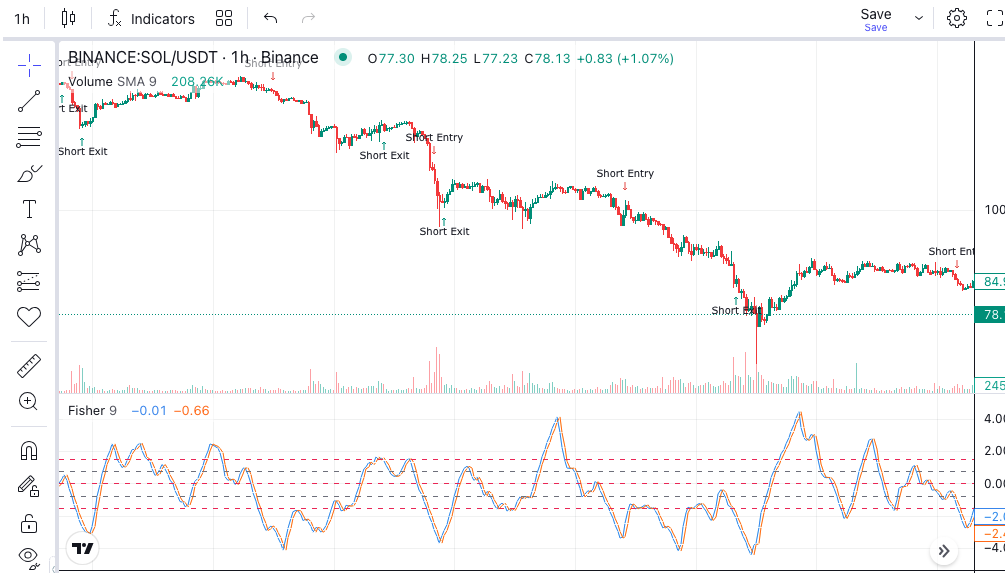
The Fisher Transform is one of the most underrated tools in an algorithmic trader’s toolkit, offering a unique way to identify turning points in price action before they become obvious on a chart. Developed by John Ehlers, a pioneer in digital signal processing for financial markets, this indicator converts price data into a near-Gaussian probability distribution — making overbought and oversold conditions dramatically easier to spot. In this guide, we’ll break down exactly how the Fisher Transform works, how to interpret its signals, and how to build automated strategies around it using a no-code visual block builder.
What Is the Fisher Transform?
The Fisher Transform is a momentum oscillator that converts price data into a Gaussian normal distribution, producing sharp and distinct turning points that help traders identify trend reversals. Unlike many traditional oscillators that produce rounded, gradual peaks and troughs, the Fisher Transform generates pointed, exaggerated signals that are easier to act on systematically.
The indicator was introduced by John Ehlers in his 2002 paper and later expanded in his book Cybernetic Analysis for Stocks and Futures. Ehlers observed that most price data does not follow a normal distribution, which makes standard statistical methods unreliable. By applying the Fisher Transform, prices are mathematically normalised so that extreme values become rare and statistically meaningful — giving traders a clearer view of when a move has truly overextended.
The result is an unbounded oscillator that swings above and below a zero line, accompanied by a signal line (the previous period’s value) that generates crossover signals similar to other momentum tools like RSI.
How Is the Fisher Transform Calculated?
The Fisher Transform calculation happens in two stages. First, the price is normalised into a range between -1 and +1. Then, the Fisher formula is applied to stretch that normalised value into a Gaussian distribution.
Step 1 — Normalise the price: Take the midpoint of each candle (the average of the high and low). Then, over a chosen lookback period (typically 9 or 10 candles), find the highest high and lowest low. The normalised value places the current midpoint within that range, scaled to sit between -1 and +1. A value near +1 means price is at the top of its recent range; near -1 means it is at the bottom.
Step 2 — Apply the Fisher formula: The normalised value is fed into the Fisher Transform equation, which uses a natural logarithm to amplify values near the extremes. In plain terms, the formula takes the natural log of (1 + normalised value) divided by (1 - normalised value), then halves the result. This stretches moderate values toward zero and pushes extreme values further out, creating the sharp turning points the indicator is known for.
Step 3 — Generate the signal line: The signal line is simply the Fisher Transform value from the previous period. Crossovers between the current Fisher value and its signal line form the primary trading trigger.
How to Read Fisher Transform Signals?
There are four main ways to interpret the Fisher Transform, each suited to different market conditions.
Zero-line crossovers: When the Fisher Transform crosses above zero, it suggests bullish momentum is building. A cross below zero indicates bearish momentum. These crossovers are the simplest signal type and work best in trending markets.
Signal line crossovers: When the Fisher line crosses above its signal line (the lagged value), it generates a buy signal. When it crosses below, it generates a sell signal. These crossovers tend to be more responsive than zero-line crosses and can catch reversals earlier.
Extreme values: Because the Fisher Transform is unbounded, readings beyond +1.5 or below -1.5 typically indicate overbought or oversold conditions. The further the reading from zero, the more stretched the move — and the higher the probability of a snap-back. Unlike RSI’s fixed 0–100 scale, the Fisher Transform’s extremes are relative and can vary by asset.
Divergence: When price makes a new high but the Fisher Transform makes a lower high (bearish divergence), it warns that momentum is fading. The opposite — price making a new low while the Fisher makes a higher low — signals potential bullish reversal. Divergence signals are among the most reliable when confirmed by other indicators.
What Are the Best Fisher Transform Trading Strategies?
Here are three practical strategies that systematic traders commonly build around the Fisher Transform.
1. Zero-line crossover with trend filter: Use a longer-term moving average (such as a 50-period EMA) as a trend filter. Only take Fisher Transform buy signals (zero-line cross upward) when price is above the moving average, and only take sell signals when price is below. This filters out counter-trend noise and improves win rates significantly in trending conditions.
2. Overbought/oversold reversal: Wait for the Fisher Transform to push beyond +1.5 or -1.5, then enter when it crosses back through its signal line in the opposite direction. This strategy targets mean reversion and works particularly well on higher timeframes (4-hour, daily) where extreme readings carry more statistical weight. Pair this with volume confirmation for stronger setups.
3. Divergence confirmation strategy: Scan for divergence between price and the Fisher Transform, then wait for a signal line crossover to confirm the reversal. This two-step approach reduces false entries. Many algorithmic traders combine Fisher divergence with RSI divergence for added conviction — if both oscillators diverge simultaneously, the signal is considerably stronger.
What Are Common Fisher Transform Mistakes to Avoid?
Trading every crossover in ranging markets: The Fisher Transform generates frequent crossovers during sideways, choppy price action. Without a trend filter or volatility check, this leads to whipsaw losses. Always add context — a moving average filter or an ATR-based volatility threshold can dramatically reduce false signals.
Ignoring the broader trend: The Fisher Transform excels at identifying turning points, but trading reversals against a strong trend is inherently risky. A Fisher sell signal during a powerful uptrend is more likely a pullback than a reversal. Respect the higher-timeframe direction.
Over-reliance without confirmation: No single indicator should drive trading decisions alone. The Fisher Transform works best as part of a multi-indicator system. Combine it with volume-based indicators, support and resistance levels, or momentum tools like complementary oscillators for a more robust strategy.
Using default settings on every asset: A 9-period lookback might work well on one asset but produce too much noise on another. Backtesting different period lengths across your target markets is essential before going live.
How to Build Fisher Transform Strategies in Arrow Algo?
Arrow Algo’s no-code visual block builder makes it straightforward to create Fisher Transform strategies without any programming knowledge. The platform includes a dedicated Fisher Transform indicator block that you can drag and drop directly onto your strategy canvas.
To get started, add a Data Watcher block for your chosen trading pair and timeframe. The Data Watcher outputs high and low price streams, which are exactly what the Fisher Transform needs. Connect the high and low outputs from your Data Watcher into the Fisher Transform block’s inputs.
The Fisher block then produces two outputs: fisher (the main Fisher Transform line) and fisherPeriod (the signal line). To detect crossovers, add Condition blocks that compare these two outputs. For example, set a condition where the fisher output crosses above the fisherPeriod output to trigger a buy signal, and another condition for the downward crossover to trigger a sell.
You can layer additional blocks to refine your strategy — add a moving average block as a trend filter, or connect an ATR block to manage dynamic stop-losses. Once your visual strategy is complete, run a backtest directly on live exchange data from Binance, Coinbase, or HyperLiquid to validate performance before going live. The entire process — from drag-and-drop design to backtested results — requires zero coding.
What Are the Key Takeaways?
- The Fisher Transform converts price data into a Gaussian distribution, producing sharp turning points that are easier to trade systematically than most oscillators.
- Signal line crossovers and extreme value readings are the two most actionable signal types for algorithmic strategies.
- Always use a trend filter (such as a moving average) to avoid whipsaw losses during ranging markets.
- The Fisher Transform pairs well with RSI, volume indicators, and divergence analysis for higher-confidence setups.
- Backtest different lookback periods for each asset — default settings rarely perform optimally across all markets.
- Arrow Algo’s visual block builder lets you build, backtest, and run Fisher Transform strategies with a drag-and-drop interface and zero code.
Educational disclaimer: This content is for educational purposes only and does not constitute financial advice. Trading involves significant risk and you should only trade with capital you can afford to lose. Past performance is not indicative of future results.
Disclaimer: The information provided in this article is for educational purposes only and does not constitute financial advice. Trading involves significant risk and you should only trade with capital you can afford to lose. Past performance is not indicative of future results. Always conduct your own research before making any trading decisions.
Ready to build your own automated trading strategies without writing a single line of code? Start for free at Arrow Algo and join thousands of traders who’ve made the switch to systematic trading.