
Money Flow Index Strategy: How to Build It in Arrow Algo
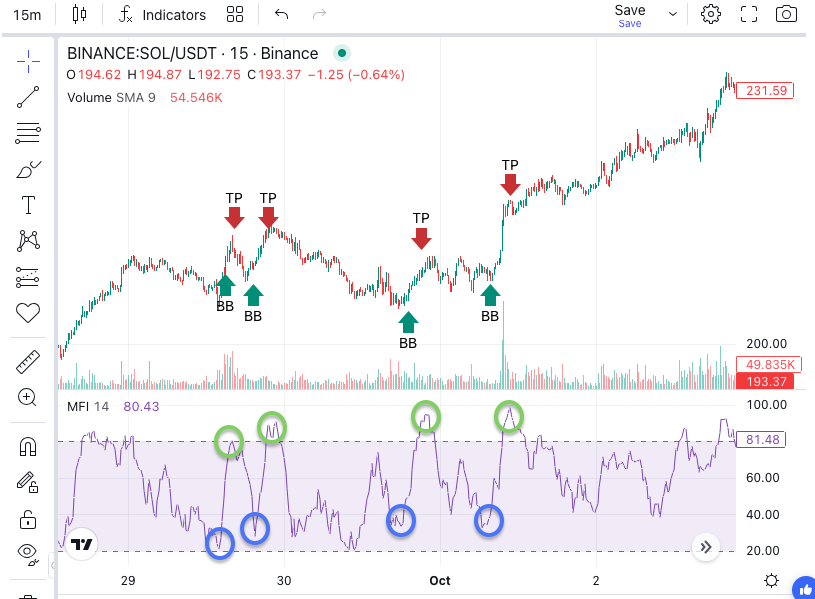
A Money Flow Index strategy trades overbought and oversold extremes with a twist that most oscillators lack: volume. The MFI is often called the volume-weighted RSI, because it asks not just “did price close up or down?” but “how much money actually moved it?” A price rise on heavy volume counts for more than the same rise on air. That single change makes the MFI’s extremes stricter — and its signals harder to fake.
What Is a Money Flow Index Strategy?
A Money Flow Index strategy uses the indicator’s 0-100 scale the way RSI traders use theirs, but with tighter bands: readings above 80 mark overbought, below 20 oversold. Because volume weighting filters out low-participation drift, the MFI reaches its extremes less often than RSI does. When it gets there, more real money is behind the move. The core plays are the same two families as any oscillator: fade the extremes in ranging markets, or use the recovery from an extreme as a pullback entry inside a trend.
How Does the Calculation Work?
Each period, the MFI multiplies the typical price (the average of high, low, and close) by volume to get raw money flow. Flows on up periods count as positive, on down periods as negative. The indicator then compares positive to negative flow over 14 periods and squeezes the ratio into the 0-100 range, as Investopedia details. In plain English: MFI at 85 means the last two weeks of money movement were overwhelmingly on the buy side — and stretched enough that continuation gets statistically expensive.
Reading the Levels
- Above 80: overbought with volume behind it — the stretch is real, not thin drift.
- Below 20: oversold — selling pressure has been heavy and one-sided.
- The 50 line: the balance point between buying and selling flow.
- Divergence: price making highs while MFI fades warns the money is leaving — the volume-weighted cousin of the signal in our OBV divergence guide.
Two Money Flow Index Strategies to Test
The 20-Line Recovery
- Filter: price above its 200-period EMA — dips get bought only inside uptrends.
- Setup: MFI drops below 20.
- Entry: MFI crosses back above 20 — the outflow has exhausted and turned.
- Exit: MFI reaching 50-60, or a fixed target; stop below the setup low.
The Volume-Confirmed Breakout
- Rule: take breakout entries only when MFI is above 50 and rising.
- Effect: breakouts with genuine money flow pass; hollow pokes above resistance get skipped. This uses MFI as a filter rather than a trigger — often its best role.
Assembling It in Arrow Algo
- Add an MFI block and connect your candle feed — the period is an editable property.
- Add an EMA block (200) and a condition block for the trend filter.
- Use a crossover block to catch MFI crossing above the 20 level for the recovery entry.
- For the breakout variant, gate your existing entry logic with a condition checking MFI is above 50.
- Backtest on Binance, Coinbase, or HyperLiquid data — and compare the same rules with RSI swapped in. The volume weighting should earn its place, not be assumed.
Where Does the MFI Go Wrong?
- Trends pin the extremes. Like every oscillator, MFI can sit above 80 for weeks in a strong trend. Overbought is a context reading, not a sell order — the same discipline as the RSI overbought/oversold strategy.
- Venue-specific volume. Crypto volume differs by exchange, so MFI on one venue can disagree with another. Backtest where you trade.
- Fading without the turn. Enter on the cross back through 20, never on the touch.
- Doubling up with RSI. MFI and RSI agree most of the time. Using both as confluence mostly duplicates one vote.
The Takeaways
- A Money Flow Index strategy trades volume-weighted extremes: 80 overbought, 20 oversold.
- Volume weighting makes extremes rarer and more meaningful than RSI’s.
- Trade the recovery cross out of the zone, with a trend filter deciding which extremes you’re allowed to fade.
- MFI above 50 doubles as a clean volume filter for breakout systems.
- Arrow Algo’s MFI block makes both builds drag-and-drop — the complete Money Flow Index guide covers the full background.
Disclaimer: This content is for educational purposes only and does not constitute financial advice. Trading involves significant risk and you should only trade with capital you can afford to lose. Past performance is not indicative of future results. Always conduct your own research before making any trading decisions.
Ready to build your own automated trading strategies without writing a single line of code? Start for free at Arrow Algo and join thousands of traders who’ve made the switch to systematic trading.