
On Balance Volume (OBV): Complete Guide for Algorithmic Trading
On Balance Volume (OBV): A Comprehensive Guide for Algorithmic Traders
On Balance Volume (OBV) is a powerful momentum indicator that uses volume flow to predict changes in stock price. Developed by Joe Granville in the 1960s, OBV is based on the premise that volume precedes price movements. This makes it a valuable tool for traders seeking to anticipate potential trend reversals or confirmations. OBV is particularly useful for algorithmic traders because it provides a quantitative measure of buying and selling pressure. By incorporating volume data, OBV offers insights that price-based indicators alone cannot provide. This makes it an excellent complement to other technical analysis tools in automated trading systems. Institutional investors, day traders, and swing traders frequently use OBV to validate price trends and identify potential breakouts. Its ability to detect divergences between price and volume makes it especially valuable for algo traders looking to build robust, multi-factor decision-making models.
How It Works
Mathematical Formula
The On Balance Volume indicator is calculated using a running total of volume. The basic formula is: If closing price > previous closing price: OBV = Previous OBV + Current Volume If closing price < previous closing price: OBV = Previous OBV - Current Volume If closing price = previous closing price: OBV = Previous OBV (no change)
Calculation Process
- Choose a starting point (usually the beginning of the available data).
- Set the initial OBV value (often to zero or the first period’s volume).
- For each subsequent period:
- Compare the current closing price to the previous closing price.
- Add the full volume if price increased, subtract if decreased, or leave unchanged if equal.
- This creates a running cumulative total.
Visual Representation
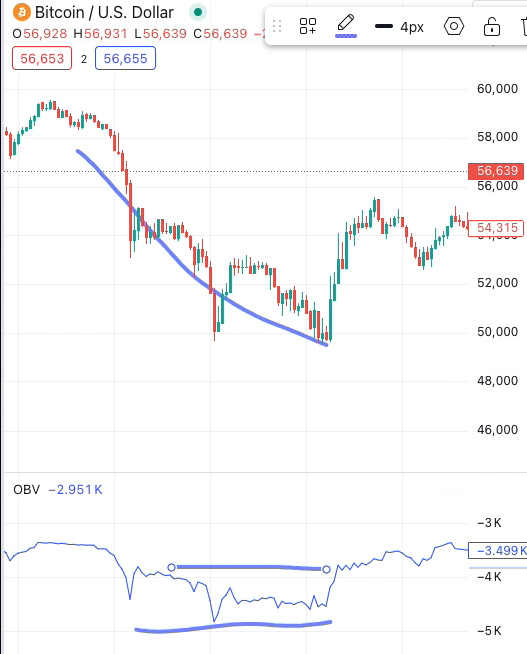
On a chart, OBV appears as a single line plotted below the price chart. This line will trend upwards when volume on up days outpaces volume on down days, and trend downwards in the opposite scenario.
Key Parameters
- Timeframe: The period over which OBV is calculated (e.g., daily, hourly).
- Smoothing: Some traders apply a moving average to the OBV line to reduce noise.
What OBV Measures
OBV measures buying and selling pressure as a cumulative indicator that adds volume on up days and subtracts volume on down days. Essentially, it tracks whether volume is flowing into or out of a security over time.
Interpretation & Signals
Reading the Indicator
- An rising OBV line generally indicates that volume is flowing into the security (accumulation).
- A falling OBV line suggests volume is flowing out of the security (distribution).
- The slope and direction of the OBV line are more important than its absolute value.
Common Trading Signals
- Trend Confirmation: If OBV is moving in the same direction as the price, it confirms the trend.
- Potential Reversal: If OBV moves contrary to the price trend, it may signal a potential reversal.
- Breakouts: A significant OBV move can precede a price breakout.
Divergences
- Bullish Divergence: Price makes a lower low, but OBV makes a higher low.
- Bearish Divergence: Price makes a higher high, but OBV makes a lower high.
Signal Strength
The strength of an OBV signal can be gauged by: - The duration of the trend in the OBV line - The angle or slope of the OBV line - The magnitude of divergence between OBV and price
Trading Strategies
1. OBV Trend Following Strategy
This strategy aims to capture strong trends by aligning with both price and volume momentum. Entry Rules: - Price is above a 50-period moving average - OBV line is trending upwards (for long positions) - OBV makes a new 20-period high Exit Rules: - Price closes below the 50-period moving average - OBV line starts trending downwards - OBV makes a new 20-period low
2. OBV Divergence Strategy
This strategy seeks to identify potential reversals by spotting divergences between price and OBV. Entry Rules for Long Position: - Price makes a lower low - OBV makes a higher low (bullish divergence) - Wait for price to close above the previous swing high for confirmation Exit Rules: - Price reaches a predetermined profit target - OBV starts trending downwards - A bearish divergence forms
3. OBV Breakout Confirmation Strategy
This strategy uses OBV to confirm price breakouts, potentially reducing false signals. Entry Rules: - Price breaks above a key resistance level - OBV is trending upwards and also breaks above its recent high - Enter long when both price and OBV confirm the breakout Exit Rules: - Price falls back below the breakout level - OBV turns downwards - Trailing stop based on ATR (Average True Range)
Combining with Other Indicators
OBV works well when combined with: - Moving Averages: For trend identification - RSI (Relative Strength Index): For overbought/oversold conditions - MACD (Moving Average Convergence Divergence): For momentum confirmation
Best Timeframes
OBV is versatile and can be applied to various timeframes: - Daily charts: For swing trading and longer-term trend analysis - 4-hour and 1-hour charts: For short-term trading and intraday analysis - 15-minute charts: For day trading, especially around key market events
When Not to Use OBV
- In very low volume conditions where small trades can skew the indicator
- During periods of significant market manipulation
- In markets where volume data is unreliable or not readily available
Implementation in Algo Trading
Integration into Algorithmic Strategies
You can build a strategy that incorporates OBV by: 1. Calculating the OBV values for each period 2. Comparing current OBV to historical values or a smoothed OBV line 3. Generating signals based on OBV trends, divergences, or breakouts 4. Combining OBV signals with price action rules and other indicators
Automated Decision-Making
You can create decision rules such as: - Enter long when OBV crosses above its 20-period moving average - Exit when OBV drops below a certain threshold - Adjust position sizing based on the strength of the OBV trend
Backtesting Considerations
When backtesting OBV strategies, pay attention to: - The impact of different timeframes on performance - How OBV performs in various market conditions (trending vs. ranging) - The effect of applying smoothing techniques to the OBV line
Common Pitfalls
- Over-reliance on OBV without considering price action
- Ignoring the broader market context
- Failing to account for abnormal volume spikes (e.g., due to news events)
Optimization Tips
- Experiment with different OBV smoothing periods
- Test various lookback periods for identifying highs and lows
- Combine OBV with volatility filters to avoid false signals in choppy markets
Building with Arrow Algo’s Block Builder
Arrow Algo’s NO-CODE block builder makes it easy to implement OBV-based strategies without writing a single line of code. Here’s how you can use the platform to create your OBV strategy:
- Add the OBV Indicator: Drag and drop the OBV indicator block from the indicator library into your strategy workspace.
- Configure Parameters: Use the visual interface to set OBV parameters such as the calculation period and any smoothing options.
- Create Trading Logic: Drag logic blocks to define your entry and exit conditions.
- For example: IF OBV is greater than OBV[1] (previous period’s OBV)
- AND Price is above 50-period moving average
- THEN Enter Long Position
- Set Position Sizing: Use position sizing blocks to determine how much to trade based on your account size and risk tolerance.
- Add Risk Management: Incorporate stop-loss and take-profit blocks to manage risk and lock in gains.
- Backtest and Optimize: Use Arrow Algo’s built-in backtesting tools to evaluate your strategy’s performance across different market conditions and timeframes.
- Refine Your Strategy: Easily adjust your strategy by dragging blocks, changing parameters, or adding new conditions without any coding required.
Conclusion
On Balance Volume (OBV) is a powerful tool for algorithmic traders seeking to incorporate volume analysis into their strategies. Its ability to confirm trends, identify potential reversals, and provide early signals of significant moves makes it a valuable addition to any trading system. Key takeaways: - Use OBV to confirm price trends and spot potential reversals - Look for divergences between OBV and price for strong trading signals - Combine OBV with other indicators for more robust decision-making - Be aware of OBV’s limitations, especially in low-volume or manipulated markets Best practices include backtesting thoroughly, optimizing parameters for your specific trading instruments and timeframes, and always considering OBV in conjunction with price action and overall market conditions. Ready to build your own strategies using On Balance Volume (OBV)? Visit https://www.arrowalgo.com to start creating custom indicator-based strategies with Arrow Algo’s NO-CODE block builder platform.
Disclaimer: Algorithmic trading involves substantial risk. Past performance is not indicative of future results. This content is for educational purposes only and should not be considered financial advice. Always do your own research and consider consulting with a financial advisor before making trading decisions.
Educational disclaimer: This content is for educational purposes only and does not constitute financial advice. Trading involves significant risk and you should only trade with capital you can afford to lose. Past performance is not indicative of future results.