
SuperTrend + RSI Confluence Strategy: How to Build It in Arrow Algo
A SuperTrend RSI strategy answers two different questions with two different tools. SuperTrend answers “which way?” The Relative Strength Index answers “when?” Used alone, each indicator has a well-known weakness. SuperTrend flips late and bleeds in ranges. RSI fires oversold signals all the way down a crash. Put together, each one patches the other’s blind spot.
That is what confluence means in practice. It is not stacking three indicators that all measure momentum and calling it confirmation. It is pairing one tool that reads trend with one tool that reads timing, then only trading when both agree.
This guide covers what each indicator contributes, the two entry models that work, the exits that fit, the traps that catch most builders, and the drag-and-drop build in Arrow Algo.
What Does Each Indicator Contribute?
SuperTrend is a trend-following overlay built on the Average True Range. It plots a single line below price in an uptrend and above price in a downtrend. The line ratchets in the trend’s direction and never loosens. When price closes through it, the line flips sides and the trend is declared reversed. Our SuperTrend reference guide covers the mechanics in full.
RSI is a bounded momentum oscillator. It runs from 0 to 100 and measures the speed of recent gains against recent losses. Readings below 30 are conventionally oversold. Readings above 70 are overbought. The 50 line marks the balance point between buying and selling pressure.
The job split is clean. SuperTrend defines the regime. RSI picks the moment inside that regime. You never buy an oversold RSI unless SuperTrend already says the trend is up. You never short an overbought RSI unless SuperTrend already says the trend is down.
Two Ways to Combine Them
There are two sensible entry models. They suit different temperaments and different timeframes.
Model A: Trend Filter Plus Pullback
SuperTrend is bullish. Price is above the line. You wait for RSI to dip below 40 and then cross back above it. That cross is the entry.
This model buys pullbacks inside an established uptrend. The 40 level matters. In a real uptrend RSI rarely reaches 30. It bounces from 40 to 45 instead. Waiting for 30 means missing most of the entries the strategy was built to catch. StockCharts documents this shift in RSI ranges during trends.
Model A produces more trades and smaller average moves. It trades with the trend’s rhythm rather than waiting for the trend to start.
Model B: Flip Plus Momentum Confirmation
SuperTrend flips from bearish to bullish. At the same time, RSI is above 50 and rising. Both conditions must be true on the same candle or within two candles of each other.
This model enters on trend changes but demands that momentum agrees. A SuperTrend flip on weak momentum is often a range-bound whipsaw. A flip with RSI already above 50 means buyers were in control before the band moved.
Model B produces fewer trades and bigger average moves. It also produces more false starts in sideways markets, because every flip is an entry candidate.
Exits That Match the Entry
Both models share the same primary exit. When SuperTrend flips against you, you are out. The band is a trailing stop that tightens as the trend extends. That is the indicator’s best feature and there is no reason to override it.
Model A can add a faster exit. If RSI pushes above 70 and then crosses back below it, the pullback trade has run its course. Taking profit there avoids giving back gains while waiting for the slower SuperTrend flip.
Model B should keep only the SuperTrend exit. The whole point of entering on a flip is to ride the full trend. Cutting it short at RSI 70 defeats the purpose.
A hard stop under the SuperTrend line at entry, offset by a fraction of ATR, protects against the gap-through scenario. SuperTrend reacts to closes. A single news candle can blow through the band and fill you well past it.
Where This Strategy Goes Wrong
- Treating it as a reversal tool. RSI oversold inside a SuperTrend downtrend is not a buy. The filter exists to stop that trade. Builders who override the filter have rebuilt plain RSI with extra steps.
- Using RSI 30 in trends. Explained above. The threshold must move with the regime. Backtest 35, 40 and 45 for the pullback level before settling.
- Low timeframes. On five-minute crypto charts SuperTrend flips constantly and RSI crosses 40 every hour. Both indicators behave better on 4-hour and daily candles.
- Ranging markets. Confluence reduces chop losses. It does not remove them. An ADX reading below 20 is a reasonable third gate that stands the strategy down entirely.
- Over-tuning. SuperTrend at 10 and 3 with RSI at 14 is the default for a reason. A backtest that only works at 11, 2.8 and 12 is describing noise.
How to Build a SuperTrend RSI Strategy in Arrow Algo
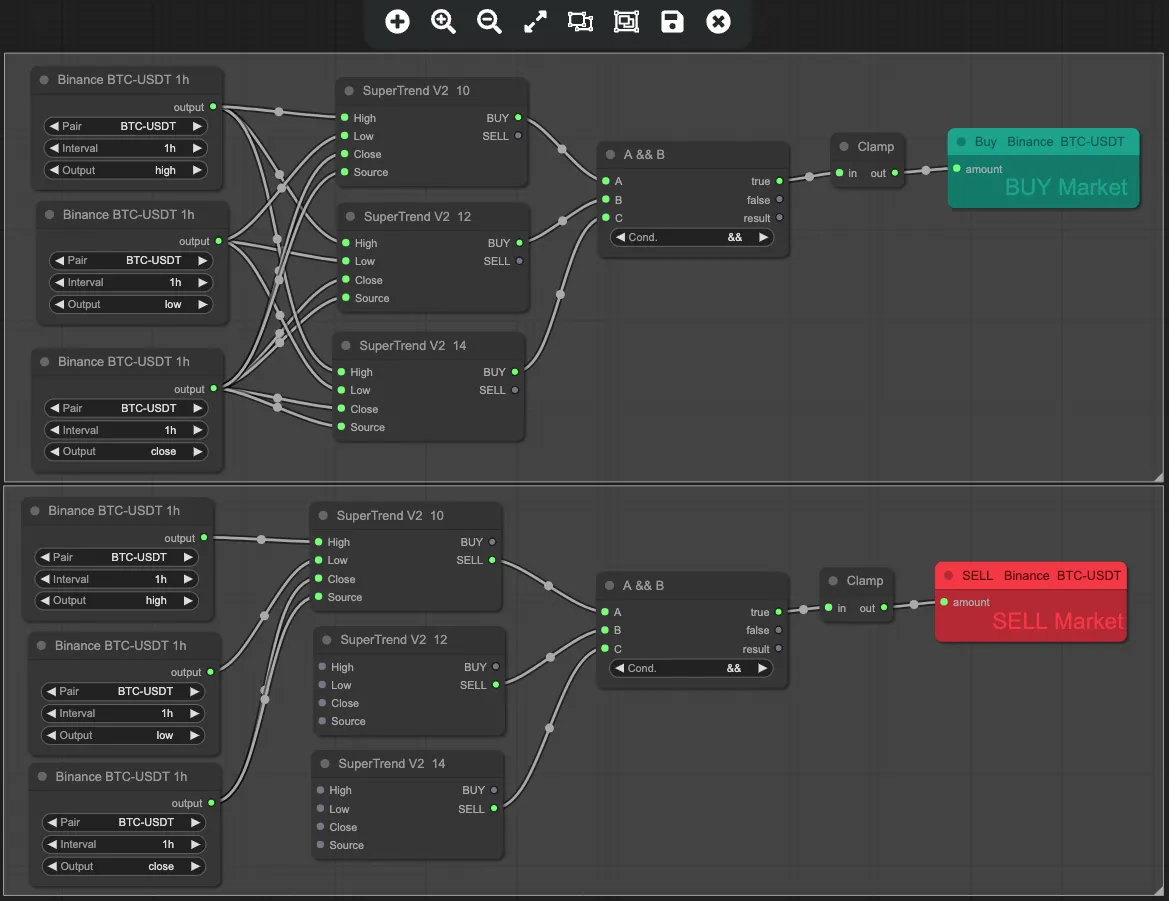
Everything below is drag-and-drop on the visual canvas. No code.
Drop a SuperTrend block and connect the candle feed. Set the period to 10 and the multiplier to 3. Its direction output tells you whether the trend is up or down.
Add an RSI block with the period at 14.
For Model A, add a crossover block that fires when RSI crosses above a fixed value of 40. Join that trigger and the SuperTrend bullish direction with a condition block set to AND with two inputs. That is your long entry gate.
For Model B, use a crossover block on price and the SuperTrend line to detect the flip. Add a comparison block checking RSI above 50. Join them with the same AND condition.
For the exit, route the opposite SuperTrend flip to the close signal. Model A adds a second crossover block watching RSI cross below 70 as an early take-profit.
Drop an ATR block and a subtract block to place a hard stop a fraction of ATR below the SuperTrend line at entry. Wire that into the stop-loss input of the order.
For the optional chop filter, add an ADX block and a comparison block requiring ADX above 20. Change the condition block to three inputs. Our ADX + DI directional strategy guide covers that gate in detail.
Then backtest. Arrow Algo pulls historical candles straight from Binance, Coinbase and HyperLiquid. Run Model A and Model B on the same pair and timeframe. Compare trade count, profit factor and maximum drawdown. Then run plain SuperTrend with no RSI gate as the control. The gap between the control and the confluence version is the value RSI added.
What Should You Take Away?
- A SuperTrend RSI strategy splits the work: SuperTrend reads direction, RSI reads timing.
- Model A buys RSI pullbacks to 40 inside a SuperTrend uptrend. Model B enters on SuperTrend flips confirmed by RSI above 50.
- The SuperTrend flip is the primary exit for both. Model A can add an RSI 70 take-profit.
- Never trade RSI against the SuperTrend direction. The filter is the strategy.
- Standard settings on 4-hour or daily candles beat tuned settings on fast charts.
- Arrow Algo’s visual builder makes both models drag-and-drop, with a plain SuperTrend control to measure the confluence gain.
Disclaimer: This content is for educational purposes only and does not constitute financial advice. Trading involves significant risk and you should only trade with capital you can afford to lose. Past performance is not indicative of future results. Always conduct your own research before making any trading decisions.
Ready to build your own automated trading strategies without writing a single line of code? Start for free at Arrow Algo and join thousands of traders who've made the switch to systematic trading.