
SuperTrend Indicator: Complete Guide for Algorithmic Trading
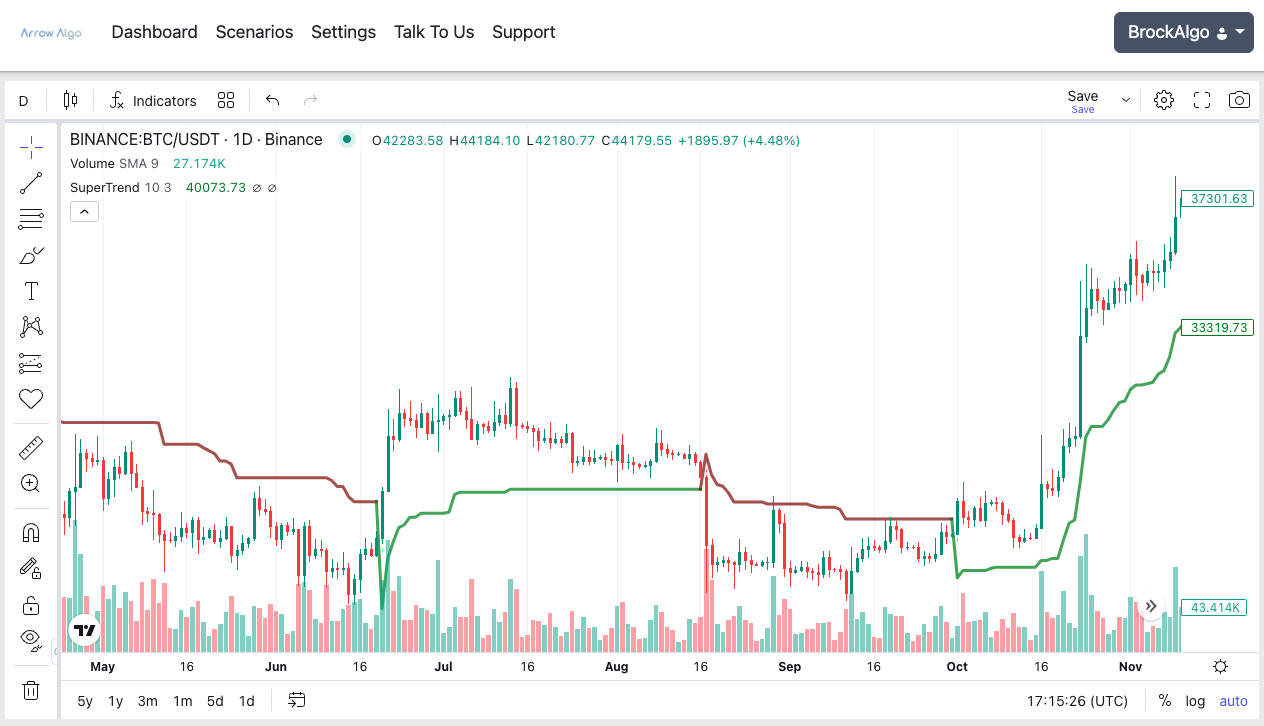
SuperTrend Indicator: A Comprehensive Guide for Algorithmic Traders
The SuperTrend Indicator is a powerful technical analysis tool that has gained significant popularity among traders, especially those involved in algorithmic trading. Developed by Olivier Seban, this versatile indicator combines trend identification with volatility to generate clear buy and sell signals. The SuperTrend stands out for its ability to adapt to market conditions, making it particularly valuable in trending markets. Algorithmic traders find the SuperTrend Indicator especially useful due to its clear, objective signals and its ability to be easily incorporated into automated trading systems. It provides a straightforward way to identify the current trend direction and potential reversal points, which can be crucial for making informed trading decisions. The indicator’s strength lies in its simplicity and effectiveness. It plots a single line above or below the price, clearly indicating whether the current trend is bullish or bearish. This makes it an excellent tool for trend-following strategies and for confirming signals from other indicators.
How It Works
Mathematical Foundation
The SuperTrend Indicator is based on two primary components:
- Average True Range (ATR)
- Basic upper and lower price levels
The indicator calculates two lines:
- Upper Band = (High + Low) / 2 + (Multiplier * ATR)
- Lower Band = (High + Low) / 2 - (Multiplier * ATR)
Where: - High and Low are the highest and lowest prices of the current period - Multiplier is a user-defined value (typically set to 3) - ATR is the Average True Range for a specified period (typically 10)
Calculation Process
- Calculate the ATR for the specified period
- Determine the basic upper and lower levels using the midpoint of the high and low
- Add (for upper band) or subtract (for lower band) the ATR multiplied by the user-defined factor
- Compare the current SuperTrend value with the previous period’s value and the current close price to determine the trend direction
Visual Representation
On a price chart, the SuperTrend appears as a single line that changes color based on the trend direction: - Green line above the price when the trend is bearish - Red line below the price when the trend is bullish The line flips from above to below the price (or vice versa) when a trend change is detected.
Key Parameters
- Period: The number of candles used to calculate the ATR (typically 10)
- Multiplier: The factor applied to the ATR to determine band width (typically 3)
These parameters can be adjusted to make the indicator more or less sensitive to price movements.
Interpretation & Signals
Reading the Indicator
The SuperTrend Indicator provides straightforward signals: - When the SuperTrend line is below the price, it indicates a bullish trend - When the SuperTrend line is above the price, it indicates a bearish trend
Trading Signals
- Buy Signal: Generated when the SuperTrend line moves from above the price to below it
- Sell Signal: Generated when the SuperTrend line moves from below the price to above it
Trend Strength
While the SuperTrend doesn’t have specific overbought/oversold levels, the distance between the price and the SuperTrend line can indicate trend strength. A larger gap suggests a stronger trend.
Confirmations and Divergences
- Trend Confirmation: Use the SuperTrend in conjunction with other trend indicators like Moving Averages for added confirmation
- Divergence: While not a primary use, divergence between price action and the SuperTrend can sometimes indicate potential trend weakening
Signal Strength Indicators
- Slope of the SuperTrend line: A steeper slope indicates a stronger trend
- Frequency of flips: Less frequent flips between bull and bear modes suggest a more stable trend
- Price distance: A greater distance between price and the SuperTrend line typically indicates a stronger trend
Trading Strategies
1. Basic Trend-Following Strategy
Entry Rules: - Enter a long position when the SuperTrend flips from above to below the price - Enter a short position when the SuperTrend flips from below to above the price Exit Rules: - Long exit: when the SuperTrend flips back above the price - Short exit: when the SuperTrend flips back below the price Timeframe: This strategy works well on daily charts for longer-term trends, or 1-hour charts for shorter-term trades.
2. SuperTrend with Moving Average Confirmation
Entry Rules: - Long: SuperTrend flips bullish AND price is above the 50-period EMA - Short: SuperTrend flips bearish AND price is below the 50-period EMA Exit Rules: - Long exit: SuperTrend flips bearish OR price closes below the 50-period EMA - Short exit: SuperTrend flips bullish OR price closes above the 50-period EMA Timeframe: Effective on 4-hour or daily charts for most markets.
3. SuperTrend Pullback Strategy
Entry Rules: - Identify the main trend using a longer-term SuperTrend (e.g., 10 period, 3 multiplier) - Use a shorter-term SuperTrend (e.g., 5 period, 2 multiplier) to identify pullbacks - Long: Main trend is bullish, shorter-term SuperTrend flips bullish after a pullback - Short: Main trend is bearish, shorter-term SuperTrend flips bearish after a pullback Exit Rules: - Exit when the shorter-term SuperTrend flips against the main trend - Or use a trailing stop based on the shorter-term SuperTrend Timeframe: Works well on 15-minute or 1-hour charts for intraday trading, or daily charts for swing trading.
Best Market Conditions
The SuperTrend Indicator excels in trending markets across various assets, including stocks, forex, and commodities. It’s particularly effective in markets with clear directional movements.
When Not to Use
Exercise caution when using the SuperTrend in: - Highly volatile, choppy markets where frequent trend changes occur - During significant news events or economic releases that can cause erratic price movements - In very low-volatility periods where the indicator may not provide meaningful signals
Implementation in Algo Trading
Integration into Algorithmic Strategies
To incorporate the SuperTrend Indicator into your algorithmic trading strategy using Arrow Algo’s block builder:
- Add the SuperTrend Indicator block to your strategy
- Configure the period and multiplier parameters
- Create decision blocks based on the SuperTrend’s signals
- Connect these blocks to your entry and exit logic
Automated Decision-Making
Use the SuperTrend for: - Trend direction determination - Entry and exit signals - Risk management (e.g., trailing stops) - Filter for other trading signals
Backtesting Considerations
When backtesting SuperTrend-based strategies: - Test across different market conditions (trending, ranging, volatile) - Optimize the period and multiplier for your specific asset and timeframe - Consider the impact of transaction costs, especially if the strategy generates frequent trades
Common Pitfalls and Solutions
- Whipsaws in choppy markets: Implement a filter or confirmation indicator
- Late entries in strong trends: Use a shorter period or lower multiplier, but be cautious of increased false signals
- Premature exits: Consider using a trailing stop or combining with other exit indicators
Optimization Tips
- Experiment with different period and multiplier combinations
- Use walk-forward optimization to avoid over-fitting
- Consider market volatility when setting parameters
- Combine with volume indicators for improved signal quality
Building with Arrow Algo’s Block Builder
Arrow Algo’s NO-CODE block builder makes it easy to implement SuperTrend-based strategies without any programming knowledge. Here’s how:
- Add the SuperTrend Indicator: Drag and drop the SuperTrend block from the indicator library into your strategy workspace.
- Configure Parameters: Double-click the SuperTrend block to open its settings. Adjust the period and multiplier visually using sliders or input fields.
- Create Trading Logic: Add condition blocks to check for SuperTrend crossovers or trend changes. For example:
- “If SuperTrend crosses above price”
- “If SuperTrend crosses below price”
- Connect to Entry/Exit Blocks: Link your SuperTrend conditions to trade entry and exit blocks. For instance:
- Connect “SuperTrend crosses below price” to a “Buy” block
- Connect “SuperTrend crosses above price” to a “Sell” block
- Add Risk Management: Incorporate stop-loss and take-profit blocks, linking them to your SuperTrend signals.
- Backtest and Optimize: Use Arrow Algo’s built-in backtesting tool to evaluate your strategy’s performance. Adjust parameters and logic visually until you achieve desired results.
- Combine with Other Indicators: Drag in additional indicator blocks (e.g., Moving Averages) and create more complex conditions to refine your strategy.
Remember, all of this is done through a visual interface – no coding required!
Conclusion
The SuperTrend Indicator is a powerful tool for algorithmic traders, offering clear trend identification and trading signals. Its simplicity and effectiveness make it an excellent choice for both novice and experienced traders. Key takeaways: - Use SuperTrend for trend direction and potential reversals - Combine with other indicators for confirmation - Adjust parameters based on market conditions and timeframes - Be cautious in choppy or highly volatile markets - Regularly backtest and optimize your strategies When implemented correctly, the SuperTrend can form the backbone of robust trading algorithms, helping to identify trends and generate timely entry and exit signals across various market conditions. Ready to build your own strategies using SuperTrend Indicator? Visit https://www.arrowalgo.com to start creating custom indicator-based strategies with Arrow Algo’s NO-CODE block builder platform.
Disclaimer: Algorithmic trading involves substantial risk. Past performance is not indicative of future results. This content is for educational purposes only and should not be considered financial advice. Always do your own research and consider consulting with a financial advisor before making trading decisions.
Educational disclaimer: This content is for educational purposes only and does not constitute financial advice. Trading involves significant risk and you should only trade with capital you can afford to lose. Past performance is not indicative of future results.