
Average Directional Index (ADX): Complete Guide for Algorithmic Trading
Average Directional Index (ADX): A Comprehensive Guide for Algorithmic Traders
Introduction
The Average Directional Index (ADX) is a powerful technical indicator that measures the strength of a trend, regardless of its direction. Developed by J. Welles Wilder Jr. in 1978, the ADX has become an essential tool for traders seeking to quantify trend strength and identify potential trading opportunities. ADX is particularly valuable for algorithmic traders because it provides a clear, numerical representation of trend strength that can be easily incorporated into automated trading systems. By measuring the momentum behind price movements, ADX helps traders distinguish between ranging and trending markets, a crucial distinction for many trading strategies. Used by both discretionary and algorithmic traders, ADX is often combined with other indicators to create robust trading systems. Its ability to work across various timeframes and asset classes makes it a versatile tool for traders in stocks, forex, commodities, and cryptocurrencies. For algo traders, ADX offers a systematic way to assess market conditions and adjust trading strategies accordingly, making it an invaluable component in many automated trading algorithms.
How It Works
The Average Directional Index (ADX) is calculated through a multi-step process that involves several components:
- True Range (TR): The greatest of:
- Current High - Current Low
- |Current High - Previous Close|
- |Current Low - Previous Close|
- Directional Movement (DM):
- +DM = Current High - Previous High (if positive, else 0)
- -DM = Previous Low - Current Low (if positive, else 0)
- Smoothed TR and DM:
- First value: 14-period sum of TR or DM
- Subsequent values: Prior value - (Prior value / 14) + Current TR or DM
- Directional Indicators (DI):
- +DI = 100 x (Smoothed +DM / Smoothed TR)
- -DI = 100 x (Smoothed -DM / Smoothed TR)
- Directional Index (DX): DX = 100 x (|+DI - -DI| / (+DI + -DI))
- Average Directional Index (ADX):
- First ADX value: 14-period average of DX
- Subsequent values: ((Prior ADX x 13) + Current DX) / 14
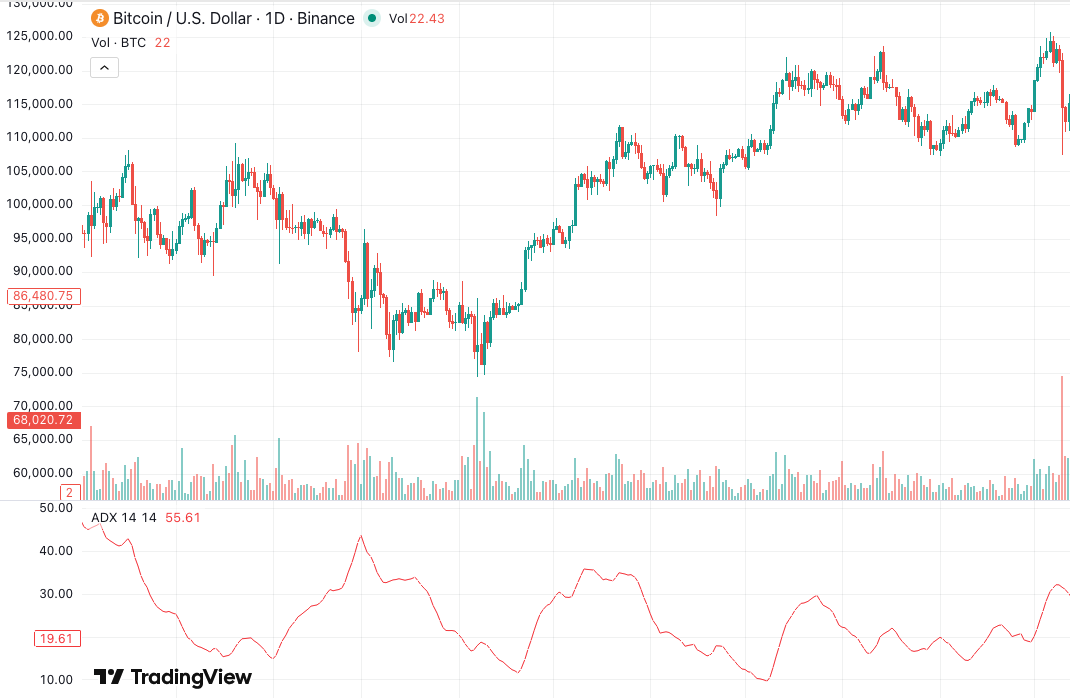
Visually, ADX appears as a single line on a chart, typically scaled from 0 to 100. The most common parameter is a 14-period lookback, though this can be adjusted based on trading preferences. What ADX actually measures is the strength of a trend, not its direction. Higher ADX values indicate stronger trends, while lower values suggest weaker trends or ranging markets.
Interpretation & Signals
Reading the ADX indicator involves understanding these key principles:
- ADX values range from 0 to 100
- ADX > 25 generally indicates a strong trend
- ADX < 20 suggests a weak trend or ranging market
- Rising ADX indicates increasing trend strength
- Falling ADX suggests weakening trend strength
Common trading signals include:
- Trend Strength Confirmation:
- When ADX rises above 25, it confirms a strong trend is present
- This can be used to validate trend-following strategies
- Range-Bound Market Identification:
- ADX below 20 suggests a ranging market
- This can signal to avoid trend-following strategies and consider range-trading tactics
- Trend Exhaustion:
- If ADX reaches extremely high levels (above 50) and then begins to fall, it may indicate trend exhaustion
- This could signal potential trend reversal or consolidation
- Breakout Confirmation:
- A rising ADX after a period of low readings can confirm a breakout from a range
- Divergence:
- If price makes new highs/lows but ADX doesn’t, it may indicate weakening trend momentum
It’s important to note that ADX doesn’t indicate trend direction, only strength. Traders often use +DI and -DI lines in conjunction with ADX to determine trend direction.
Trading Strategies
Here are two specific trading strategies using ADX:
- ADX Trend-Strength Entry Strategy
Entry Rules: - ADX rises above 25 - +DI is above -DI for long trades (reverse for shorts) - Price closes above a 20-period moving average Exit Rules: - ADX falls below 20, or - A trailing stop of 2 x ATR (Average True Range) This strategy aims to enter strong trends early and exit when the trend weakens or a significant pullback occurs.
- ADX Range-Breakout Strategy
Entry Rules: - ADX has been below 20 for at least 10 periods - ADX starts rising and crosses above 20 - Enter in the direction of the breakout (use +DI and -DI for direction) Exit Rules: - ADX reaches 40, or - A fixed stop-loss of 1.5 x the average range during the low-ADX period This strategy attempts to catch breakouts from consolidation periods as they develop into new trends. Combining ADX with other indicators can enhance its effectiveness:
- Use with moving averages for trend direction confirmation
- Pair with momentum oscillators like RSI to identify overbought/oversold conditions within trends
ADX typically works well on daily charts for longer-term trends and 1-hour or 4-hour charts for shorter-term trades. It excels in markets with clear trending behavior, such as major forex pairs or large-cap stocks. However, ADX is less effective in highly volatile or choppy markets. During these conditions, it may give false signals or lag too much to be useful for short-term trading.
Implementation in Algo Trading
Integrating ADX into algorithmic trading strategies requires careful consideration:
- Signal Generation:
- Create rules based on ADX levels and movements
- Combine ADX signals with other indicators for confirmation
- Trend Filtering:
- Use ADX to filter out low-probability trades in ranging markets
- Adjust position sizing based on trend strength
- Dynamic Parameter Adjustment:
- Adapt strategy parameters (e.g., stop-loss distances) based on ADX readings
- Market Regime Detection:
- Use ADX to classify market conditions (trending vs. ranging)
- Switch between different sub-strategies based on the detected regime
When backtesting ADX-based strategies: - Be aware of look-ahead bias in ADX calculation - Test across different market conditions to ensure robustness - Consider the impact of ADX lag on entry and exit timing Common pitfalls to avoid: - Over-reliance on ADX alone without confirming indicators - Ignoring the broader market context when interpreting ADX signals - Using ADX for very short-term trading where lag can be significant Optimization tips: - Experiment with different ADX thresholds for your specific market and timeframe - Consider using adaptive thresholds based on recent ADX behavior - Combine ADX with volatility measures for more nuanced strategy adjustments
Building with Arrow Algo’s Block Builder
Implementing ADX-based strategies using Arrow Algo’s NO-CODE block builder is straightforward and intuitive:
- Adding the ADX Indicator:
- Drag the ADX indicator block from the indicator library into your strategy workspace
- Connect it to your data source block
- Configuring Parameters:
- Click on the ADX block to open its settings
- Adjust the period (e.g., 14) and other parameters visually
- Creating Trading Logic:
- Drag condition blocks (e.g., “Greater Than”, “Less Than”) into the workspace
- Connect ADX output to these conditions to create trading rules
- Combining with Other Indicators:
- Add other indicator blocks (e.g., Moving Average) to your strategy
- Use logic blocks to combine signals from multiple indicators
- Setting Entry and Exit Rules:
- Use “Buy” and “Sell” blocks to define entry points based on your ADX conditions
- Set stop-loss and take-profit blocks, connecting them to your ADX logic if desired
- Backtesting and Optimization:
- Use Arrow Algo’s built-in backtesting tool to evaluate your strategy
- Adjust parameters and logic visually based on results
- Implementing Advanced Logic:
- Use “Variable” blocks to store ADX values or create custom calculations
- Employ “If-Then” blocks for more complex decision-making based on ADX readings
This NO-CODE approach allows you to quickly prototype, test, and refine ADX-based strategies without writing a single line of code.
Conclusion
The Average Directional Index (ADX) is a powerful tool for algorithmic traders, offering a systematic way to measure trend strength and adapt strategies to different market conditions. Key takeaways include:
- ADX measures trend strength, not direction
- Values above 25 indicate strong trends, below 20 suggest weak trends
- Combine ADX with directional indicators for more comprehensive analysis
- Use ADX to filter trades, adjust parameters, and identify market regimes
- Be aware of ADX lag and validate signals with other indicators
Best practices include thorough backtesting, combining ADX with complementary indicators, and regularly reviewing and adjusting strategies based on changing market conditions. By leveraging ADX in your algorithmic trading strategies, you can enhance your ability to identify strong trends, avoid ranging markets, and potentially improve your overall trading performance. Ready to build your own strategies using Average Directional Index (ADX)? Visit https://www.arrowalgo.com to start creating custom indicator-based strategies with Arrow Algo’s NO-CODE block builder platform.
Disclaimer: Algorithmic trading involves substantial risk. Past performance is not indicative of future results. This content is for educational purposes only and should not be considered financial advice. Always do your own research and consider consulting with a financial advisor before making trading decisions.
Educational disclaimer: This content is for educational purposes only and does not constitute financial advice. Trading involves significant risk and you should only trade with capital you can afford to lose. Past performance is not indicative of future results.