
Chande Momentum Oscillator Strategy: How to Build It in Arrow Algo
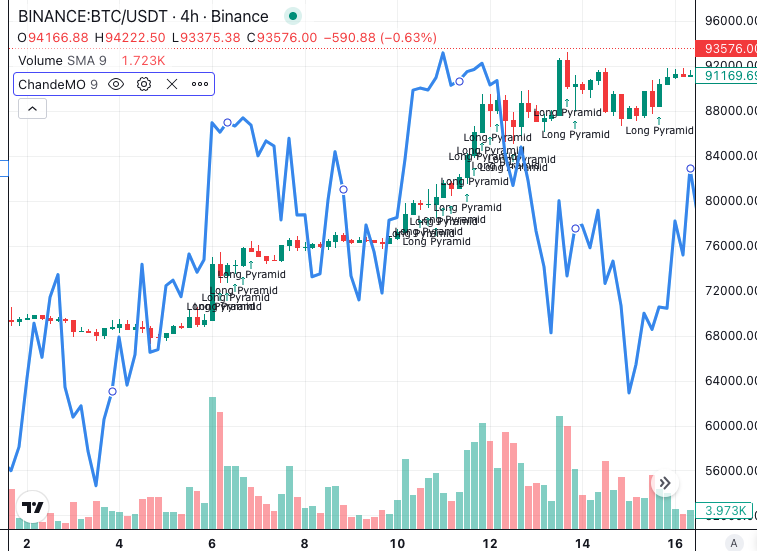
The Chande Momentum Oscillator measures momentum with both sides of the ledger in view. Where RSI tracks only the strength of up moves against a smoothed average, Tushar Chande’s oscillator weighs total gains against total losses directly — no smoothing, no damping. The result swings between +100 and -100, hits its extremes faster than RSI, and gives systematic traders one of the most responsive momentum readings available.
What Is the Chande Momentum Oscillator?
The CMO, introduced in Chande’s 1994 book alongside indicators like the VIDYA, compares the sum of gains to the sum of losses over a lookback window — typically 9 or 14 periods. The formula divides the difference by the total, per Investopedia, scaling everything to a fixed range. A reading of +60 means recent movement has been heavily one-sided to the upside. Zero means gains and losses have balanced. The conventional extreme thresholds are +50 and -50.
How Is It Different From RSI?
Three ways that matter for strategy building. First, no smoothing: the CMO uses raw sums, so it reacts immediately and reaches extremes often — like the Williams %R, speed is both the feature and the hazard. Second, symmetry: down moves appear in the numerator, not just the denominator, so bearish momentum registers as forcefully as bullish. Third, the zero centre line gives a natural trend-balance reading that RSI’s 50 line only approximates. In practice: CMO tells you sooner, and lies to you more often. The rules have to handle that trade-off.
Reading the Scale
- Above +50: overbought — recent movement is heavily one-sided upward.
- Below -50: oversold — selling has dominated the window.
- Crossing zero: the balance of momentum has flipped sides.
- Extreme + flattening: a CMO pinned at +70 that stops rising often precedes the pause, even before price shows it.
Two CMO Strategies to Build
The -50 Recovery
- Filter: price above its 200-period EMA — only fade sell-offs inside uptrends.
- Setup: CMO drops below -50.
- Entry: CMO crosses back above -50 — the one-sided selling has broken.
- Exit: CMO reaching zero or +50; stop below the setup low. The touch-versus-turn discipline from our RSI strategy applies doubly to an unsmoothed oscillator.
The Zero-Line Momentum Confirm
- Rule: take breakout or crossover entries only when CMO is above zero — momentum balance already favours the trade’s direction.
- Exit assist: CMO collapsing from above +50 back through zero flags momentum failure earlier than most price-based exits.
- Character: the CMO as a gate and early-warning system rather than a trigger — often its most profitable role.
Building It in Arrow Algo
- Add a CMO block and connect your candle feed — the period is an editable property.
- Use a crossover block on the CMO output against a -50 constant for the recovery entry.
- Add the EMA block (200) and a condition block as the trend gate.
- For the confirm variant, gate your existing entry logic with a condition checking CMO > 0.
- Backtest on Binance, Coinbase, or HyperLiquid data — then rerun with a smoothed CMO (a short moving average on the output) and compare. Taming the noise sometimes pays for the added lag.
Where Does the CMO Go Wrong?
- Extremes in trends. Strong trends hold the CMO beyond ±50 for long stretches. Unfiltered fading is the fastest way to give the responsiveness back.
- Raw noise. No smoothing means every candle counts fully. On low timeframes, consider averaging the output before building rules on it.
- Threshold tinkering. The ±50 convention is robust; a backtest-optimised ±43 is usually curve-fitting wearing a lab coat.
- Redundancy with RSI. They disagree mainly in speed. Run one as your oscillator, not both as fake confluence.
The Essentials
- The Chande Momentum Oscillator weighs gains against losses symmetrically, unsmoothed, from +100 to -100.
- ±50 marks the extremes; zero marks the momentum balance.
- Fade extremes only with the trend behind you, and always on the cross back, not the touch.
- Above zero as an entry gate — and collapsing extremes as an early exit flag — may beat using it as a trigger.
- Arrow Algo’s CMO block makes every variant drag-and-drop — the complete CMO guide has the full background.
Disclaimer: This content is for educational purposes only and does not constitute financial advice. Trading involves significant risk and you should only trade with capital you can afford to lose. Past performance is not indicative of future results. Always conduct your own research before making any trading decisions.
Ready to build your own automated trading strategies without writing a single line of code? Start for free at Arrow Algo and join thousands of traders who’ve made the switch to systematic trading.