
Stochastic Oscillator: Complete Guide for Algorithmic Trading
The Stochastic Oscillator: A Comprehensive Guide for Algorithmic Traders
Introduction
The Stochastic Oscillator is a powerful momentum indicator that has stood the test of time in technical analysis. Developed by George Lane in the 1950s, this versatile tool compares a security’s closing price to its price range over a specified period. The indicator’s name, “stochastic,” refers to the point of a current price in relation to its range over a period of time. Traders across various markets—including stocks, forex, and commodities—rely on the Stochastic Oscillator to identify potential trend reversals, overbought or oversold conditions, and hidden divergences. Its popularity stems from its ability to provide insights into price momentum before actual price movements occur. For algorithmic traders, the Stochastic Oscillator is particularly valuable due to its clear mathematical formula and ability to generate precise signals. These characteristics make it well-suited for integration into automated trading systems, allowing for consistent application of trading rules based on momentum shifts and potential reversal points.
How Does Stochastic Oscillator Work?
Mathematical Formula
The Stochastic Oscillator consists of two lines: %K (the fast stochastic) and %D (the slow stochastic). The formulas are: %K = (Current Close - Lowest Low) / (Highest High - Lowest Low) * 100 %D = 3-period simple moving average of %K Where: - Current Close is the most recent closing price - Lowest Low is the lowest price over the past n periods - Highest High is the highest price over the past n periods - n is the number of periods used (typically 14)
Calculation Process
- Determine the lookback period (n)
- Find the lowest low and highest high within this period
- Calculate where the current close falls within this range (as a percentage)
- Smooth the %K line by calculating a 3-period moving average to get %D
Visual Representation
On a chart, the Stochastic Oscillator appears as two lines oscillating between 0 and 100. The faster %K line is usually represented by a solid line, while the slower %D line is often dotted or dashed. These lines weave above and below each other, creating crossovers that traders use as potential signals.
Key Parameters
- Lookback Period: Typically 14 periods, but can be adjusted
- %K Slowing Period: Usually 3, smooths the raw %K values
- %D Period: Commonly 3, for the moving average of %K
What It Measures
The Stochastic Oscillator essentially measures the momentum of price. It’s based on the observation that prices tend to close near their recent highs in an uptrend and near their recent lows in a downtrend. By quantifying this tendency, the indicator helps traders identify potential reversals or continuations of trends.
How to Read Stochastic Oscillator Signals?
Reading the Indicator
- Values range from 0 to 100
- Readings above 80 are considered overbought
- Readings below 20 are considered oversold
- The relationship between %K and %D lines provides additional insights
Common Trading Signals
- Overbought/Oversold Reversals: When the oscillator moves above 80 or below 20, it suggests a potential reversal. However, assets can remain overbought or oversold for extended periods in strong trends.
- Crossovers: When the %K line crosses above the %D line, it’s considered a bullish signal. A bearish signal occurs when %K crosses below %D.
- Divergences: When the price makes a new high or low, but the Stochastic Oscillator fails to confirm this by making a corresponding new high or low, it suggests a potential reversal.
Signal Strength Indicators
- The speed and angle of crossovers can indicate signal strength
- Extreme readings (very close to 0 or 100) may suggest stronger reversal potential
- Multiple timeframe confirmation can increase signal reliability
What Are the Best Stochastic Oscillator Trading Strategies?
1. Overbought/Oversold Reversal Strategy
This strategy aims to capture reversals from extreme conditions. Entry Rules: - For long positions: Enter when the Stochastic Oscillator moves above 20 from below - For short positions: Enter when the Stochastic Oscillator moves below 80 from above Exit Rules: - Exit long positions when the oscillator moves above 80 - Exit short positions when the oscillator moves below 20 - Use a trailing stop or fixed stop-loss for risk management
2. Stochastic Crossover with Trend Strategy
This strategy combines the Stochastic Oscillator with trend analysis for potentially higher-probability trades. Entry Rules: - Identify the overall trend using a longer-term moving average - For long positions: Enter when %K crosses above %D in an uptrend - For short positions: Enter when %K crosses below %D in a downtrend Exit Rules: - Exit when %K crosses back in the opposite direction - Use a profit target based on recent price swings - Implement a time-based exit if the expected move doesn’t materialize within a specific timeframe
3. Stochastic Divergence Strategy
This advanced strategy looks for discrepancies between price action and the Stochastic Oscillator. Entry Rules: - Identify a divergence where price makes a new high/low, but the Stochastic doesn’t confirm - For bullish divergence: Enter long when the Stochastic makes a higher low while price makes a lower low - For bearish divergence: Enter short when the Stochastic makes a lower high while price makes a higher high Exit Rules: - Set a profit target at the next significant support/resistance level - Use a stop-loss below the recent swing low for long positions or above the recent swing high for short positions
Optimal Timeframes and Market Conditions
The Stochastic Oscillator can be applied to various timeframes, from intraday charts to weekly or monthly views. However, it tends to be most effective in ranging markets or during periods of consolidation. In strongly trending markets, the indicator may give premature reversal signals. For algorithmic trading, consider using multiple timeframes to confirm signals. For example, use a longer timeframe to identify the overall trend and a shorter timeframe for precise entry and exit points.
When Not to Use
Exercise caution when using the Stochastic Oscillator in the following situations: - During strong, persistent trends where overbought/oversold conditions can last for extended periods - In markets with very low volatility, where the indicator may not provide meaningful signals - Immediately before major news events or economic releases that can cause unpredictable price movements
Implementation in Algo Trading
Integrating the Stochastic Oscillator into algorithmic trading strategies requires careful consideration of several factors:
- Signal Generation: Create clear rules for generating buy and sell signals based on Stochastic readings, crossovers, or divergences.
- Confirmation: Consider using additional indicators or price action confirmation to reduce false signals. For example, you might require a price close above a moving average in addition to a bullish Stochastic crossover.
- Risk Management: Implement proper position sizing and stop-loss orders. The Stochastic Oscillator doesn’t inherently provide stop levels, so combine it with other techniques like support/resistance levels or volatility-based stops.
- Backtesting Considerations:
- Test over various market conditions and timeframes
- Be aware of look-ahead bias when calculating the indicator
- Consider transaction costs and slippage in your backtests
- Optimization Tips:
- Experiment with different lookback periods to find the optimal setting for your traded instruments
- Adjust overbought/oversold levels based on the volatility of the asset
- Combine the Stochastic Oscillator with trend-following indicators for potentially better results
- Common Pitfalls:
- Over-reliance on a single indicator
- Ignoring the broader market context
- Failing to account for fundamental factors that may override technical signals
Building with Arrow Algo’s Block Builder
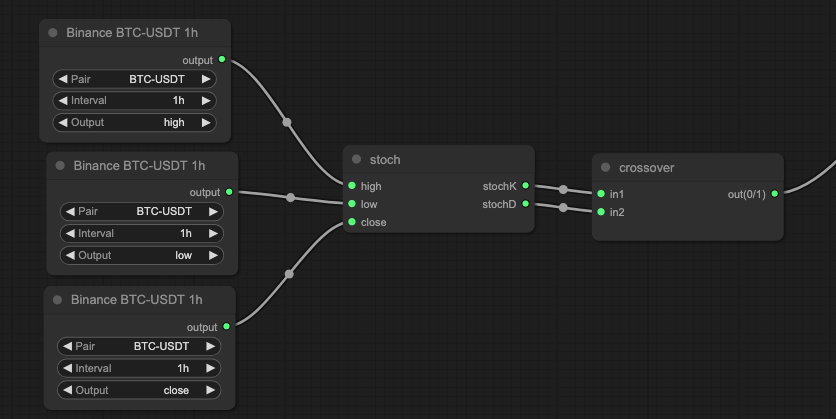
Implementing the Stochastic Oscillator in your trading strategy is straightforward with Arrow Algo’s NO-CODE block builder. Here’s how you can create a strategy using this indicator:
- Adding the Indicator: Drag and drop the Stochastic Oscillator block from the indicator library into your strategy workspace.
- Configuring Parameters: Double-click the Stochastic block to open its settings. Here, you can visually adjust parameters like the lookback period, %K slowing period, and %D period without writing any code.
- Creating Trading Logic: Use condition blocks to set up your entry and exit rules. For example, drag a “Crossover” block and connect the %K and %D outputs from the Stochastic block to create a signal when they cross.
- Combining with Other Indicators: Easily add other indicator blocks, such as moving averages or RSI, to create more complex strategies. Connect their outputs to additional condition blocks for confirmation signals.
- Setting Up Orders: Use order blocks to define your entry, exit, and risk management rules. Connect these to your condition blocks so your Stochastic signals send the orders automatically.
- Backtesting and Optimization: Utilize Arrow Algo’s built-in backtesting tools to evaluate your strategy’s performance. Adjust parameters visually and re-run tests to optimize your strategy without any coding required.
- Live Trading: Once satisfied with your backtest results, deploy your strategy to live trading with just a few clicks, all while maintaining full control over your algorithm’s logic.
Conclusion
The Stochastic Oscillator is a versatile momentum indicator that can significantly enhance algorithmic trading strategies. Its ability to identify potential reversals, overbought/oversold conditions, and divergences makes it a valuable tool for traders across various markets and timeframes. Key takeaways for successful implementation include: - Combine the Stochastic Oscillator with other indicators or analysis techniques for confirmation - Be aware of its limitations in strongly trending markets - Regularly optimize parameters based on the specific assets and market conditions you’re trading - Implement robust risk management alongside your Stochastic-based signals By thoughtfully incorporating the Stochastic Oscillator into your algorithmic trading strategies, you can potentially improve your ability to identify high-probability trading opportunities and manage risk effectively. Ready to build your own strategies using Stochastic Oscillator? Visit https://www.arrowalgo.com to start creating custom indicator-based strategies with Arrow Algo’s NO-CODE block builder platform.
Disclaimer: Algorithmic trading involves substantial risk. Past performance is not indicative of future results. This content is for educational purposes only and should not be considered financial advice. Always do your own research and consider consulting with a financial advisor before making trading decisions.
Educational disclaimer: This content is for educational purposes only and does not constitute financial advice. Trading involves significant risk and you should only trade with capital you can afford to lose. Past performance is not indicative of future results.