
TRIX Momentum Strategy: How to Build It in Arrow Algo
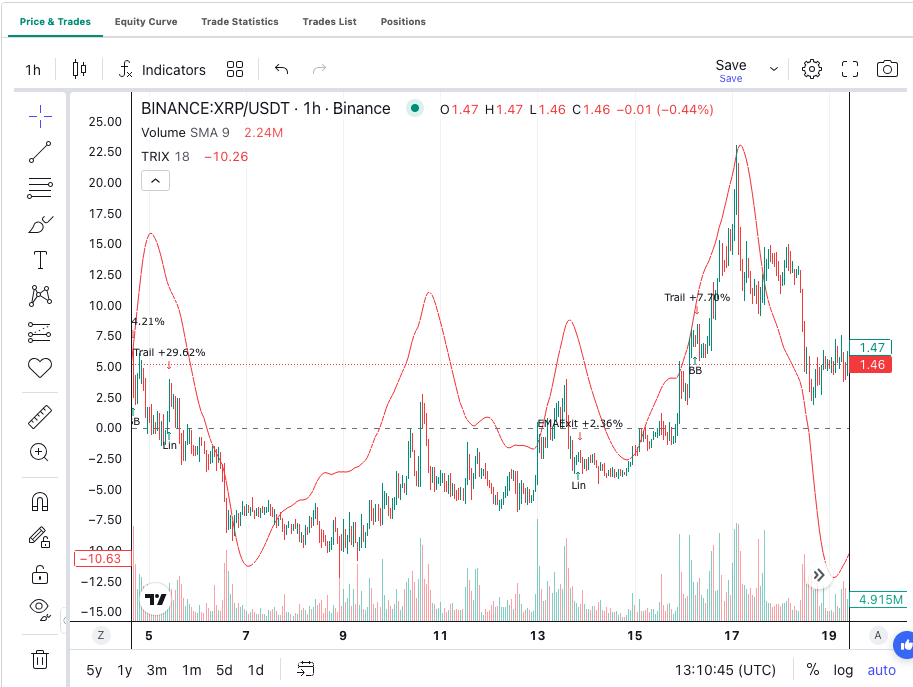
A TRIX strategy trades momentum with an unusual promise: most market noise never reaches the signal at all. The TRIX indicator runs price through three rounds of exponential smoothing, then measures the rate of change of the result. Movements shorter than the indicator’s period get filtered out by construction. What survives is the underlying momentum — late, but clean.
What Is a TRIX Strategy?
TRIX — short for triple exponential — was popularised by Jack Hutson in the 1980s. It plots as an oscillator around a zero line. Positive and rising, momentum is up and building; negative and falling, the opposite. A TRIX strategy trades two transitions: the zero-line cross, which marks a full momentum regime change, and the signal-line cross, where TRIX crosses its own moving average for an earlier, more frequent trigger. The design goal is stated plainly by Investopedia: filter insignificant price cycles so only trends longer than the chosen period generate signals.
How Does the Triple Smoothing Work?
Take an EMA of price — typically 15 periods. Then take an EMA of that EMA. Then a third. Each pass strips out faster wiggles the previous pass let through. Finally, TRIX measures the one-period percentage change of that triple-smoothed line. In plain English: TRIX asks “is the deeply smoothed trend rising or falling right now, and how fast?” A single wild candle that would spike a raw momentum reading barely dents a line that has been averaged three times.
Reading the Signals
- Zero-line cross up: the smoothed trend has turned positive — a genuine regime shift, not a blip.
- Zero-line cross down: the uptrend’s momentum has fully rolled over.
- Signal-line cross: TRIX crossing its 9-period EMA — momentum turning within a regime, earlier but noisier.
- Divergence: price making highs while TRIX fades — the smoothed engine is losing power beneath the surface.
Two TRIX Strategies to Build
The Zero-Line Regime Trade
- Entry: TRIX crosses above zero while price is above its 200-period EMA.
- Exit: TRIX crossing back below zero, or a trailing stop.
- Character: few signals, long holds. The triple smoothing means entries come late — the trade-off for skipping most false starts. Similar territory to a MACD crossover system, but calmer.
The Signal-Line Timing Trade
- Filter: TRIX above zero — the momentum regime is already bullish.
- Entry: TRIX crosses above its signal line — a dip within the regime resolving upward.
- Exit: TRIX crossing back below the signal line, or a fixed target.
- Character: more trades, earlier entries, still protected by the regime filter. The same pause-and-resume logic as Friday’s Awesome Oscillator saucer, on a smoother engine.
Building It in Arrow Algo
- Add a TRIX block and connect your candle feed — the period is an editable property.
- Use a crossover block on the TRIX output and a zero constant for the regime trade.
- For the timing trade, add an EMA block on the TRIX output (9 periods) and a second crossover between them.
- Add the 200 EMA price filter with a condition block, gating entries in both variants.
- Backtest on Binance, Coinbase, or HyperLiquid data across trending and ranging stretches — the zero-line version should shine in trends and go quiet in chop. If it doesn’t go quiet, lengthen the period.
Where Does TRIX Fall Short?
- Lag is the price of smoothness. Three smoothing passes mean TRIX confirms trends after they’ve started and ends them after they’ve ended. Fast reversals will outrun it — position sizing, not the indicator, handles those.
- Chop still crosses zero. Extended ranges produce slow oscillations around zero that trigger both directions. The price-side trend filter is what keeps those trades ungated.
- Period tuning temptation. Shortening the period to reduce lag surrenders the noise filtering that justifies TRIX in the first place. If you want fast, use a fast indicator.
- Redundant confluence. TRIX agrees with MACD most of the time — stacking both adds correlation, not confirmation.
The Essentials
- A TRIX strategy trades triple-smoothed momentum: zero crosses for regime changes, signal-line crosses for timing.
- Noise shorter than the period is filtered out by construction — the cleanest momentum line in the standard toolkit.
- The cost is lag: TRIX is deliberately late everywhere, and worst in fast reversals.
- Keep the standard 15/9 settings; shortening them defeats the design.
- Arrow Algo’s TRIX block makes both builds drag-and-drop — the complete TRIX guide covers the full background.
Disclaimer: This content is for educational purposes only and does not constitute financial advice. Trading involves significant risk and you should only trade with capital you can afford to lose. Past performance is not indicative of future results. Always conduct your own research before making any trading decisions.
Ready to build your own automated trading strategies without writing a single line of code? Start for free at Arrow Algo and join thousands of traders who’ve made the switch to systematic trading.