
Exponential Moving Average (EMA): A Guide for Traders
Exponential Moving Average (EMA): A Guide for Traders
The Exponential Moving Average (EMA) is a powerful and widely-used technical indicator that helps traders identify trends and potential reversal points in financial markets. Developed as an improvement over the Simple Moving Average (SMA), the EMA gives more weight to recent price data, making it more responsive to current market conditions.
First introduced in the 1950s, the EMA quickly gained popularity among technical analysts and traders. Today, it’s a staple tool for both discretionary and algorithmic traders across various financial instruments, including stocks, forex, and cryptocurrencies.
The EMA’s value in algorithmic trading lies in its ability to smooth out price fluctuations while remaining sensitive to recent price changes. This dual nature allows trading algorithms to detect trends earlier and react more quickly to potential reversals, making it an essential component in many automated trading strategies.
How It Works
Mathematical Formula
The EMA is calculated using the following formula:
EMA = (Close - Previous EMA) * Multiplier + Previous EMA
Where:
- Close is the current closing price
- Previous EMA is the EMA value from the previous period
- Multiplier = (2 / (Number of periods + 1))
Calculation Process
- Calculate the Simple Moving Average (SMA) for the initial EMA value
- Calculate the multiplier for smoothing (the weighting)
- Calculate the EMA for each subsequent period using the formula above
Visual Representation
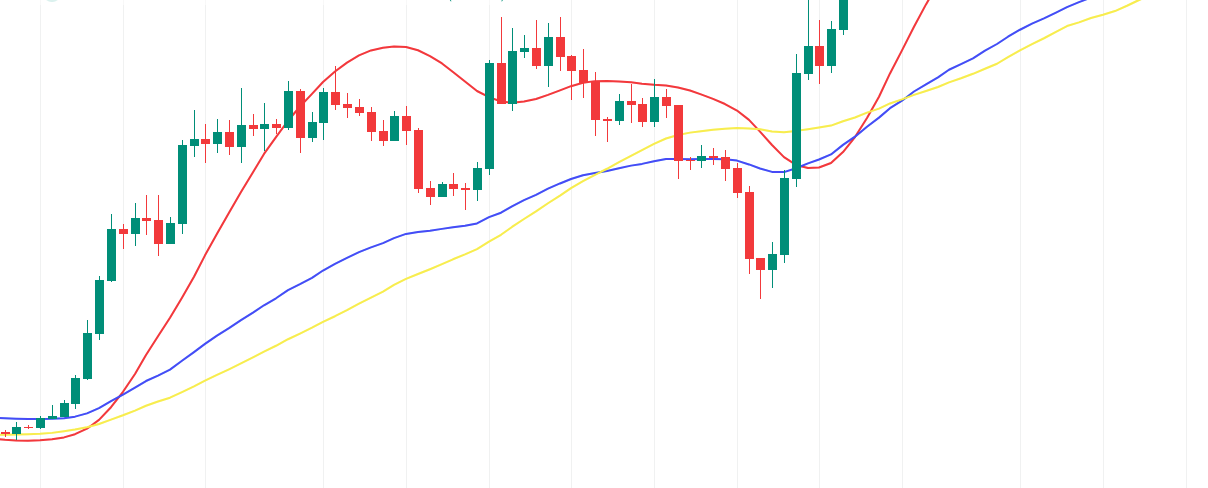
On a price chart, the EMA appears as a smooth line that follows the price action. It tends to be closer to the current price than an SMA of the same period, due to its greater weighting of recent data.
Key Parameters
The primary parameter for an EMA is the number of periods used in the calculation. Common settings include:
- Short-term: 12 or 26 periods
- Medium-term: 50 or 100 periods
- Long-term: 200 periods
What EMA Measures
The EMA measures the average price over a specified number of periods, with more emphasis on recent prices. This weighting allows the EMA to react more quickly to price changes compared to an SMA, potentially identifying trend changes earlier.
Interpretation & Signals
Reading the Indicator
- When price is above the EMA, it generally indicates an uptrend
- When price is below the EMA, it generally indicates a downtrend
- The slope of the EMA line indicates the strength of the trend
Common Trading Signals
Crossovers:
- Bullish signal: Price crosses above the EMA
- Bearish signal: Price crosses below the EMA
Multiple EMA Crossovers:
- Bullish signal: Shorter-term EMA crosses above longer-term EMA
- Bearish signal: Shorter-term EMA crosses below longer-term EMA
Support/Resistance:
- EMA can act as dynamic support in uptrends
- EMA can act as dynamic resistance in downtrends
Divergences and Confirmations
- Trend Confirmation: Price consistently staying above or below the EMA confirms the trend direction
- Divergence: When price makes new highs/lows, but the EMA doesn’t, it may indicate a potential trend reversal
Signal Strength Indicators
- The distance between price and the EMA can indicate trend strength
- Rapid EMA slope changes may signal increased momentum or potential reversals
Trading Strategies
1. EMA Crossover Strategy
This strategy uses two EMAs of different periods to generate buy and sell signals.
Setup:
- Fast EMA: 12 periods
- Slow EMA: 26 periods
Entry Rules:
- Buy when the fast EMA crosses above the slow EMA
- Sell when the fast EMA crosses below the slow EMA
Exit Rules:
- Long positions - exit when the fast EMA crosses below the slow EMA
- Short positions - exit when the fast EMA crosses above the slow EMA
Best Used:
- In trending markets
- On daily or 4-hour timeframes for stocks and forex
2. EMA Pullback Strategy
This strategy aims to enter trades in the direction of the overall trend during temporary pullbacks.
Setup:
- Primary Trend EMA: 200 periods
- Entry EMA: 20 periods
Entry Rules:
- For long trades:
1. Confirm uptrend: Price and 20 EMA above 200 EMA
2. Wait for pullback: Price touches or crosses below 20 EMA
3. Enter long when price crosses back above 20 EMA
- For short trades:
1. Confirm downtrend: Price and 20 EMA below 200 EMA
2. Wait for pullback: Price touches or crosses above 20 EMA
3. Enter short when price crosses back below 20 EMA
Exit Rules:
- Use a trailing stop based on the 20 EMA
- Exit when price crosses the 200 EMA in the opposite direction
Best Used:
- In strong trending markets
- On daily timeframes for stocks, weekly for long-term forex trades
3. EMA Ribbon Strategy
This strategy uses multiple EMAs to create a “ribbon” effect, providing more nuanced trend information.
Setup:
- EMAs: 10, 20, 30, 40, 50, 60
Entry Rules:
- For long trades:
1. All EMAs are aligned in ascending order (10 EMA on top, 60 EMA on bottom)
2. Enter when price crosses above the highest EMA (10)
- For short trades:
1. All EMAs are aligned in descending order (60 EMA on top, 10 EMA on bottom)
2. Enter when price crosses below the lowest EMA (10)
Exit Rules:
- (Long trades when price crosses below the 30 EMA
- Exit short trades when price crosses above the 30 EMA
Best Used:
- In trending markets with clear directional movement
- On 1-hour or 4-hour timeframes for intraday trading
When Not to Use EMA Strategies
- During highly volatile, choppy markets
- In ranging markets with no clear trend
- During major news events or economic releases
- When other indicators or analysis contradict EMA signals
Implementation in Algo Trading
Integration into Algorithmic Strategies
- Trend Identification: Use EMA slope and position relative to price to determine overall trend direction
- Signal Generation: Implement EMA crossovers or price-EMA crossovers as entry/exit triggers
- Dynamic Support/Resistance: Use EMAs as adaptive support/resistance levels for stop-loss placement
- Filter: Apply EMA-based filters to other strategy components to avoid trading against the trend
Automated Decision-Making
- Create boolean conditions based on EMA relationships (e.g., “Fast EMA > Slow EMA”)
- Use EMA values in position sizing calculations (e.g., larger positions when trend is strong)
- Incorporate EMA-derived signals into a larger decision tree or scoring system
Backtesting Considerations
- Test EMA strategies across different market conditions and timeframes
- Be aware of look-ahead bias when calculating EMAs (ensure you’re using only past data)
- Compare EMA performance to SMA and other trend indicators
- Analyze the impact of different EMA periods on strategy performance
Common Pitfalls and Solutions
Whipsaws in choppy markets
-
- Solution: Add additional filters or confirm signals with other indicators
Late entries in strong trends
-
- Solution: Use shorter-period EMAs or implement breakout confirmation rules
False signals during range-bound periods
-
- Solution: Incorporate range-detection algorithms to disable EMA signals when appropriate
Over-optimization of EMA periods
-
- Solution: Use round numbers and standard periods, test robustness across multiple assets
Optimization Tips
- Experiment with non-standard EMA periods to find less crowded signals
- Combine EMAs with momentum indicators for confirmation
- Adjust EMA periods based on the volatility of the instrument being traded
- Consider using adaptive EMAs that adjust based on market conditions
Building with Arrow Algo’s Block Builder
Arrow Algo’s NO-CODE block builder makes it easy to implement EMA-based strategies without writing a single line of code. Here’s how you can use the platform to create your own EMA strategies:
Adding EMA Indicators:
- Drag and drop the EMA indicator block onto your strategy canvas
- Connect the EMA block to your price data source
Configuring Parameters:
- Double-click the EMA block to open its settings
- Use the visual interface to set the EMA period and apply it to your desired price (e.g., close, high, low)
Creating Multiple EMAs:
- Add additional EMA blocks for strategies requiring multiple EMAs
- Use different colors to distinguish between fast and slow EMAs
Building Trading Logic:
- Drag condition blocks onto the canvas to create entry and exit rules
- Use comparison blocks to check EMA crossovers or price-EMA relationships
Connecting to Order Blocks:
- Link your EMA conditions to buy and sell order blocks
- Set position sizing and risk management parameters visually
Testing and Optimization:
- Use Arrow Algo’s built-in backtesting tools to evaluate your strategy
- Easily adjust EMA periods and other parameters to optimize performance
Combining with Other Indicators:
- Drag additional indicator blocks (e.g., RSI, MACD) onto the canvas
- Create complex strategies by combining EMA signals with other indicators
By using Arrow Algo’s visual block builder, you can quickly prototype, test, and refine EMA-based strategies without any coding knowledge. This allows you to focus on strategy development rather than technical implementation.
Conclusion
The Exponential Moving Average (EMA) is a versatile and powerful tool for algorithmic traders. Its ability to adapt quickly to price changes while smoothing out market noise makes it ideal for trend identification and trade signal generation.
Key takeaways for using EMAs in algorithmic trading:
- Use multiple EMAs for more robust trend identification
- Combine EMAs with other indicators for signal confirmation
- Be aware of market conditions and adjust strategies accordingly
- Regularly review and optimize EMA parameters
Best practices include thorough backtesting, avoiding over-optimization, and using EMAs as part of a comprehensive trading system rather than in isolation.
EMAs are particularly effective in trending markets and can be applied across various timeframes and asset classes. However, always remember to validate EMA signals with other forms of analysis and be cautious in choppy or ranging markets.
Ready to build your own strategies using Exponential Moving Average (EMA)? Visit https://www.arrowalgo.com to start creating custom indicator-based strategies with Arrow Algo’s NO-CODE block builder platform.
Disclaimer: Algorithmic trading involves substantial risk. Past performance is not indicative of future results.
This content is for educational purposes only and should not be considered financial advice.
Always do your own research and consider consulting with a financial advisor before making trading decisions.
Educational disclaimer: This content is for educational purposes only and does not constitute financial advice. Trading involves significant risk and you should only trade with capital you can afford to lose. Past performance is not indicative of future results.