
Volume Weighted Average Price (VWAP): Complete Guide for Algorithmic Trading
Introduction to Volume Weighted Average Price (VWAP)
The Volume Weighted Average Price (VWAP) is a powerful and widely-used technical indicator that provides traders with a unique perspective on price action by incorporating volume data. Developed in the 1980s, VWAP has become an essential tool for institutional traders and is increasingly popular among retail algorithmic traders. VWAP calculates the average price a security has traded at throughout the day, weighted by volume. This weighting gives more importance to price levels where higher volume occurred, offering a more accurate representation of the security’s “true” price. Institutional traders often use VWAP as a benchmark for execution quality, aiming to buy below VWAP and sell above it to minimize market impact. For algorithmic traders, VWAP serves as a dynamic support/resistance level and can be used to identify trends, generate trading signals, and optimize entry and exit points. The indicator’s value in algo trading stems from its ability to provide a volume-adjusted view of price, helping strategies account for both price movements and trading activity. This makes VWAP particularly useful for liquidity-sensitive algorithms and those seeking to identify value areas in the market.
How VWAP Works
Mathematical Formula and Calculation
The VWAP is calculated using the following formula: VWAP = Σ(Price * Volume) / Σ(Volume) Where: - Σ represents the sum - Price is typically the average of high, low, and close prices for each period - Volume is the trading volume for each period To calculate VWAP:
- For each period (e.g., 1-minute candle):
- Calculate the typical price: (High + Low + Close) / 3
- Multiply the typical price by the volume for that period
- Sum these values for all periods since the start of the session
- Divide the sum by the cumulative volume traded
Visual Representation
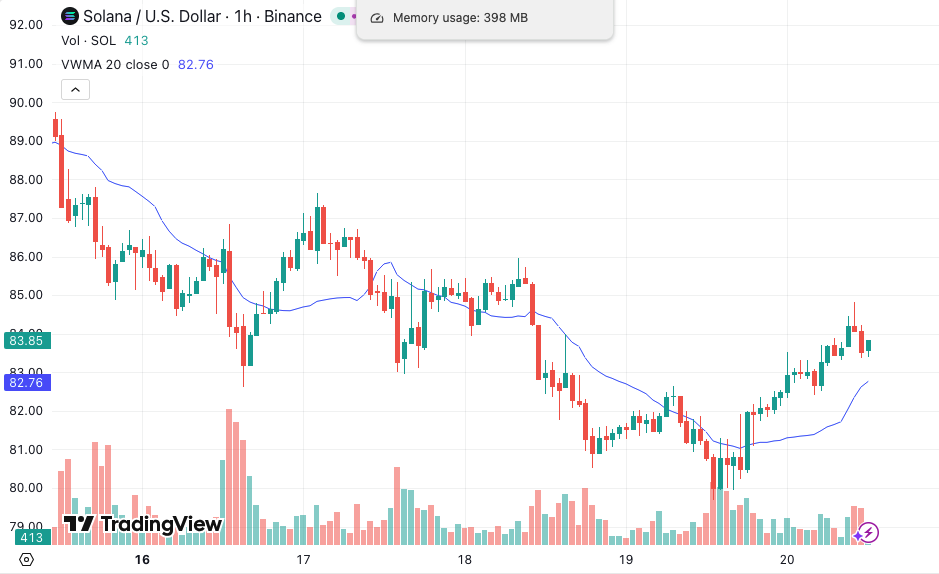
On a chart, VWAP appears as a single line that updates with each new period. Unlike a simple moving average, VWAP doesn’t maintain a fixed lookback period but considers all data since the start of the session.
Key Parameters
- Time Frame: VWAP is typically calculated on an intraday basis, resetting at the start of each trading day. However, some traders use multi-day VWAP for longer-term analysis.
- Session Definition: The start and end times of the trading session must be defined, especially for assets traded in multiple sessions or 24-hour markets.
- Price Input: While typical price (H+L+C)/3 is common, some implementations use different price inputs like closing price only.
What VWAP Measures
VWAP essentially measures the average price at which a security has traded, accounting for volume. It represents a “fair” price based on both price levels and the volume of trading at those levels. This makes it an excellent tool for assessing whether current prices are relatively high or low compared to the day’s activity.
How to Read Volume Weighted Average Price (VWAP) Signals?
Reading the VWAP Indicator
- Price above VWAP: Indicates bullish sentiment; the current price is trading above the average
- Price below VWAP: Suggests bearish sentiment; the current price is trading below the average
- Price crossing VWAP: Can signal potential trend changes or short-term reversals
Common Trading Signals
- Bullish Signal: Price moves from below to above VWAP with increasing volume
- Bearish Signal: Price drops from above to below VWAP with increasing volume
- Trend Confirmation: Price consistently trading above or below VWAP confirms the trend direction
Overbought/Oversold Levels
While VWAP itself doesn’t have specific overbought/oversold levels, traders often use standard deviation bands around VWAP to identify potential reversal zones:
- Price near upper band: Potentially overbought
- Price near lower band: Potentially oversold
Divergences and Confirmations
- VWAP Divergence: Occurs when price makes a new high/low, but VWAP doesn’t confirm. This can signal potential reversals.
- Volume Confirmation: Strong moves away from VWAP accompanied by high volume are considered more significant.
Signal Strength Indicators
- Distance from VWAP: Larger deviations from VWAP may indicate stronger trends or potential for mean reversion.
- Slope of VWAP: A steeper slope indicates a stronger trend in that direction.
- Volume at Price Levels: High volume at levels far from VWAP can create strong support/resistance.
What Are the Best Volume Weighted Average Price (VWAP) Trading Strategies?
1. VWAP Mean Reversion Strategy
This strategy assumes that price will tend to return to the VWAP over time. Entry Rules: - Long: Enter when price falls below VWAP by a predefined percentage (e.g., 0.5%) and shows signs of reversal (e.g., bullish candlestick pattern) - Short: Enter when price rises above VWAP by a predefined percentage and shows signs of reversal Exit Rules: - Take Profit: Exit when price returns to VWAP - Stop Loss: Set at a fixed percentage beyond the entry point (e.g., 1% for stocks) Best Used: - In ranging markets or during periods of low volatility - On shorter timeframes (5-15 minute charts) for intraday trading
2. VWAP Trend Following Strategy
This strategy aims to capture larger moves by trading in the direction of the established trend. Entry Rules: - Long: Enter when price crosses above VWAP with above-average volume - Short: Enter when price crosses below VWAP with above-average volume Exit Rules: - Take Profit: Use a trailing stop based on ATR or a fixed multiple of the initial risk - Stop Loss: Place stop on the opposite side of VWAP Best Used: - In trending markets - On longer timeframes (hourly or daily charts) for swing trading
3. VWAP with Standard Deviation Bands Strategy
This strategy combines VWAP with standard deviation bands to identify potential reversal points. Entry Rules: - Long: Enter when price touches the lower standard deviation band and starts moving back towards VWAP - Short: Enter when price touches the upper standard deviation band and starts moving back towards VWAP Exit Rules: - Take Profit: Exit when price reaches VWAP or the opposite standard deviation band - Stop Loss: Set just beyond the standard deviation band that triggered entry Best Used: - In volatile markets with clear trading ranges - On intraday charts (15-minute to 1-hour) for day trading
Combining with Other Indicators
- Use RSI or Stochastic to confirm overbought/oversold conditions at VWAP levels
- Combine with moving averages (e.g., 20 EMA) for additional trend confirmation
- Use volume indicators like On-Balance Volume (OBV) to validate VWAP movements
When Not to Use VWAP
- During major news events or earnings releases when normal price-volume relationships may break down
- In very illiquid markets where sporadic volume can skew VWAP calculations
- For long-term trading strategies, as VWAP is primarily an intraday tool
Implementation in Algo Trading
Integrating VWAP into algorithmic strategies requires careful consideration of its characteristics:
- Dynamic Calculation: Ensure your algorithm recalculates VWAP with each new data point, accounting for cumulative volume since session start.
- Session Handling: Implement logic to reset VWAP calculations at the beginning of each trading session, considering market hours and potential pre/post-market data.
- Data Requirements: VWAP needs price and volume data. Ensure your data feed provides accurate volume information, especially for less liquid assets.
- Timeframe Consistency: When using VWAP for signal generation, ensure all other indicators and logic in your algorithm operate on the same timeframe for consistency.
- Volume Outlier Handling: Implement methods to handle or filter out extreme volume spikes that could distort VWAP calculations.
Backtesting Considerations
- Look-Ahead Bias: Ensure your backtest calculates VWAP using only data available up to that point in time, not future data.
- Volume Data Quality: Verify the accuracy and consistency of historical volume data used in backtests.
- Slippage Modeling: Account for potential slippage when trading large volumes, as VWAP strategies often involve significant trade sizes.
Common Pitfalls and Optimization Tips
- Over-optimization: Avoid curve-fitting by testing VWAP strategies across various market conditions and timeframes.
- Late Signals: VWAP can lag in fast-moving markets. Consider using shorter timeframes or combining with leading indicators for more responsive signals.
- False Breakouts: Implement filters or confirmation mechanisms to reduce false signals when price briefly crosses VWAP.
- Volume Profile: Analyze the typical volume profile of your traded assets to optimize VWAP-based entry and exit timing.
Building with Arrow Algo’s Block Builder
Implementing VWAP-based strategies using Arrow Algo’s NO-CODE block builder is straightforward and intuitive. Here’s how you can create and test VWAP strategies without writing a single line of code: Adding VWAP to Your Strategy:
- Drag the VWAP indicator block from the indicator library into your strategy workspace.
- Connect the VWAP block to your data source block to feed it price and volume data.
Configuring VWAP Parameters:
- Click on the VWAP block to open its settings panel.
- Adjust parameters like session start/end times or standard deviation bands visually.
Creating Trading Logic:
- Drag condition blocks (e.g., “Price Crosses Above”) and connect them to your VWAP block.
- Use logic blocks to combine multiple conditions (e.g., VWAP cross AND volume increase).
Setting Entry and Exit Rules:
- Connect your condition blocks to action blocks.
- Configure position sizing, take profit, and stop loss levels using visual input fields.
Backtesting and Optimization:
- Use Arrow Algo’s built-in backtesting tool to evaluate your strategy’s performance.
- Easily adjust parameters and rerun tests to optimize your strategy.
Combining with Other Indicators:
- Drag additional indicator blocks (e.g., RSI, Moving Averages) into your workspace.
- Visually connect these to your VWAP conditions to create more complex strategies.
By leveraging Arrow Algo’s visual block builder, you can experiment with various VWAP strategies, from simple crossovers to complex multi-indicator systems, all without writing code. This allows you to focus on strategy development and testing rather than programming details.
Conclusion
Volume Weighted Average Price (VWAP) is a versatile and powerful indicator that offers traders a unique perspective on price action by incorporating volume data. Its ability to identify “fair” price levels and serve as a dynamic support/resistance makes it invaluable for both institutional and retail algorithmic traders. Key takeaways for implementing VWAP in your trading strategies:
- Use VWAP as a benchmark for entry and exit decisions
- Combine VWAP with volume analysis for stronger signals
- Consider market conditions and asset characteristics when applying VWAP strategies
- Be mindful of VWAP’s limitations, particularly for longer-term trading or during abnormal market conditions
By understanding how to interpret VWAP and implement it effectively in algorithmic strategies, traders can gain a significant edge in their decision-making process. Whether you’re developing mean reversion, trend-following, or volatility-based strategies, VWAP can provide valuable insights to enhance your trading approach. Ready to build your own strategies using Volume Weighted Average Price (VWAP)? Visit https://www.arrowalgo.com to start creating custom indicator-based strategies with Arrow Algo’s NO-CODE block builder platform.
Disclaimer: Algorithmic trading involves substantial risk. Past performance is not indicative of future results. This content is for educational purposes only and should not be considered financial advice. Always do your own research and consider consulting with a financial advisor before making trading decisions.
Educational disclaimer: This content is for educational purposes only and does not constitute financial advice. Trading involves significant risk and you should only trade with capital you can afford to lose. Past performance is not indicative of future results.